In the canonical ensemble, normalizes the probabilities . For temperature-independent levels,The derivative holds external parameters, including magnetic field, fixed.
For one independent symmetric three-level system put and . Then andAt nonzero fixed field, the ground state dominates as , so . At high temperature all three levels become nearly equally populated and their mean tends to zero from below. At fixed positive temperature the energy is even in , is quadratic near zero field, and approaches at large as the lowest level becomes occupied. The heat capacity vanishes both when excitations are frozen out and when populations are almost equal, with a positive Schottky anomaly between those limits.
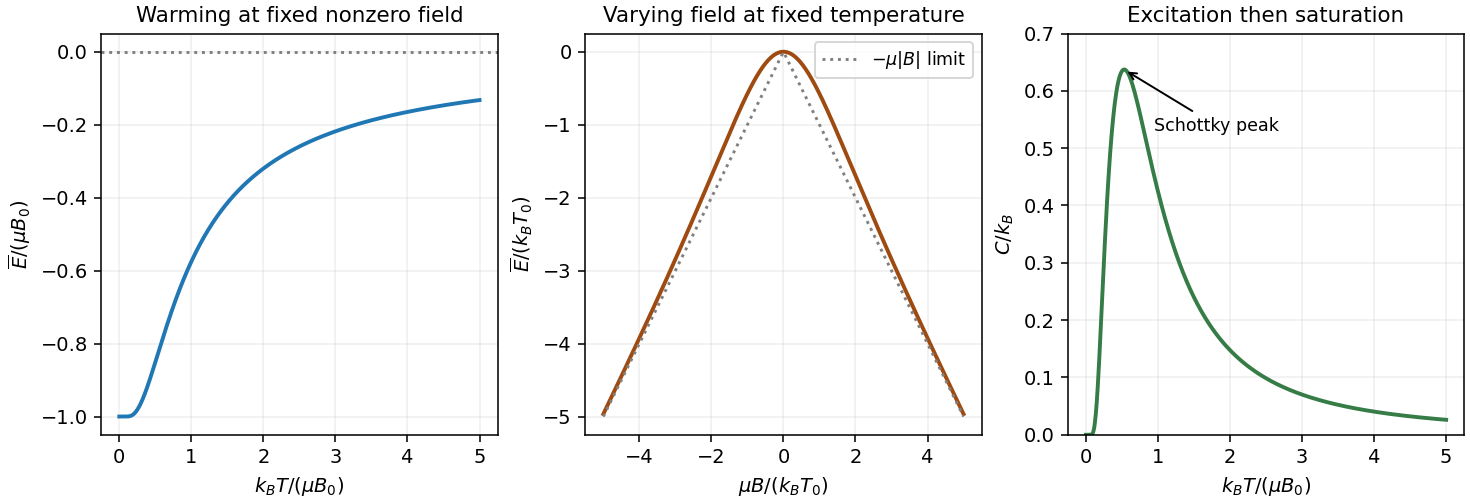

At , expanding the hyperbolic functions givesInterpreting the stated heat capacity on the same one-atom basis as the preceding calculation, its tail coefficient givesHere is used consistently with in electronvolt kelvin. For a sample of independent atoms, the total coefficient would be times the one-atom coefficient; it must first be divided by .
Finally, two derivatives of supply the second energy moment:Combining this with the heat-capacity derivative yields the canonical energy fluctuation relationIt also explains why this canonical heat capacity is nonnegative.[ref]
Articles by others on the same topic
There are currently no matching articles.