A heat engine operates cyclically, absorbing heat from a hotter source, rejecting heat to a colder sink and delivering net work . Its efficiency is . The working substance returns to its original state; the reservoirs and surroundings need not.
Suppose an engine were more efficient than a reversible Carnot engine between the same reservoirs. Couple it to a reversed Carnot engine, scaling the cycles to have equal work. With no net external work, their combined effect would be to transfer heat from the colder reservoir to the hotter one, contradicting the Second law of thermodynamics. No such engine can exceed . Equivalently, the cyclic entropy inequality gives , hence the same bound.
The reversible working substance changes entropy by on its hot isotherm and on its cold isotherm, with zero change on the two reversible adiabats. Closure requires . The substance has zero entropy change over a cycle, while the reservoirs have changes and . Thus for the complete Carnot cycle.
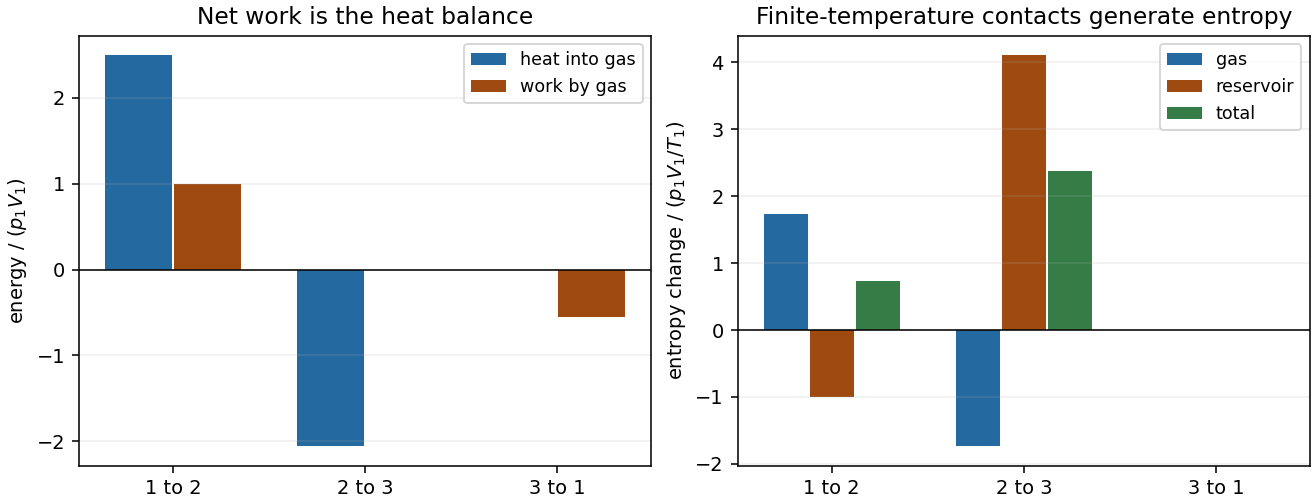
Put . For the specified ideal gas, , and . Isobaric expansion doubles temperature, so . Reversible adiabatic closure gives , henceThere is no heat input on that compression. The other stages giveTherefore andThe hot reservoir changes entropy by . The cold reservoir changes by . Since the gas completes a cycle,Although the mechanical paths can be quasistatic, heat flows across finite temperature differences in both contacts. This entropy generation explains why the efficiency is well below the Carnot value between these reservoirs.
For an isothermal final compression at , the preceding constant-volume cooling must instead end at ; keeping the old state 3 would not close the cycle. Compression then requires work , while the heat input remains . Thuswhich is lower: this isothermal compression occurs at a higher temperature throughout than the original adiabat and consumes more work. It also rejects heat during compression.
With , the thermodynamics of a liquid film givesEquality of mixed derivatives of gives the Maxwell relationUse the area convention already specified by ; do not insert an additional factor for two film faces.
At fixed area, . ThereforeFor reversible adiabatic stretching, andThe film cools, assuming positive heat capacity. Adiabaticity alone would not ensure constant entropy if the deformation were irreversible.
Reading the approximately straight trend in the supplied graph gives and . These are graph-read estimates, not more precise material constants. For , reversible isothermal stretching givesBoth are positive: stretching does mechanical work on the film and requires heat input to prevent cooling. Its internal energy increases by about .
Write , with . Constant then makes the reversible adiabatic conditionwhere is an arbitrary fixed reference temperature; absorbing it into the constant gives the requested logarithm convention. HenceHere . Since , integration gives . To first order this isThere is no heat exchange on this reversible adiabat. Cooling and increasing internal energy are compatible: positive area work more than offsets the decrease of the temperature-dependent energy term.
In the canonical ensemble, normalizes the probabilities . For temperature-independent levels,The derivative holds external parameters, including magnetic field, fixed.
For one independent symmetric three-level system put and . Then andAt nonzero fixed field, the ground state dominates as , so . At high temperature all three levels become nearly equally populated and their mean tends to zero from below. At fixed positive temperature the energy is even in , is quadratic near zero field, and approaches at large as the lowest level becomes occupied. The heat capacity vanishes both when excitations are frozen out and when populations are almost equal, with a positive Schottky anomaly between those limits.
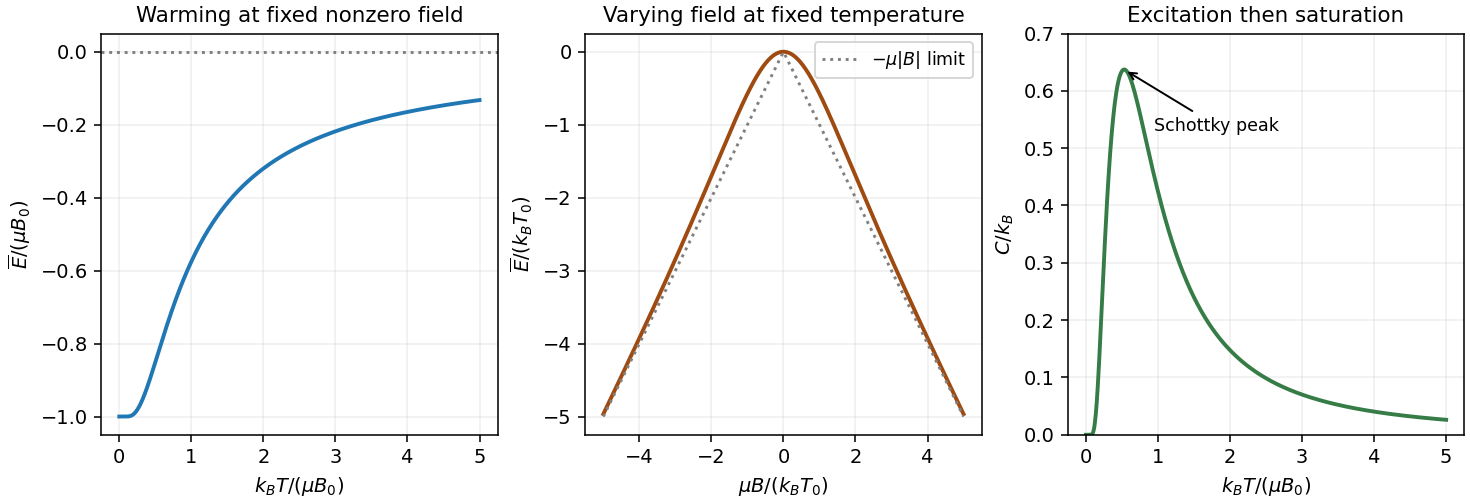


At , expanding the hyperbolic functions givesInterpreting the stated heat capacity on the same one-atom basis as the preceding calculation, its tail coefficient givesHere is used consistently with in electronvolt kelvin. For a sample of independent atoms, the total coefficient would be times the one-atom coefficient; it must first be divided by .
Finally, two derivatives of supply the second energy moment:Combining this with the heat-capacity derivative yields the canonical energy fluctuation relationIt also explains why this canonical heat capacity is nonnegative.[ref]
Molecules. In a dilute classical gas, collisions establish a Maxwell-Boltzmann distribution. The normalized speed distribution and its first two moments areMomentum transfer to a wall gives . Translational internal energy is ; rotational and vibrational degrees of freedom add energy when thermally populated, without changing the dilute ideal-gas pressure law. Classical equipartition gives per quadratic contribution, but quantum level spacing can freeze out modes.
Only the molecules moving towards a surface contribute to its one-sided number flux:For an effusive molecular energy flux, faster molecules are preferentially sampled, giving mean translational energy per crossing molecule and . This differs from multiplying by the bulk mean . Collisions and finite molecular interactions produce transport and departures from the ideal-gas equation of state.
Photons. All photons travel at in vacuum, so their thermal distribution is over frequency, not over a range of speeds. The two polarizations and Bose-Einstein occupation with zero chemical potential giveHere the spectral quantity is and the total energy density is . Momentum flux gives , while isotropic angular averaging gives the one-sided energy flux through a small aperture of a black-body cavity. The photon number flux is similarly .
Both pressures arise from momentum transfer, but their equations of state differ: a classical molecular gas has with fixed molecule number, whereas a photon gas has , and an equilibrium photon number that changes with temperature. Photon creation and absorption by the walls are essential to the zero-chemical-potential equilibrium description.
Articles by others on the same topic
There are currently no matching articles.