Treat the vapour as an ideal gas, neglect the liquid's molar volume, and take the molar latent heat as constant across this small interval. Integrating the Clausius-Clapeyron equation givesOnly the pressure ratio enters, so conversion from atmospheres to pascals is unnecessary.
The Hohmann transfer orbit has periapsis and apoapsis , so its semi-major axis is . Kepler's third law gives a period times the original orbital period. Only half the ellipse is traversed:The relevant radii are measured from Earth's centre, not its surface.
Use turns of mean radius , including the wire radius, on a light nonmagnetic rod. With wire radius , length and density , neglecting helical pitch givesThe last expression is the transverse central moment of inertia of the uniformly distributed turns. The magnetic torque is , so the small-angle magnetic dipole oscillation obeys . HenceThe number of turns cancels. Taking the turn radius as instead gives , consistent at the accuracy of the thin-winding model. The rod's inertia, damping and lead-wire torque are neglected.
For slow gyroscopic precession, the gravitational torque turns the spin angular momentum: , with . ThusThe inclination cancels at this order. More precisely, uniform precession of a heavy symmetric top satisfiesIts slow root gives . About is the slow-precession answer; arbitrary initial conditions can also produce nutation rather than exact steady precession.
For a waveguide mode in a homogeneous nondispersive filling, . Its phase velocity is and its group velocity is , giving
The Biot-Savart law gives the magnetic field of a steady thin-wire electric current in vacuum:The cross product fixes the circulation direction by the right-hand rule; fields from different electric current elements superpose. Integration gives outside a straight infinite wire and at the centre of a circular loop of radius . A distributed electric current replaces by . This is a magnetostatic law: arbitrary time-dependent electric currents require retarded electromagnetic fields, not instantaneous substitution.
In magnetostatics, Ampère's circuital law in vacuum isIt is especially useful when symmetry makes the tangential field constant on an Amperian loop. It gives for an infinite straight wire, inside a long solenoid, and in an ideal toroid. The long-solenoid and toroidal expressions neglect fringing.
For time-dependent fields, displacement current is essential:In matter, the corresponding macroscopic form is . The enclosed electric current alone is sufficient only in the magnetostatic limit.
Because , a magnetic vector potential can be introduced with . It is not unique: gives the same field. In magnetostatics, the Coulomb gauge gives in vacuum. For localized electric currents,A magnetic scalar potential is more restricted. In a simply connected current-free region of constant permeability, write ; then . Alternatively define the scalar potential for , differing by a constant permeability factor. A single-valued scalar potential generally cannot cover a domain encircling a net electric current, even where the local curl vanishes. The vector potential does not require the field itself to be curl-free.
Guided electromagnetic waves propagate along a structure whose boundaries select transverse field patterns. At a perfect conductor the tangential electric field vanishes. In a hollow rectangular guide, TE modes have and TM modes have . Their longitudinal wavenumber obeysBelow the waveguide cutoff frequency , that mode is evanescent rather than freely propagating. TM modes require both indices positive; TE modes may have one zero but not both. For , the lowest cutoff is the TE mode, with . A hollow single-conductor guide has no TEM mode, whereas a two-conductor transmission line can support one without this geometrical cutoff.[ref]
Rectangular Waveguide Modes. §13.4, mode boundary conditions, index restrictions and lowest-cutoff discussion
For a propagating TE or TM mode, and . The phase velocity can exceed without superluminal information transfer. Frequency-dependent group delay can broaden pulses; excitation of several modes adds intermodal dispersion.
Electromagnetic induction produces an electromotive force when magnetic flux linkage changes. For an oriented moving loop,For a stationary loop this reduces to Faraday's law of induction, . Motion in a static field can instead supply the motional term. Lenz's law gives the minus sign: the induced electric current opposes the flux change, with the required electrical energy supplied by mechanical work or the field source.
For linear fixed-geometry circuits, flux linkages satisfy and . Self-inductance gives ; mutual inductance gives the additional term . Reciprocity gives the same mutual coefficient for both circuits, with its sign determined by winding orientation. The stored field energy isThe bound follows from nonnegative energy for arbitrary electric currents. In a linear medium the equivalent field expression is .
An ideal electrical transformer links both windings with one changing core flux, giving for corresponding voltage magnitudes. A loaded secondary drives an opposing magnetomotive force and increases primary electric current; ideally and input and output powers agree. A electrical transformer exchanges voltage for electric current, not for extra power. Real devices have winding resistance, leakage flux, eddy-current and hysteresis losses, and finite magnetizing electric current. A steady DC input gives no continuing secondary voltage after the switching transient and may cause excessive primary electric current or core saturation.
An isotropic linear elastic solid has two independent elastic constants. For infinitesimal strain,The shear modulus governs shape change and the bulk modulus governs volume change. Young's modulus and Poisson's ratio are equivalent parameters:Positive strain energy requires , hence ; is the incompressible limit. Small-amplitude bulk waves have speeds and . Isotropy removes directional dependence, not the distinction between compression and shear. These laws apply within the elastic small-strain regime, not after yielding or fracture.
For a rigid body about a chosen origin,The inertia tensor is real and symmetric, so orthogonal principal axes diagonalize it. Angular momentum is parallel to angular velocity for rotation about a principal axis, but need not be parallel in a general direction. Its eigenvalues are the principal moments of inertia.
If the origin is translated from the centre of mass by , the parallel-axis theorem becomes . In body axes, Euler's equation is . Thus the full tensor is needed whenever the rotation is not confined to one fixed principal axis.
For two bodies interacting through , defineTheir kinetic energy separates exactly:Without external forces, the centre of mass moves uniformly while . The relative orbit is a one-body problem with reduced mass , not generally either individual mass. For , ; for equal masses , . If the interaction is central, relative angular momentum is conserved and the relative motion is planar.
Dynamic viscosity measures resistance to a velocity gradient. In Newtonian simple shear, ; positive viscosity dissipates mechanical energy into heat. Kinematic viscosity is . For an incompressible fluid of constant viscosity,Scaling velocity by and length by gives the Reynolds number , the ratio of inertial to viscous terms. At small Reynolds number, creeping-flow approximations neglect inertia; at large Reynolds number, inertia dominates much of the bulk but viscosity can remain crucial in boundary layers. A large Reynolds number permits instability and turbulence; it does not by itself specify a universal transition threshold. Geometry and disturbances also matter.
A central potential conserves angular momentum and confines a nonradial orbit to a plane. With reduced mass , the radial motion obeysTurning points satisfy . A radially bounded allowed interval gives bound motion, whereas an interval reaching infinity permits escape. The energy sign alone classifies these only with suitable assumptions about and barriers. Circular orbits satisfy and are radially stable when . Bound orbits in a general central potential need not close: successive periapses can precess.
For attractive inverse-square gravity, andEllipses have , , and the attracting centre at a focus; parabolic and hyperbolic escape have and . Conservation of angular momentum gives equal swept areas in equal times. The inverse-square law additionally yields . These are Kepler's laws; a harmonic central potential is another example with closed bound orbits, while generic central laws produce precession.
In a gravitational assist, a spacecraft's asymptotic speed relative to a planet is approximately unchanged but its direction turns. Transforming to the frame in which the planet has velocity givesThe spacecraft can gain or lose orbital energy; the planet supplies the compensating energy and momentum, with a very small velocity change because of its large mass.
Repulsive Coulomb scattering instead has . For incident relative kinetic energy and impact parameter , the hyperbolic orbit givesThis Rutherford scattering formula follows by equating the incident annulus to the scattered solid-angle ring. It assumes classical elastic scattering by a point Coulomb centre; screening, finite nuclear size or quantum effects can change the applicable regime.
A heat engine operates cyclically, absorbing heat from a hotter source, rejecting heat to a colder sink and delivering net work . Its efficiency is . The working substance returns to its original state; the reservoirs and surroundings need not.
Suppose an engine were more efficient than a reversible Carnot engine between the same reservoirs. Couple it to a reversed Carnot engine, scaling the cycles to have equal work. With no net external work, their combined effect would be to transfer heat from the colder reservoir to the hotter one, contradicting the Second law of thermodynamics. No such engine can exceed . Equivalently, the cyclic entropy inequality gives , hence the same bound.
The reversible working substance changes entropy by on its hot isotherm and on its cold isotherm, with zero change on the two reversible adiabats. Closure requires . The substance has zero entropy change over a cycle, while the reservoirs have changes and . Thus for the complete Carnot cycle.
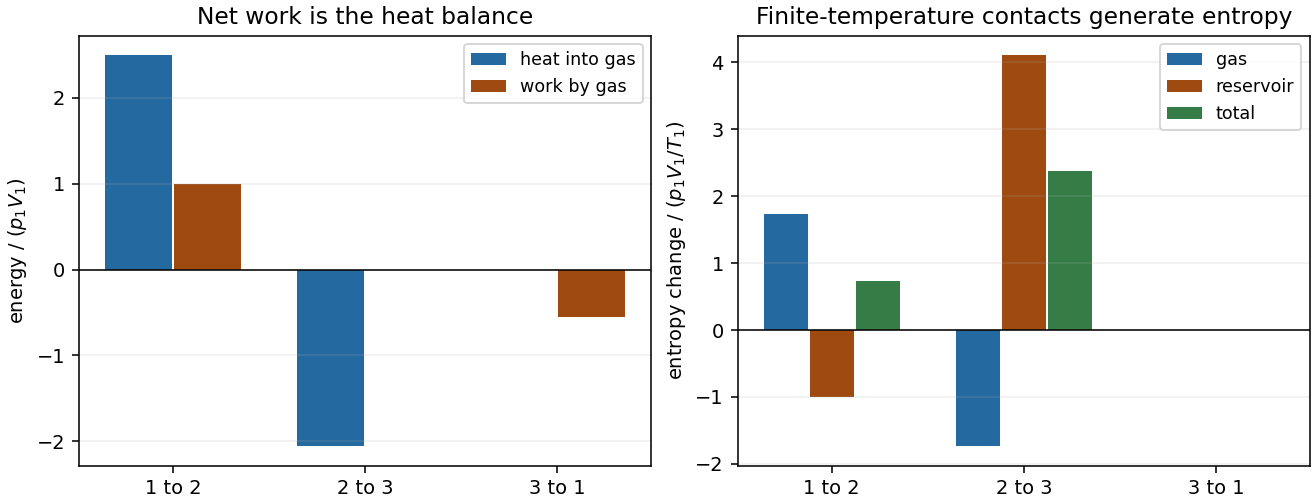
Put . For the specified ideal gas, , and . Isobaric expansion doubles temperature, so . Reversible adiabatic closure gives , henceThere is no heat input on that compression. The other stages giveTherefore andThe hot reservoir changes entropy by . The cold reservoir changes by . Since the gas completes a cycle,Although the mechanical paths can be quasistatic, heat flows across finite temperature differences in both contacts. This entropy generation explains why the efficiency is well below the Carnot value between these reservoirs.
For an isothermal final compression at , the preceding constant-volume cooling must instead end at ; keeping the old state 3 would not close the cycle. Compression then requires work , while the heat input remains . Thuswhich is lower: this isothermal compression occurs at a higher temperature throughout than the original adiabat and consumes more work. It also rejects heat during compression.
With , the thermodynamics of a liquid film givesEquality of mixed derivatives of gives the Maxwell relationUse the area convention already specified by ; do not insert an additional factor for two film faces.
At fixed area, . ThereforeFor reversible adiabatic stretching, andThe film cools, assuming positive heat capacity. Adiabaticity alone would not ensure constant entropy if the deformation were irreversible.
Reading the approximately straight trend in the supplied graph gives and . These are graph-read estimates, not more precise material constants. For , reversible isothermal stretching givesBoth are positive: stretching does mechanical work on the film and requires heat input to prevent cooling. Its internal energy increases by about .
Write , with . Constant then makes the reversible adiabatic conditionwhere is an arbitrary fixed reference temperature; absorbing it into the constant gives the requested logarithm convention. HenceHere . Since , integration gives . To first order this isThere is no heat exchange on this reversible adiabat. Cooling and increasing internal energy are compatible: positive area work more than offsets the decrease of the temperature-dependent energy term.
In the canonical ensemble, normalizes the probabilities . For temperature-independent levels,The derivative holds external parameters, including magnetic field, fixed.
For one independent symmetric three-level system put and . Then andAt nonzero fixed field, the ground state dominates as , so . At high temperature all three levels become nearly equally populated and their mean tends to zero from below. At fixed positive temperature the energy is even in , is quadratic near zero field, and approaches at large as the lowest level becomes occupied. The heat capacity vanishes both when excitations are frozen out and when populations are almost equal, with a positive Schottky anomaly between those limits.
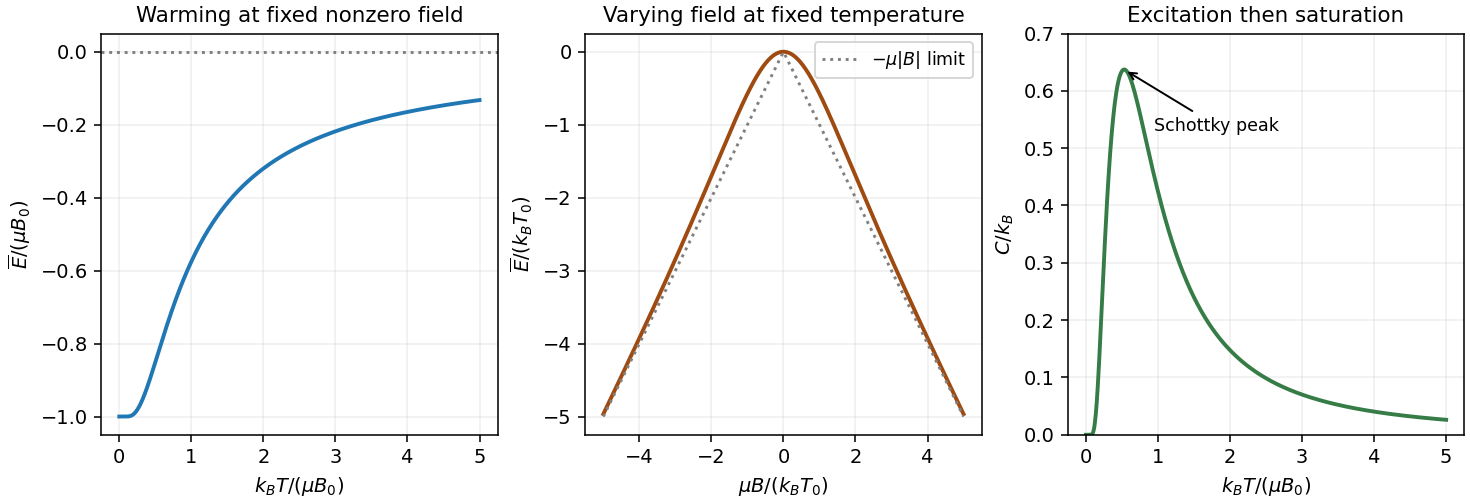


At , expanding the hyperbolic functions givesInterpreting the stated heat capacity on the same one-atom basis as the preceding calculation, its tail coefficient givesHere is used consistently with in electronvolt kelvin. For a sample of independent atoms, the total coefficient would be times the one-atom coefficient; it must first be divided by .
Finally, two derivatives of supply the second energy moment:Combining this with the heat-capacity derivative yields the canonical energy fluctuation relationIt also explains why this canonical heat capacity is nonnegative.[ref]
Molecules. In a dilute classical gas, collisions establish a Maxwell-Boltzmann distribution. The normalized speed distribution and its first two moments areMomentum transfer to a wall gives . Translational internal energy is ; rotational and vibrational degrees of freedom add energy when thermally populated, without changing the dilute ideal-gas pressure law. Classical equipartition gives per quadratic contribution, but quantum level spacing can freeze out modes.
Only the molecules moving towards a surface contribute to its one-sided number flux:For an effusive molecular energy flux, faster molecules are preferentially sampled, giving mean translational energy per crossing molecule and . This differs from multiplying by the bulk mean . Collisions and finite molecular interactions produce transport and departures from the ideal-gas equation of state.
Photons. All photons travel at in vacuum, so their thermal distribution is over frequency, not over a range of speeds. The two polarizations and Bose-Einstein occupation with zero chemical potential giveHere the spectral quantity is and the total energy density is . Momentum flux gives , while isotropic angular averaging gives the one-sided energy flux through a small aperture of a black-body cavity. The photon number flux is similarly .
Both pressures arise from momentum transfer, but their equations of state differ: a classical molecular gas has with fixed molecule number, whereas a photon gas has , and an equilibrium photon number that changes with temperature. Photon creation and absorption by the walls are essential to the zero-chemical-potential equilibrium description.
Articles by others on the same topic
There are currently no matching articles.