A liquid-gas thermodynamic critical point is the endpoint of the coexistence curve where distinct liquid and gas densities merge. In the van der Waals illustration, write the original constants as to distinguish them from the later polynomial coefficients. The critical isotherm has a horizontal inflection in ; setting its first two volume derivatives to zero givesBelow this temperature the homogeneous van der Waals loop contains an unstable region; physical equilibrium instead separates into liquid and gas.[ref]
For the critical point of a cubic density equation of state, assume . Its density derivatives areBecause is a smooth monotone function of at finite positive density, a stationary inflection obeys as well. Solving these equations and substituting back givesThe symbols here have different units from the van der Waals excluded-volume parameter. With , , the isotherms becomeThe spinodal densities of a cubic gas delimit the two-extrema regime. The curves are monotone for , have a stationary inflection at for , and have two extrema for .
For the critical-density compressibility of a cubic gas, since , evaluation at the critical density givesIt diverges as in this mean-field model. For it is negative on the homogeneous branch at , violating mechanical stability: a pressure increase would expand rather than compress that branch.
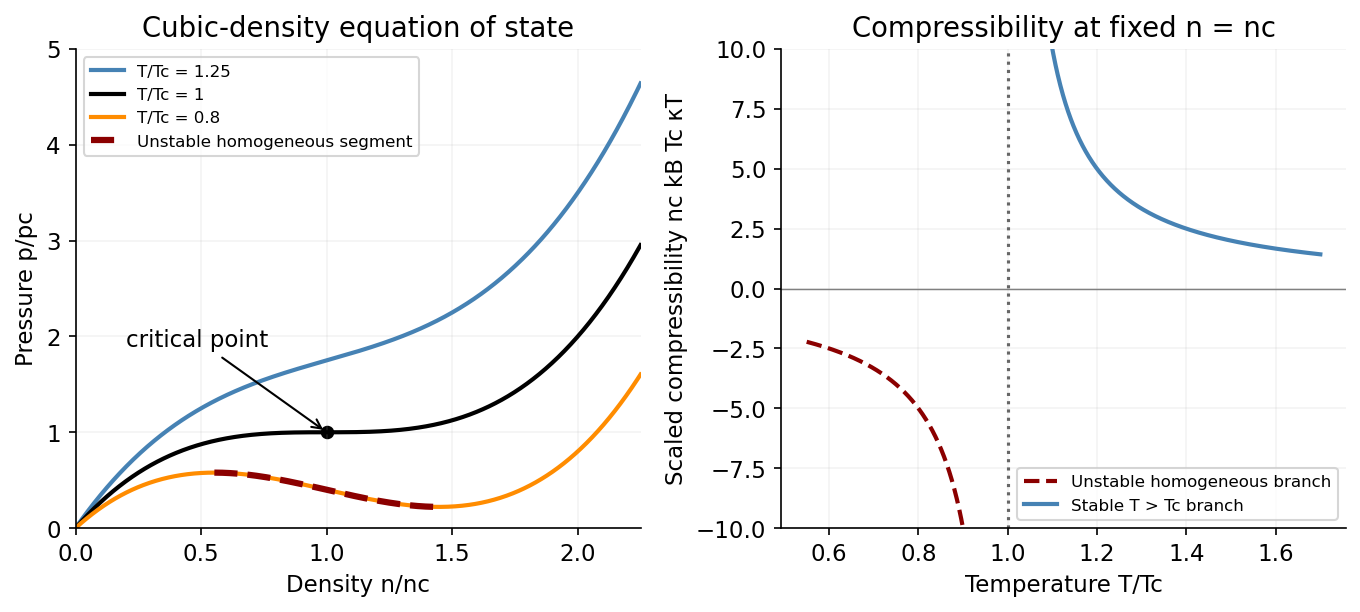
Polynomial gas isotherms develop an unstable negative-slope region below criticality; the homogeneous compressibility becomes negative there
. Source. Details. 
The actual equilibrium below criticality is coexistence of two phases, with equal pressure and chemical potential and different densities. A sample's mean density can change by changing phase proportions. The unstable homogeneous branch is not a realizable equilibrium isotherm. The Maxwell construction in density coordinates requires care: the equal-area construction is performed in versus volume, not by using unweighted area in versus density. The truncated polynomial is an approximate mean-field equation, so its predictions need not give quantitative critical behaviour for a real gas.
Articles by others on the same topic
There are currently no matching articles.