For a smooth isolated conducting sphere, Gauss's law gives the surface electric field and electric potential . At the specified dielectric strength, . The capacitance of an isolated conducting sphere is , so its capacitor energy isThis is the ideal breakdown-limited energy of a conducting sphere, taking air's permittivity approximately equal to vacuum permittivity and neglecting nearby objects and surface irregularities. The vacuum permittivity used numerically is .[ref]
Fundamental Physical Constants — Complete Listing by National Institute of Standards and Technology and others. 2022 CODATA adjustment, vacuum electric permittivity entry
Take the initial thrower and receiver positions to be and , with counterclockwise angular velocity . Interpret as the launch speed relative to the thrower. The ball inherits the thrower's tangential velocity, so in an inertial frame its initial horizontal velocity is . The flight time across the diameter is . During that time the receiver moves approximately sideways while the ball moves . Thus the transverse miss on a rotating platform isThe ball passes behind the receiver in the sense of rotation. Equivalently, in the rotating frame its transverse Coriolis acceleration has magnitude to leading order; integrating over gives . Terms neglected here are higher order in . Specifying an initially radial launch velocity in the inertial frame instead would define a different throw and would lose the inherited tangential velocity.
The dynamic viscosity measures the transport of tangential momentum between adjacent layers. The kinetic estimates of gas transport coefficients givewhere is number density, the molecular mass, the mean free path, and a collision cross section. At fixed temperature, raising the pressure increases the number of momentum carriers but shortens their mean free path by the same factor. Consequently the dynamic viscosity of a dilute gas is approximately independent of pressure.
For a temperature-independent collision cross section, the same estimate gives , so in the hard-sphere model. Faster molecules carry momentum across layers more rapidly. Real intermolecular interactions make the effective collision cross section temperature-dependent, changing this simple exponent. The pressure-independence also fails when wall collisions, rather than molecule–molecule collisions, set the transport distance; the continuum estimate assumes a small Knudsen number.
The varying magnetic flux through the ring induces an electromotive force by Faraday's law of induction. Its direction follows Lenz's law. With solenoid current , ring current , ring self-inductance , electrical resistance , and mutual inductance ,The ring sits in a nonuniform magnetic field: coupling decreases above the solenoid, so and with a common orientation for the two windings. For , the in-phase part of the induced ring current is negative:Thus alternating-current induction levitation can balance the ring's weight when . A falling mean lifting force with height supplies vertical stability. In the strongly inductive limit the two currents are almost opposite: the ring repels the solenoid during both half cycles. Finite self-inductance matters; an ideal purely resistive loop would carry a current exactly in quadrature with and give zero average force in this model. The source supplies the Joule heating in the real ring, and any mechanical work while it rises.
After the photon has thermalized, its energy belongs to the macroscopic body's internal energy. The body's heat capacity makes the resulting temperature change negligible. Its equilibrium entropy therefore increases byThe Boltzmann entropy then gives the microstate multiplier from photon absorption:For scale, explicitly choosing a representative visible wavelength and room temperature gives , or , and a multiplier approximately . These are illustrative choices, not additional supplied data: the exact multiplier depends exponentially on the particular visible wavelength and temperature. The exact Planck constant, speed of light, and Boltzmann constant fix the conversion.[ref]
In electrostatics, the Maxwell equations in matter areHere is free charge density and is polarization density. For a homogeneous isotropic linear dielectric, the constitutive equation is . Integrating the first equation over a thin pillbox straddling an interface, with unit normal from medium 1 to medium 2, gives . Integrating the second around a vanishingly narrow rectangular loop gives . These are the electrostatic interface boundary conditions. When there is no free surface electric charge, the normal electric displacement field and tangential electric field are continuous; the normal electric field generally is not.
Neglect end fringing field of a capacitor. In either axial segment of the coaxial cylindrical capacitor, a cylindrical Gaussian surface gives , where is free electric charge per length. Integrating the radial electric field between the conductors givesThe liquid and air segments share the same conductor electric potential difference, so their capacitances add in parallel. Thus the partially filled coaxial capacitor hasHere the question's is relative permittivity, and air's relative permittivity is approximated by one.
Write for the rise above the external level. The wide reservoir keeps that level approximately fixed. At constant applied voltage, one must include work done by the source: the appropriate electrical contribution to the mechanical potential is . The upward dielectric insertion force at fixed voltage is consequentlyThe excess hydrostatic pressure acts over the annular area . Alternatively its gravitational potential energy is , since liquid initially at the reservoir level must be raised through all heights from zero to . Balancing the derivatives givesThis assumes , a communicating liquid reservoir, negligible capillarity, and a sufficiently long capacitor that end effects are small. Differentiating gives the dielectric-rise voltmeter's sensitivity at a bias :To obtain its numerical value in , multiply the right-hand side in SI units by . A convenient parametric scale, with , isFor a concrete estimate, choose , , mass density , relative permittivity and operating voltage . These are illustrative choices, not supplied apparatus data. They giveThus this millimetre-scale example requires fine optical displacement measurement for volt-level changes. The parametric formula states exactly how the estimate changes with the chosen geometry, liquid and bias.
The displacement is quadratic in voltage, cannot distinguish its sign, and has zero first-order sensitivity at zero bias. Smaller gaps and larger relative permittivity increase sensitivity, but capillarity, leakage, dielectric breakdown, temperature-dependent liquid properties, and finite available rise then limit performance. A nonconducting liquid avoids a sustained conduction load, although charging still draws electric charge and leakage is possible. A high voltage can give a readable displacement; a low-voltage instrument would require fine displacement measurement and careful calibration.
The differential form of Faraday's law of induction isBy Stokes theorem, for a stationary oriented circuit it becomes , where is magnetic flux and is electromotive force. Circuit orientation and surface normal obey the right-hand rule. Lenz's law is the physical meaning of the minus sign: the induced current's magnetic field opposes the change in linked magnetic flux. For a moving circuit, the force per unit electric charge is , and its line integral is the corresponding electromotive force. Motion through a static magnetic field can therefore induce a voltage even when .
Let be the wire's angle from the downward vertical, , and choose and upward, as in the figure. The motional term along the wire has radial component at cylindrical radius . In steady electrical equilibrium, integrating from the grounded axis to the bob givesThe Lorentz force on this positive electric charge is radially outward. Its ratio to the required centripetal term is , so the stated heavy-bob condition makes its effect on the zero-field conical pendulum geometry negligible. With wire tension , and , giving . Hence the magnetically charged conical pendulum hasA nonzero-radius orbit requires . Reversing the sense of rotation or the magnetic field reverses the sign of .
The response to the added electric field requires an electrical convention. In the usual mechanical approximation, treat the pre-existing electric charge as , include its upward electric force , and neglect all magnetic-force feedback. ThenThis predicts an increased radius for . It is the result when the newly applied field is used only as a probe force on the original electric charge.
There is a first-order qualification if the bob remains electrically connected to the grounded pivot and the uniform added field's potential is included consistently. Put and set the external electric potential to zero at the pivot. The external potential at the bob is then , so the charging relation and full force balance becomeThe second equation follows by eliminating the wire tension between vertical balance and radial balance, including the outward magnetic Lorentz force. Expanding both equations to first order in , and to leading order in , with , givesThe extra factor arises from the added field changing by and therefore changing the radial magnetic force. That term is linear in too; the heavy-bob assumption alone does not justify retaining while dropping it. The two expressions refer to the two electrical approximations just specified. The expansion requires a small change relative to the initial radius and is nonuniform as that radius tends to zero.
For an electrical measurement, route the grounded connection through a sensitive electrometer operated near zero input voltage, and integrate the charging electric current when or is changed. Starting with the field off, the transferred electric charge is in this ideal capacitance model. Reversing separates the induced signal from offsets. Alternatively, isolate the charged bob briefly and measure its electric potential with a high-input-impedance electrometer, accounting for the instrument's extra capacitance and for the fact that isolation changes the electrical boundary condition.
The characteristic impedance of a lossless transmission line is the ratio of the voltage to the current amplitude of a single forward-travelling wave. If and denote inductance and capacitance per unit length, the lossless telegrapher equations giveA backward wave has when current is positive along . Thus characteristic impedance is not a resistor's electrical resistance: it describes travelling-wave amplitudes and determines impedance matching, power transfer and reflections. A semi-infinite line, or a line terminated by a matching load, presents that impedance at its input.
At a junction with no lumped branch, voltage and electric current are continuous:Eliminating gives the voltage reflection coefficientFor real positive , incident and reflected waves occupy the same line, so their power ratio is .
For the slightly mismatched coaxial cables, the change in characteristic impedance isConsequentlyThe requested power limit implies . Since for the stated line, the adjacent cables' outer radii must match within approximately . If a tolerance is quoted separately as a symmetric manufacturing range and arbitrary worst-case pairs can differ by , the corresponding individual tolerance is approximately . The leading calculation is for small mismatches; the exact logarithmic expression gives slightly asymmetric positive and negative limits. The vacuum wave impedance used here is approximately .[ref]
A needle is a shunt electrical resistance , so the load seen at its location is the continuation of the line in parallel with : . The local voltage reflection coefficient and transmission amplitude areFor periodic resistive loading of a transmission line, the reflection from the next needle travels an additional round trip and crosses each previous needle twice. Taking the first needle as phase reference, the single-return approximation for periodic line reflections therefore sums toHere is the propagation phase velocity in the cable, for the stated nondispersive nonmagnetic filling. Squaring the amplitude gives the requested expressionFor a finite number of needles the amplitude has the additional numerator . The displayed semi-infinite result assumes sufficiently many needles, no terminal reflection, and neglects intrinsic propagation loss.
For real , write . The denominator of the power coefficient is . It has constructive peaks at and minima at , repeating with frequency spacing . Within this approximation,Weak individual shunts thus give narrow interference peaks, with phase width of order .
The requested sum excludes paths that reflect repeatedly between different needles. It should not be read as an exact multiple-scattering result, particularly at the coherent peaks. For example the exact semi-infinite amplitude satisfiesAt this equation reduces to : the exact ideal infinite array has unit power reflection there, rather than the first-return approximation's value near . This does not change the requested geometric-series derivation, but identifies its physical limitation.
Choose the guide axis as , with and . The electric field is along , parallel to the walls' dimension. Take a homogeneous lossless nonmagnetic dielectric with relative permittivity , ideal conducting walls, and time dependence . The lowest transverse electric mode of a rectangular waveguide isAt , this tangential electric field vanishes. At the electric field is normal to the wall; a nonzero value is supported by surface electric charge and violates no conducting boundary condition. The field has zero divergence. The associated normal magnetic field also vanishes at each wall, as verified below. The fundamental sine across the wider dimension minimizes the nonzero transverse wave number; is not a physical propagating mode of a hollow simply connected guide.
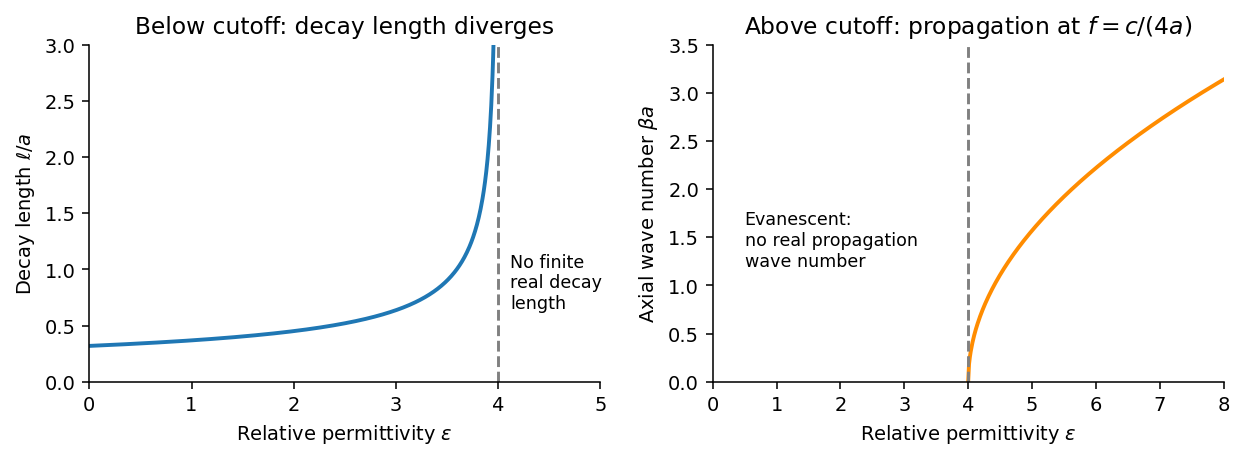
Below the waveguide cutoff frequency , put with to select decay for . The evanescent transverse electric mode in a rectangular waveguide then hasFor the fixed frequency in the question,The decay length increases monotonically and diverges as ; its formal limit at is . At the mode is at cutoff, with zero axial wave number. For , is real and the mode propagates without axial attenuation in this ideal lossless model. There is no real finite evanescent decay length to continue beyond cutoff. The paper's graph notation denotes the same as its preceding formula.
From Faraday's law of induction, . Writing givesThus vanishes on the walls and vanishes on the walls, meeting the normal magnetic boundary conditions. The fields also satisfy . For real the physical fields are , , and .
The time-averaged Poynting vector isAll products are imaginary because the electric field and magnetic field are in quadrature. A single decaying evanescent wave stores reactive energy without transmitting average power into a semi-infinite lossless guide. A finite below-cutoff section can transmit power when both independent evanescent solutions are present; that is a different boundary-value problem.
The skin effect also gives exponential field decay, but in a good metal has both real and imaginary parts and there is a real inward mean Poynting vector. That flux supplies Joule heating . Here attenuation comes from geometric cutoff in a lossless region, with no conductivity and no dissipative power sink; exponential decay alone does not establish absorption.
For the attractive inverse-square force, choose zero potential energy at infinity, so . At either radial turning point , the kinetic energy is purely tangential, with conserved angular momentum . ThusIts two roots are the periapsis and apoapsis distances. Their sum is , whereas the ellipse has . Therefore , with for a nondegenerate bound ellipse. The circular case follows by the double-root limit.
For the two-body problem, define , total mass , reduced mass , and center of mass . The relative equation is , while the isolated center of mass has . Once the relative orbit is known,The relative energy uses in its kinetic energy and in the gravitational potential energy.
In the equal-mass case the initial relative speed is , , and the center-of-mass velocity is half B's initial velocity. ThusNegative relative energy requires . The escape threshold is ; equality is marginal parabolic escape, so a strictly bound pair has .
For , and the relative semimajor axis is . The initial transverse speed is below the relative circular value , so the initial turning point is apoapsis. HenceChoose the initial separation along from A to B, with B's initial velocity . Conservation of angular momentum gives relative periapsis speed . At the opposite end of the ellipse the direction is , soThus B has the same speed as initially but the opposite velocity. A has at that instant. A value for B would be its center-of-mass-frame speed, not the requested initial laboratory frame result.
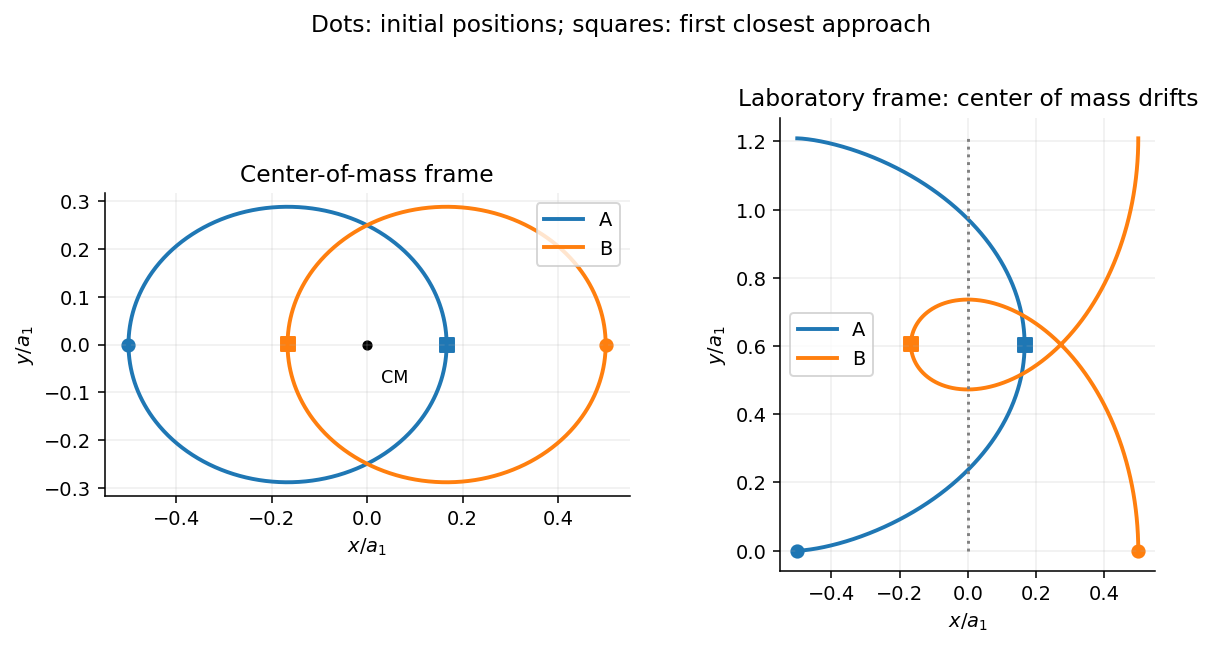
The relative orbital period follows from Kepler's third law with total gravitating mass :In the center-of-mass frame each star follows an ellipse of semimajor axis and eccentricity , with the center of mass at a focus; they remain opposite on their simultaneous position vectors. In the laboratory frame add the uniform drift along . The laboratory paths of an equal-mass binary are therefore not closed ellipses, even though their relative motion repeats.
In Lagrangian mechanics, choose independent generalized coordinates compatible with the mechanical constraints, write , and apply the Euler-Lagrange equationEquivalently, the physical path makes the action stationary under variations with fixed endpoints. For ideal holonomic constraints, their unknown reaction forces need not appear in the reduced equations. Direct use of Newton's laws of motion instead resolves vector forces and reactions and enforces the constraints separately. Both approaches describe the same mechanics; the scalar Lagrangian is often shorter in curvilinear coordinates. Nonconservative generalized forces must be added separately. Here a drive maintains the prescribed azimuthal angular velocity .
The mass has polar speed and azimuthal speed , so its kinetic energy is . The elastic potential energy is , and the height is , giving gravitational potential energy . Thereforeand the Euler-Lagrange equation givesFor , define and , so . Near zero,When the upright equilibrium is linearly stable and the small oscillations have .
For , the graph of initially rises, whereas . There must therefore be a zero inside the interval. More strongly, for ,is strictly decreasing: decreases and increases because . The ratio goes from to , giving exactly one zero in that interval. At the zero, , so it is a stable equilibrium. The rotating torsion-stabilized inverted pendulum also has a symmetric stable angle if both signs of tilt are permitted.
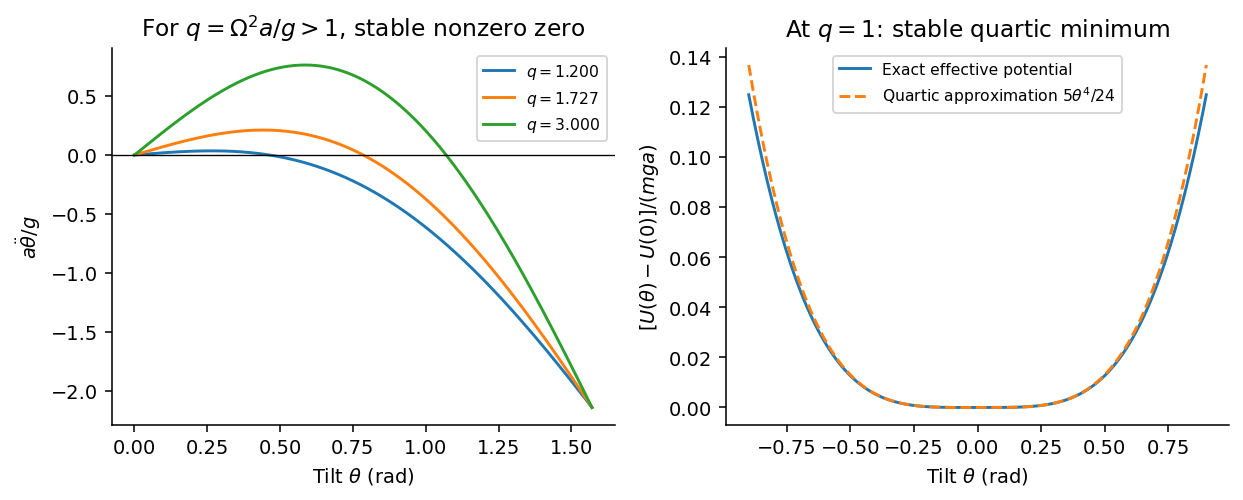
At , setting gives , soFor , the linearized equation is . Since ,At the threshold the linear restoring term vanishes, but the cubic term remains:The upright state remains nonlinearly stable, with no nonzero infinitesimal harmonic frequency. Small finite disturbances produce quartic oscillator motion whose frequency is proportional to its small angular amplitude; its period tends to infinity as that amplitude tends to zero. Zero linear stiffness is not the same as an absent restoring torque.
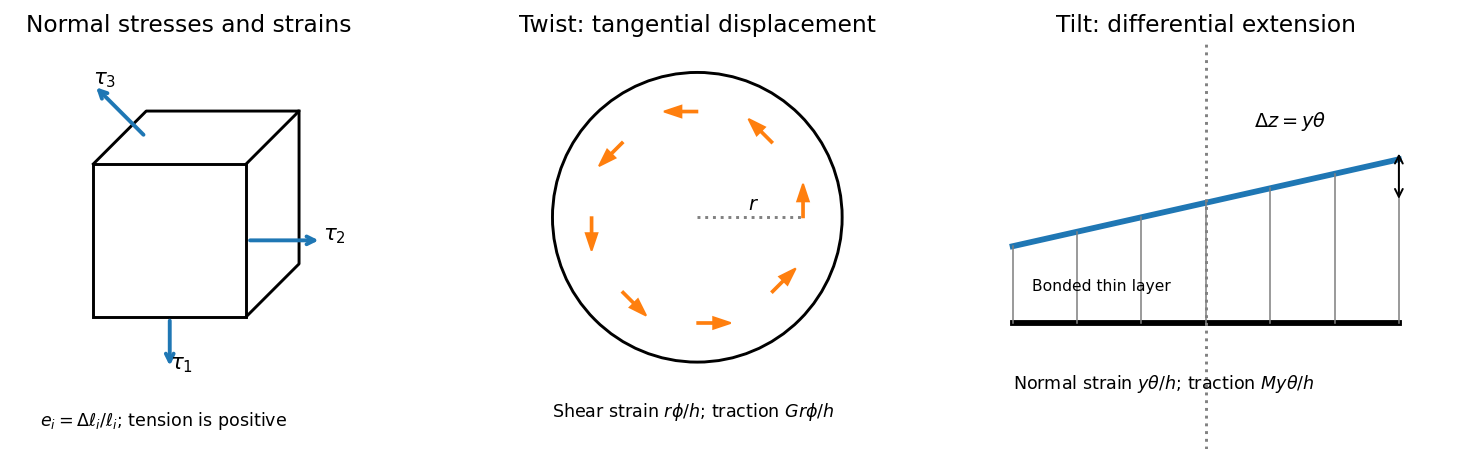
Use positive normal stress for tension. On a small rectangular material element, is the normal force per unit area on the face perpendicular to axis , and is the corresponding normal strain. Young's modulus is the ratio of axial normal stress to axial strain in uniaxial stress; Poisson's ratio is minus the transverse-to-axial strain ratio in the same test. Thus isotropic linear elasticity gives and cyclic permutations. The stress symbols here follow the question; denotes Poisson's ratio, not a stress component.


For , the two transverse compliance equations imply . Substitution into the first givesThis uniaxial strain modulus is greater than the uniaxial-stress Young's modulus for the positive Poisson's ratio of interest, because the lateral constraints prevent free Poisson contraction.
For a small twist , the bonded faces' relative tangential displacement at radius is . The layer's shear strain is , so the shear stress is . Integrating the torque givesThe minus sign denotes a restoring torque; the question quotes its magnitude. This uses the disk's polar second moment of area.
For tilt about H, choose in the plate perpendicular to H. The vertical displacement of the bonded top face is to first order, giving normal strain . The thin layer is constrained laterally by bonding, so its leading normal traction is , not . Integrating its moment about H givessince the diametric second moment of area is . This is the specified thin-layer approximation to the torsion and tilt stiffness of a bonded elastic disk. Relaxation near the free cylindrical edge is neglected; for a nearly incompressible layer it can limit quantitative accuracy unless the thinness is sufficient.
The thin square plate's moment of inertia about V is . Its two perpendicular in-plane central moments are equal and sum to , so the diagonal H has . Dividing the two angular stiffnesses by the appropriate moments of inertia givesThe geometry factors cancel in their ratio. Using the supplied relation between shear modulus and Young's modulus,The result lies just below the incompressible isotropic limit , as expected for a rubber with a large compression stiffness compared with its shear modulus. It is an inference within the bonded-layer model, rather than an independently measured material constant.
For a Newtonian fluid with velocity , is the component of traction on a plane whose normal points along . The opposite face has the opposite traction. The coefficient is dynamic viscosity, with units . Faster layers transfer positive momentum toward slower neighbours; the internal shear stress resists relative sliding.
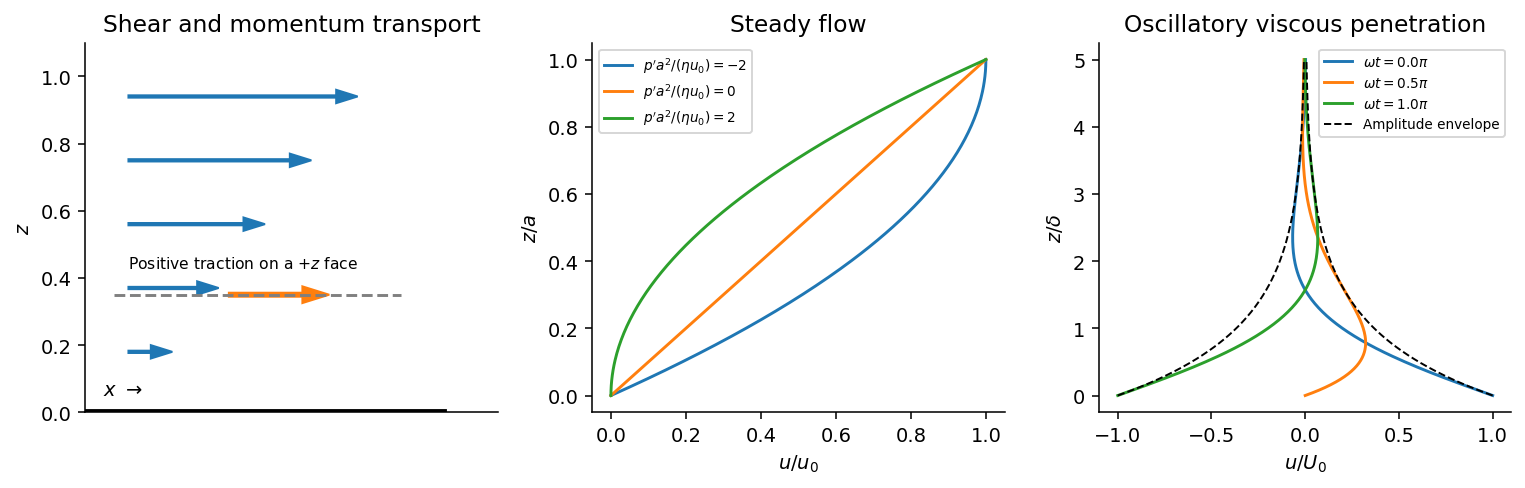
Shear-traction convention, Couette-Poiseuille profiles, and oscillatory viscous penetration
. Details. 
Take a thin fluid element with horizontal area and thickness . The difference between its upper and lower viscous tractions is . The pressure gradient supplies . Incompressibility is satisfied because has no dependence, and the convective acceleration vanishes: . Equating net force to mass times acceleration therefore gives the relevant component of the Navier-Stokes equation:For steady flow, integrate twice and impose the no-slip boundary condition at each plate, and . The Couette-Poiseuille flow profile isThe linear term is Couette flow and the parabolic term is plane Poiseuille flow. A negative drives flow in . Integrating the profile across the gap gives the volumetric flow per unit width,It has units ; multiplying by the plate width gives the actual volume per time.
With zero pressure gradient, substituting gives . Select the root that decays into fluid occupying :The other sign applies to decay in the opposite half-space. With a real wall velocity amplitude , the established periodic solution of Stokes' second problem isThe oscillation's amplitude decays exponentially and its phase lags with distance from the plate. This is diffusion of tangential momentum, not a freely propagating undamped elastic wave. Initial transients must have decayed before this purely periodic expression applies.
The fluid-displacement amplitude and the wall-displacement amplitude have the same ratio as their velocity amplitudes, since both are divided by the common . Thus for the specified amplitudes,Using the standard approximate water density , explicitly an approximation rather than another value printed on the paper, gives and from either face of a sufficiently large plate. The viscous penetration depth varies as if a more precise water density is used. The ideal parallel-flow solution ignores finite plate edges and tank walls.
For entropy gain from impact and thermal equilibration, let the large lake be a reservoir at an initially unspecified temperature , in kelvin, and take the final meteorite temperature to be . Its initial temperature is . The meteorite loses thermal energy , and its kinetic energy is also dissipated into the lake. ThusandBoth heat equilibration and dissipation contribute positively. For the requested estimate, assume a lake temperature . This gives . Taking – instead gives about –; this shows the estimate's sensitivity without asserting an unprovided lake temperature. The boxed expression retains the full temperature dependence. The model uses the stated constant heat capacity, no phase change of the meteorite, and a lake large enough that its temperature change is negligible.[ref]
For the image force on a line charge above a conducting plane, with no imposed external electric field, use the method of images: replace the plane by a parallel image line of charge at height . The image is from the real line, and its field at the real line has magnitude . ThereforeHere points upward from the plane. The force is attractive and normal to the conductor, for either sign of . The image reproduces the induced surface charge field; it is not an extra physical charge, and no factor is inserted in the force on the actual line.
Interpret the two radial turning values as and ; the printed maximum/minimum order is reversed. The potential is . At either turning point,Equating these two energies gives . A radial impulse changes the radial velocity and energy but exerts no torque about the centre, so it preserves . For radial-impulse circularization of a harmonic central orbit, the circular orbit satisfies . HenceThe original orbit crosses this radius. Cancelling its radial velocity there leaves the tangential speed required for the circular orbit; the impulse is not applied at an original radial turning point.
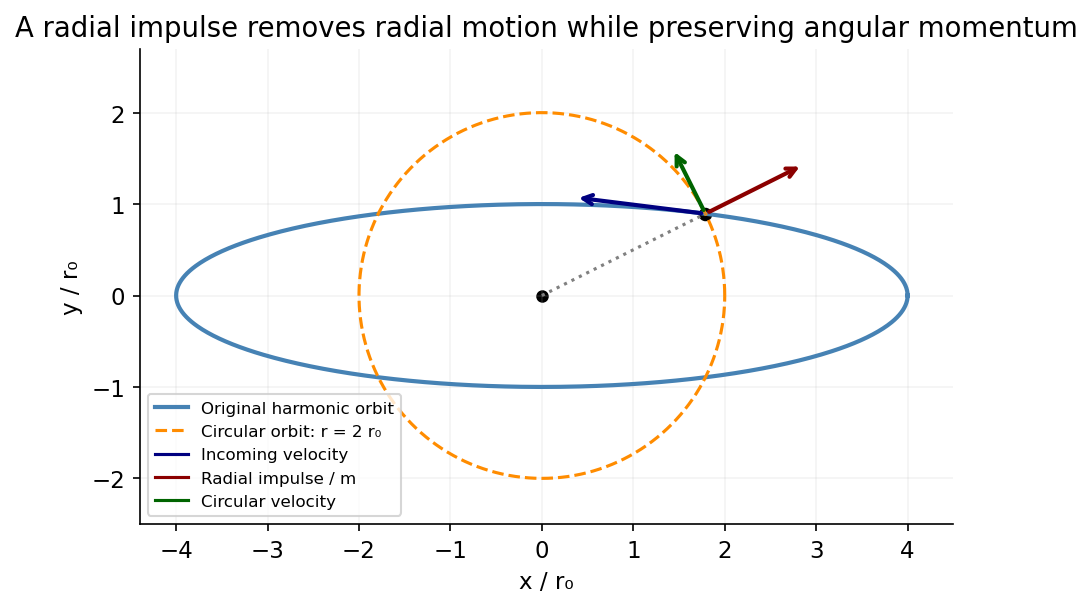
A radial impulse at the geometric-mean radius turns an elliptical harmonic orbit into a circular orbit
. Source. Details. 
For a thick good conductor in the normal skin effect regime, the skin-effect surface resistance is determined byIdentical guide geometry then giveswhere the numerical ratio assumes both coatings are nonmagnetic, with . A magnetic stainless-steel grade would require its magnetic permeability; conductivity alone does not fix that alternative.
Using , the gold skin depth at the stated frequency isThe metal coating thickness relative to skin depth sets the useful scale. Thus a layer of order begins to be useful, and a few skin depths, roughly –, substantially screen the poorer substrate. This is a thickness scale, not a specified attenuation threshold. It assumes a continuous coating thicker than the relevant microscopic surface scale.[ref][ref]
CODATA recommended values of the fundamental physical constants 2014 by National Institute of Standards and Technology. Vacuum permeability in the then-current SI convention
Take upward as positive and interpret the stated as the total mass immediately before launch, including the harpoon. The remaining probe mass is . Conservation of momentum during the short firing interval givesThe harpoon speed used here is relative to the comet, as printed. From , the near-surface gravitational acceleration isFor the near-surface recoil height with constant downward thrust, the upward motion has downward acceleration . ThereforeSince , treating gravity as constant is consistent. This uses only the stated gravity and thrust after firing; a taut tether could reduce this free-flight height, but no tether length or elasticity is specified. If instead meant the probe mass after firing, the pre-firing mass would be and its momentum would leave the probe still moving downward, with no upward excursion. This illustrates nearly cancelling recoil momenta in payload ejection. The mass convention matters because the launch momenta nearly cancel.
At an interface with unit normal pointing from medium 1 to medium 2, the magnetic boundary conditions areThe first follows from a pillbox applied to . The tangential magnetic field jump from a free surface current follows from a shrinking rectangular Ampère loop; is the free surface current. With no free sheet current, normal and tangential are continuous. In linear isotropic media , so neither all components of nor all components of generally remain continuous.
For magnetic field-line refraction at a permeability interface, with angles measured from the normal, these conditions give . They determine the bending of magnetic flux at a material interface. In a slender core electromagnet, flux continuity and Ampère's law lead to the magnetic-circuit estimateAn air gap can dominate the reluctance even when the iron core has high magnetic permeability. Boundary conditions also determine demagnetizing fields; fringing, saturation and hysteresis limit the simple linear circuit model. A high-magnetic permeability material redirects flux, whereas a perfect-conductor boundary is a different physical assumption.[ref]
An inductor stores magnetic energy and opposes changes of current through electromagnetic induction. For a fixed linear device, the flux linkage is , the self-induced electromotive force is , and the passive terminal voltage is . HenceThe voltage leads a sinusoidal current by a quarter cycle. A long solenoid has and ; its energy agrees with the volume integral of .
For two coupled coils, , , with signs set by coil orientations. Reciprocity gives the same mutual inductance in both equations. For the energy stored in a nonlinear inductor, replaces the simple quadratic formula, and hysteresis can dissipate energy. Real coils also have resistance, core loss and parasitic capacitance, so an ideal inductance model has a finite useful frequency range.[ref]
In a linear, nondispersive, lossless medium, the field energy density and energy flux areThe Poynting theorem follows by dotting the two curl Maxwell equations with the other field and subtracting:The right-hand side is power transferred from the field to free charges. In vacuum the energy density is .
Static electric or magnetic fields store energy even though their time derivatives vanish. Static Poynting flow occurs because static crossed fields can also have a nonzero Poynting flux: for example, a steady current-carrying coaxial line has radial electric and azimuthal magnetic fields, carrying energy along the line toward the load. Time independence therefore does not imply zero energy flow.
For phasors whose real parts represent the physical fields,For a travelling plane wave in vacuum the electric and magnetic contributions are equal and . In dispersive matter the simple macroscopic energy formula needs modification to include the material response; it is not a universal formula for plasma energy.[ref]
Electromagnetism by David Tong. Chapter 4: conservation of electromagnetic energy and the Poynting vector
Reflected and transmitted waves arise because the fields must satisfy the electromagnetic boundary conditions. With no free surface charge or current, tangential and normal are continuous. At normal incidence between lossless media, define the real wave impedance . Writing and in a common transverse electric-field direction givesFor the power normalization of Fresnel amplitudes, power fractions are and , so . An electric-field amplitude coefficient alone is not a transmitted power fraction.
At oblique incidence, phase matching along the interface gives Snell's law, . Applying the same boundary conditions separately to the two linear polarizations gives the Fresnel equations. For nonmagnetic dielectrics the parallel-polarized reflection vanishes at . Above the critical angle into a lower-index lossless medium, the transmitted field is evanescent and reflection is total. A perfect conductor instead has zero tangential electric field and unit reflected power; finite conductivity introduces penetration and absorption.[ref]
Displacement current makes Ampère's law compatible with charge conservation. The macroscopic Maxwell equations areTaking the divergence of the last equation and using Gauss's law gives . Omitting would wrongly require the conduction current to be divergence free during charging. The displacement-current density has current-density units, but need not represent free charges crossing a region.
The surface independence of Ampère circulation during capacitor charging illustrates the need directly. A surface spanning the circuit can cut the wire or pass between the plates. For ideal parallel plates, andThe corrected circulation of is independent of that surface choice. Free conduction current stops at a plate; displacement current supplies the gap contribution.
In vacuum the two time-dependent curl equations support waves. Taking a curl of Faraday's law in a source-free region yieldsThe corresponding magnetic equation is identical. For a plane wave, and . The fields carry energy through the Poynting flux. Dropping displacement current everywhere would remove these freely propagating solutions.[ref]
In a metal, conduction and displacement compete. For a uniform ohmic material with , constant , and transverse waves,Use . The dispersion relation and conduction-to-displacement current ratio areWhen , with : fields are screened within a skin depth and energy is dissipated by Joule heating. This quasistatic limit neglects displacement current locally compared with conduction; it does not invalidate the full Maxwell law. At sufficiently high frequency, conductivity and permittivity are frequency dependent, so a constant- approximation must be replaced by a material model.
In an unmagnetized cold plasma, electron inertia gives a cutoff. With immobile ions and negligible collisions, and give . For the transverse wave cutoff in a cold unmagnetized plasma, combining this carrier current with vacuum displacement current givesTransverse waves propagate above and are evanescent below it. The group velocity is even though the phase velocity exceeds . The cold model also has longitudinal charge-density oscillations at , distinct from transverse light waves. Collisions add damping, and pressure or magnetic fields modify these simple dispersions. To avoid carrier-current double counting in effective permittivity, once the carrier response is included in it must not be counted a second time as a separate conductivity. Displacement current therefore connects circuit continuity, vacuum radiation, conductor screening and plasma propagation within one consistent field theory.[ref]
Electromagnetism by David Tong. Sections 7.6.2–7.6.3: conductors, plasma frequency and longitudinal plasma oscillations
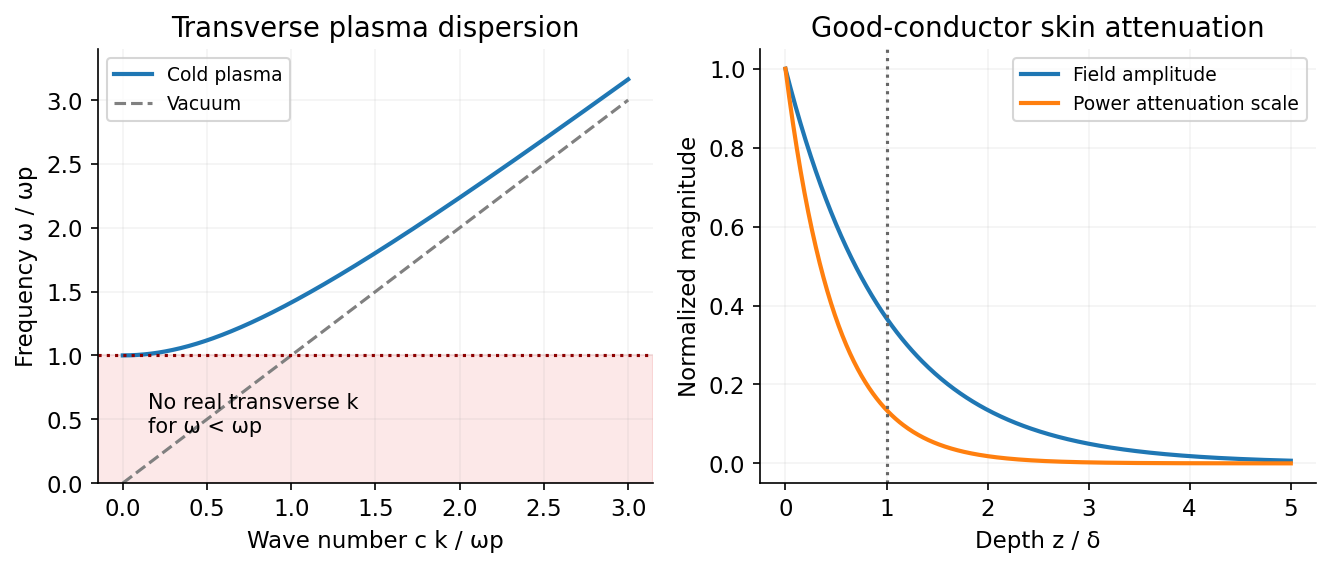
Electron inertia gives transverse plasma waves a cutoff, while a good conductor attenuates fields over a skin depth
. Source. Details. 
A torque-free rigid body has constant angular momentum in inertial space. Its angular velocity need not be parallel to , because . In body principal axes, Euler equations for a torque-free rigid body areFor a symmetric top , , the component is constant andThis is the signed rotation frequency of the transverse angular-velocity components in the body frame. In space the symmetry axis instead obeysIts angle to is constant, with . The body-frame and space-frame frequencies of free symmetric-top precession describe different frames. A spherical body has and no corresponding wobble. For a triaxial body, rotations about the largest and smallest principal-inertia axes are stable, whereas rotation about the intermediate axis is unstable.[ref]
Classical Dynamics by David Tong. Sections 3.4.2–3.4.3: free symmetric top and stability of the asymmetric top
For generalized coordinates with Lagrangian , the conjugate momentum isA coordinate absent from is cyclic, and its conjugate momentum is conserved. More generally, Noether's theorem connects continuous symmetries of the action to conserved quantities: spatial translations give linear momentum and rotations give angular momentum. If has no explicit time dependence, the conserved energy function isThe momentum conjugate to an angle is an angular momentum, not a linear velocity. Canonical momentum can also differ from mechanical momentum: for , . Thus a conserved conjugate momentum must be identified from the actual Lagrangian and its symmetry, rather than assumed to equal . Gauge-dependent canonical momenta require the corresponding gauge choice or gauge-covariant symmetry interpretation.[ref]
Classical Dynamics by David Tong. Chapters 2 and 4: conservation laws, conjugate momentum and the Hamiltonian
For positions measured from the chosen origin, the inertia tensor isIt relates angular momentum and rotational kinetic energy to angular velocity:The real symmetric tensor has orthogonal principal axes, in which . Its eigenvalues are nonnegative moments of inertia. Rotation about a principal axis has ; a general rotation does not. The moment about a unit axis is .
Changing from the centre of mass to a parallel origin displaced by gives the tensor parallel-axis theorem,For example, a uniform solid sphere has , while a thin rod along has principal moments in the ideal zero-radius limit. The tensor is needed to describe off-axis rotation and torque-free precession; a single scalar inertia only suffices after an axis is specified.[ref]
Classical Dynamics by David Tong. Sections 3.1–3.3: inertia tensor, principal axes and the parallel-axis theorem
For steady, inviscid, incompressible flow, Euler's equation integrated along a streamline givesThis is Bernoulli's equation. The constant is common to different streamlines if the flow is also irrotational; incompressibility alone does not imply that. Viscous loss or work by a pump requires additional terms.
A Pitot-static tube compares stagnation pressure at a forward-facing opening with nearby static pressure . For equal height, the stagnation point has , soThis measures flow speed when compressibility corrections are negligible.
In a flowmeter using the Venturi effect, continuity gives . For a horizontal constriction with , Bernoulli gives , henceThe fluid accelerates and static pressure falls in the throat. This is a second practical application of the conversion between pressure and kinetic energy; real instruments need calibration for flow losses.
A normal mode is a motion in which all coordinates have a fixed relative pattern and oscillate at one frequency. Near a stable equilibrium, let the quadratic kinetic and potential energies be and . With positive-definite mass matrix , the equations and harmonic ansatz giveThe stiffness and mass matrices are symmetric. For distinct frequencies, their symmetry gives , so the mode vectors are orthogonal in the mass inner product. A basis can also be chosen in a degenerate eigenspace. Expanding decouples the equations into ; initial displacements and velocities determine the coefficients. Positive stiffness gives real frequencies, a zero eigenvalue can describe a free symmetry motion, and a negative one signals instability rather than an oscillatory mode.[ref]
Classical Dynamics by David Tong. Section 2.6: small oscillations and generalized normal-mode eigenvalue equations
For two equal masses between fixed walls with three equal springs, the stiffness matrix is and the mass matrix is . The patterns and have frequencies and . An initial displacement of one mass excites both modes and can produce beats.
For a uniform taut string fixed at both ends, the wave equation , with , has patterns and angular frequenciesThe boundary conditions select the spectrum. Fourier expansion of arbitrary admissible initial data provides the mode amplitudes, illustrating the extension from a finite set of coordinates to a field.
For the normal modes of inductively coupled LC circuits, take two identical circuits with self-inductance , capacitance and mutual inductance , where . The capacitor charges obey and the exchanged equation. In-phase and opposite-phase charge patterns haveThe positive inductance matrix for two identical coils is the physical counterpart of positive mass. Here inductance plays the role of the mass matrix. Mechanical, wave and electrical examples therefore share the same eigenvalue structure. Weak forcing excites modes according to its spatial overlap with each pattern; damping broadens the resonances, while strong nonlinearity can invalidate a fixed linear-mode decomposition.
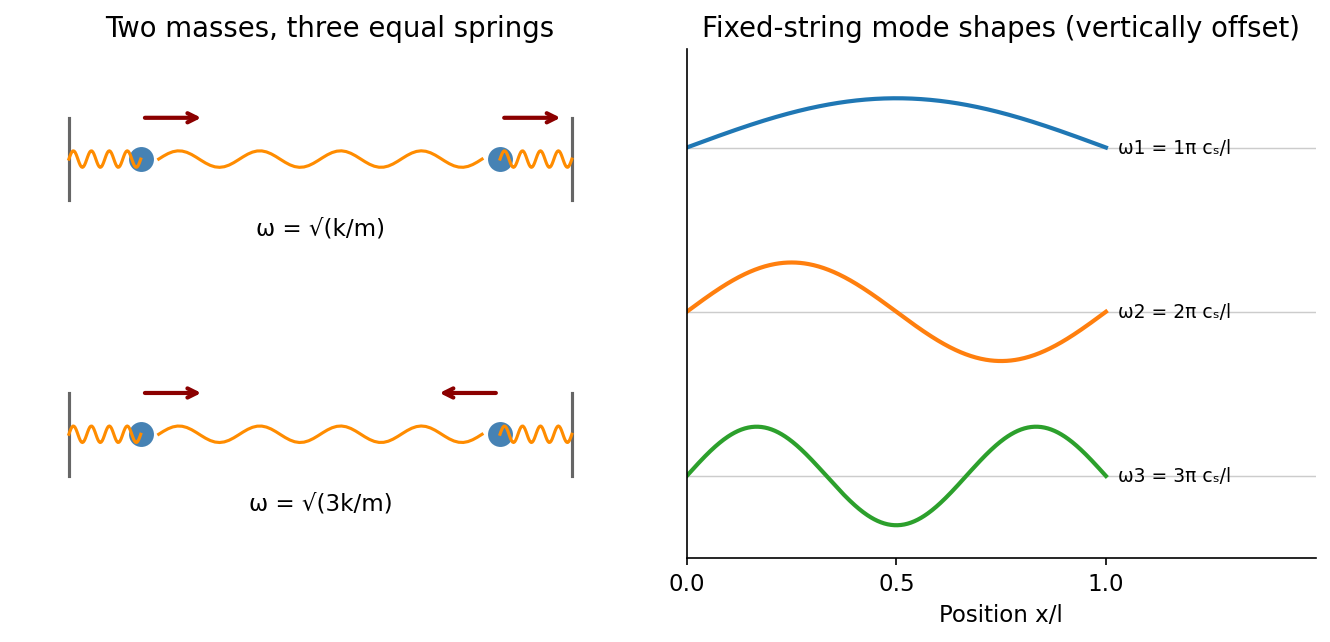
Normal modes range from two-mass displacement patterns to the standing-wave harmonics of a fixed string
. Source. Details. 
A liquid-gas thermodynamic critical point is the endpoint of the coexistence curve where distinct liquid and gas densities merge. In the van der Waals illustration, write the original constants as to distinguish them from the later polynomial coefficients. The critical isotherm has a horizontal inflection in ; setting its first two volume derivatives to zero givesBelow this temperature the homogeneous van der Waals loop contains an unstable region; physical equilibrium instead separates into liquid and gas.[ref]
For the critical point of a cubic density equation of state, assume . Its density derivatives areBecause is a smooth monotone function of at finite positive density, a stationary inflection obeys as well. Solving these equations and substituting back givesThe symbols here have different units from the van der Waals excluded-volume parameter. With , , the isotherms becomeThe spinodal densities of a cubic gas delimit the two-extrema regime. The curves are monotone for , have a stationary inflection at for , and have two extrema for .
For the critical-density compressibility of a cubic gas, since , evaluation at the critical density givesIt diverges as in this mean-field model. For it is negative on the homogeneous branch at , violating mechanical stability: a pressure increase would expand rather than compress that branch.
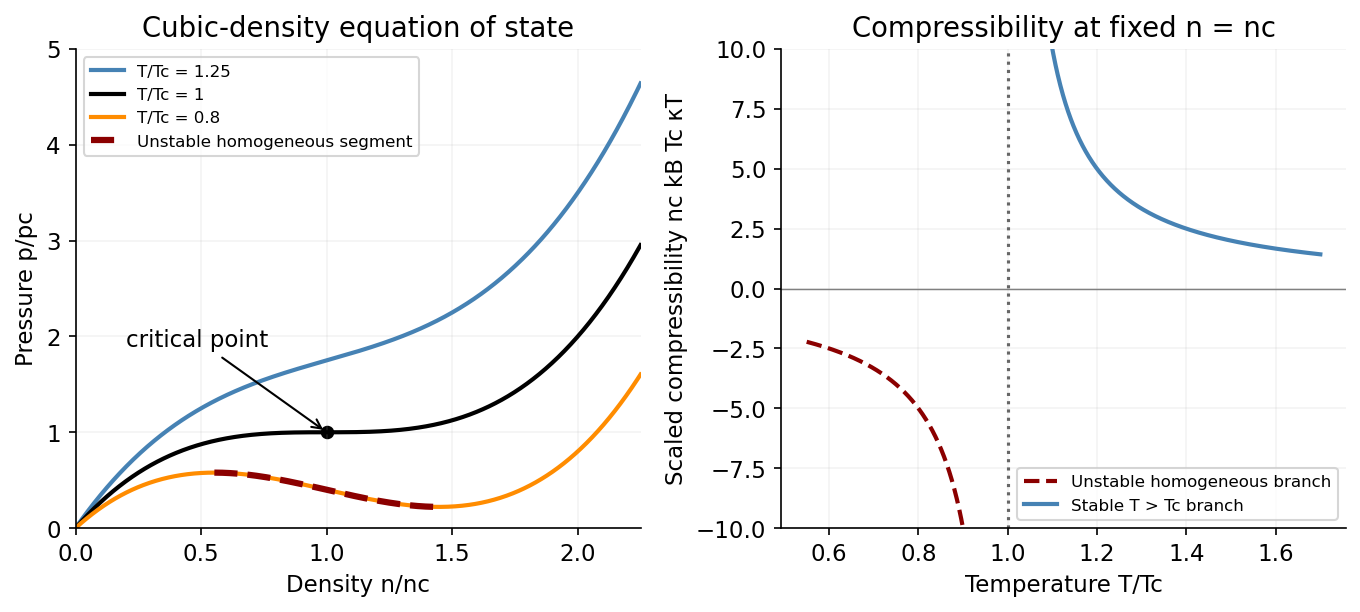
Polynomial gas isotherms develop an unstable negative-slope region below criticality; the homogeneous compressibility becomes negative there
. Source. Details. 
The actual equilibrium below criticality is coexistence of two phases, with equal pressure and chemical potential and different densities. A sample's mean density can change by changing phase proportions. The unstable homogeneous branch is not a realizable equilibrium isotherm. The Maxwell construction in density coordinates requires care: the equal-area construction is performed in versus volume, not by using unweighted area in versus density. The truncated polynomial is an approximate mean-field equation, so its predictions need not give quantitative critical behaviour for a real gas.
The Boltzmann distribution assigns probability to each microstate. For the equilibrium height distribution in a uniform gravitational field, take a dilute gas above a floor in a constant gravitational field. Uniform cross-section and no relevant upper boundary give the normalized height densityThusThe gravitational potential is linear in height, so its mean is not a quadratic-mode contribution of .
The equipartition states that each independent quadratic term in a classical equilibrium Hamiltonian contributes mean energy , provided the relevant degrees of freedom are thermally accessible. Equivalently, when the phase-space integration by parts has vanishing boundary terms. Three translational velocity components therefore contribute .
For rotational equipartition in a rough-ball gas, collisions exchange both translational and rotational energy. In the intended three-dimensional classical equilibrium model there are three translational and three rotational quadratic terms, giving in total kinetic energy per ball. Adding , and conserving the initial energy per ball, givesRoughness is relevant because it allows rotation to thermalize. The effective mechanical temperature of released rough balls describes the balls' mechanical degrees of freedom, not their internal material temperature; finite ball size and excluded-volume effects are neglected.[ref]
The height tail isThis can be nonzero because collisions redistribute energy between balls; an individual ball is not restricted to its original energy. The exponential distribution is the large-number statistical approximation under the stated effective-equilibrium assumption.
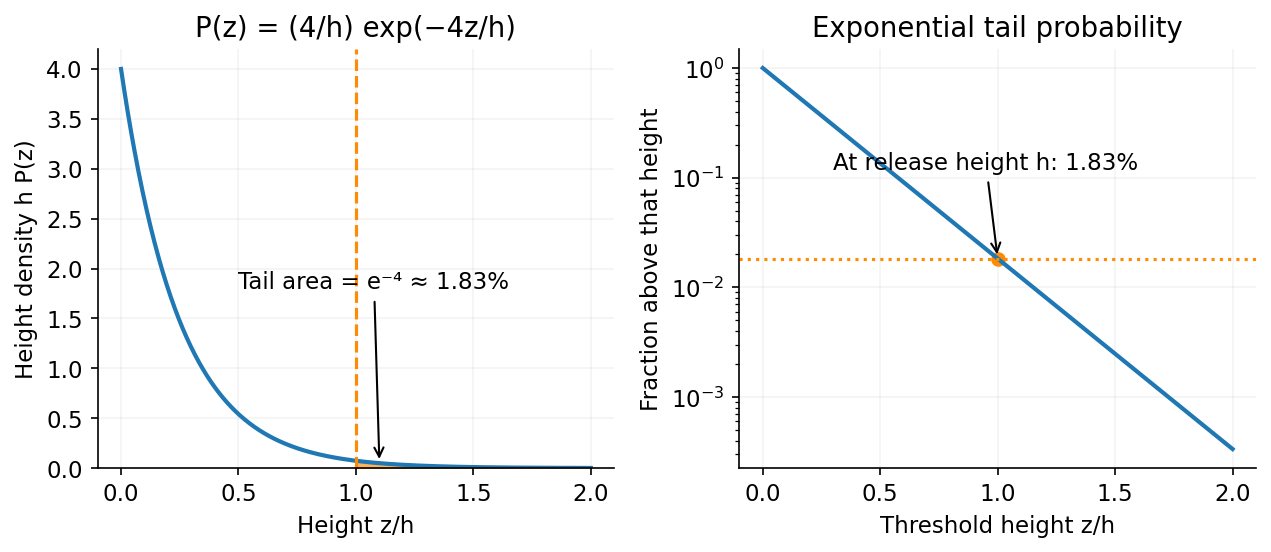
The thermal height distribution puts about 1.83 percent of the rough balls above their release height
. Source. Details. 
For the angularly resolved molecular arrival flux, let be normalized by . Isotropic velocity directions have probability . Integrating over azimuth gives , while the speed normal to a stationary piston is . For incident directions , the arrival flux is thereforeAn elastic collision transfers normal momentum to the piston. Integrating the momentum flux givesNo specific Maxwellian speed distribution was needed for this isotropic kinetic-pressure identity.
Use the figure's direction toward the piston and let its inward speed mean piston velocity . For reflection from a translating planar piston, in the piston frame the incoming normal velocity is . Elastic reflection reverses it, and transforming back givesThe exact kinetic-energy change in this ideal massive-piston model is . Thus, to first order in the small piston speed,The first-order collision-flux approximation for a slow piston applies: the incident collision flux changes at order , but its product with the order- energy increment changes the energy rate only at order . Hence one may use the stationary flux at leading order. For piston area ,Here . This compression work from molecular impacts, with no heat flow, is the first law for work done on the gas by compression. The derivation assumes small compared with thermal speeds and an approximately isotropic distribution at the piston; rapid compression can produce nonequilibrium pressure and higher-order corrections.
The Second law of thermodynamics restricts which energy-conserving processes can occur. In the Kelvin-Planck statement of the second law, no cyclic engine can have as its sole effect the extraction of heat from one reservoir and its complete conversion into work. In the Clausius statement of the second law, no process can have as its sole effect transferring heat from a colder reservoir to a hotter one. An engine or refrigerator combined with the reverse of a reversible device shows that a violation of either statement would violate the other.
A heat engine takes heat from a reservoir at , rejects to one at , and returns its working substance to the initial state. Energy conservation gives and efficiency . Carnot's theorem states that no engine between these reservoirs is more efficient than a reversible one, and that all reversible engines between them have the same efficiency. Otherwise, drive a reversible engine backwards with the work of a more efficient engine; the composite cycle transfers heat from cold to hot without external work, contradicting the Clausius statement.
A reversible Carnot cycle consists of two isotherms joined by two reversible adiabats. For an ideal gas, and . The adiabats give , soCarnot's theorem makes this independent of the working substance and defines the thermodynamic absolute-temperature scale consistently with ideal-gas temperature.[ref]
Classical Thermodynamics by David Tong. Sections 4.3.1–4.3.2: heat engines, Carnot's theorem and temperature
For any reversible cycle, . This makes the integral between two equilibrium states independent of the reversible path, defining the state function entropy:Heat itself is path dependent; entropy is not. An irreversible change can be evaluated using any imagined reversible path between its equilibrium endpoints. For example, a fixed amount of ideal gas with constant has .
For a general cycle the Clausius inequality is . The entropy balance for a process is , with equality for reversible heat exchange and no entropy production. The surroundings' entropy must be included, giving . A system's own entropy can decrease by exporting entropy; an isolated system's cannot.
The engine's reservoirs have net entropy change , sowith equality for a reversible engine. Friction, heat flow through a finite temperature difference and unrestrained expansion produce entropy and reduce usable work. Thus energy conservation fixes the balance of heat and work, while the second law fixes their direction and the attainable efficiency.[ref]
Classical Thermodynamics by David Tong. Section 4.3.3: entropy as a state function and the second law
Articles by others on the same topic
There are currently no matching articles.