The boundary-value method. In a charge-free region, the electric potential obeys the Laplace equation, , and . Conductors impose equipotential boundaries, with specified voltages or charges, and a far-field condition fixes the remaining behaviour. The Uniqueness of the Dirichlet problem guarantees that a solution meeting the prescribed conductor potentials is the physical one. To see why, the difference of two candidate solutions is harmonic and vanishes on the boundaries; integration by parts gives , hence no difference in their fields. An exterior problem also needs the appropriate condition at infinity.
Two axisymmetric harmonic functions. For in spherical coordinates, the Laplacian reduces toFor , the bracket is . For , it is . ThereforeThe second function is singular at the origin, which is allowed here because that point lies inside the excluded conductor. The printed spherical Laplacian has a typo in its azimuthal term: its denominator should be . Both functions are axisymmetric, so that term vanishes and the typo does not affect these calculations.
Potential and field geometry. Set the lower conductor to zero potential and the distant upper plate to . The small boss sees approximately uniform background field , where . Combining the two harmonic functions to make on gives the conducting hemispherical protrusion in a uniform field,It also vanishes on the surrounding plane . The electric field components areEquipotentials crowd near the apex, and field lines meet the conductor normally.
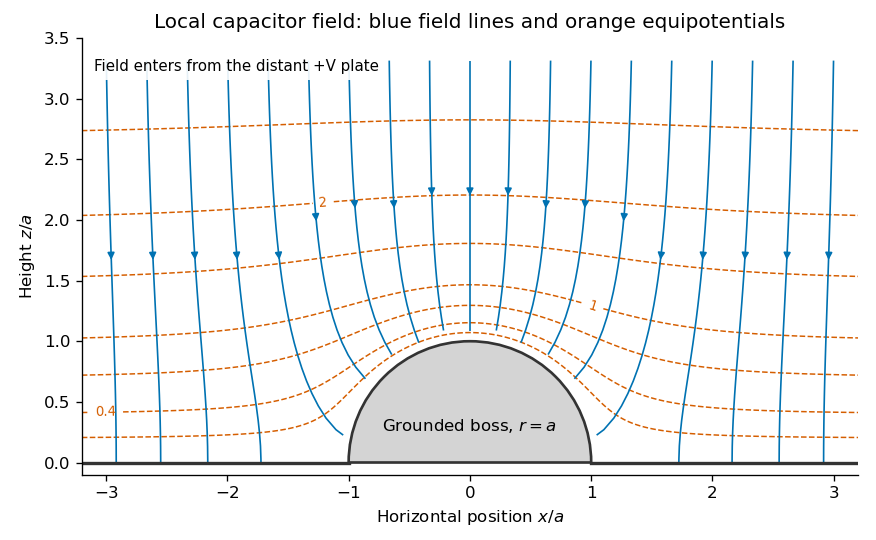
Original calculated local equipotentials and electric-field lines above the hemispherical boss; this is the small-boss approximation rather than an exact finite-gap solution
. Details. 
The formula has the correct uniform far field but does not exactly impose a flat upper equipotential at finite . It is the leading approximation justified by ; an exact finite-gap solution would include further corrections.
At the hemispherical surface , the outward normal from the conductor into the gap is . The tangential field is zero there andThe electrostatic interface boundary conditions give surface charge density , because the interior electric field is zero. HenceIt is negative for a positive upper-plate voltage, greatest in magnitude at the apex, and zero at the equator. Its units are coulombs per square metre.
On the lower plane outside the boss, write for distance from the boss centre along the plane, so . Differentiate the potential normally before putting :Thus the normal field is andThe source uses for this distance on the plane. Near the rim it tends to zero, while far from the boss it recovers the uniform parallel-plate surface charge.
The largest gap field is at the apex: . If the fixed breakdown threshold is , a smooth parallel-plate gap permits , whereas this small hemispherical boss permitsThus the maximum voltage is reduced by a factor of three, within the stated local-field approximation. This comparison holds the material dielectric strength and gap fixed.
Articles by others on the same topic
There are currently no matching articles.