Compression and stretch viewed on rotated faces. To isolate shear, take equal small principal strains , . A square with sides at to these directions becomes a rhombus: adjacent side lengths are unchanged to first order, but their right angle changes by . In axes rotated through , the same strain tensor has zero diagonal entries and off-diagonal entries of magnitude .
The pure shear from opposite principal strains therefore has engineering shear strain , not . Equal opposite principal stresses give purely tangential traction of magnitude on those rotated faces. HenceIf the compression and stretch are not equal and opposite, an additional dilatational strain remains; their deviatoric part still supplies shear.
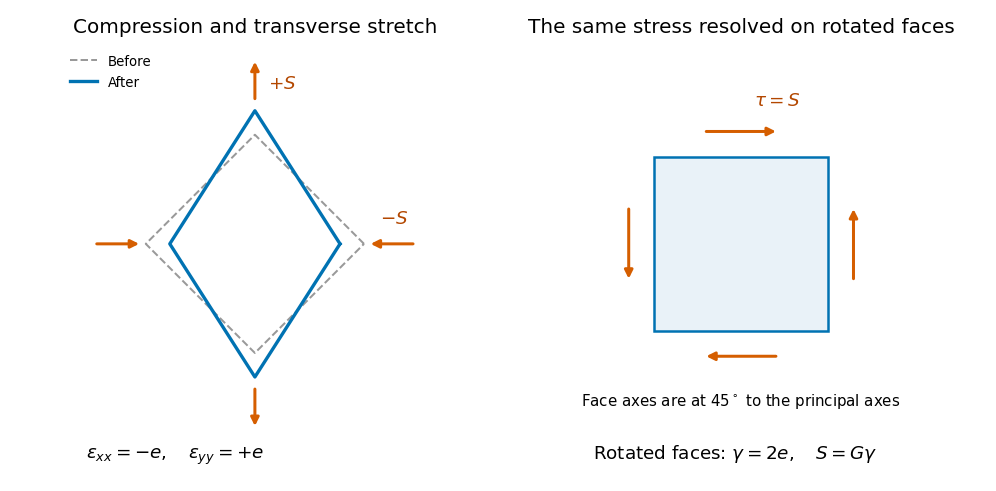
Original comparison of compression and transverse extension with the same stress resolved as shear on faces rotated through 45 degrees; deformation is exaggerated
. Details. 
The shaft's torsional stiffness. At radius , an end twist over length gives tangential displacement and shear angle . The local shear stress is . An annular area contributes torque , soThus torsion of a solid circular shaft givesHere is the polar second moment of area, in , not a mass moment of inertia. This is the transmitted torque magnitude; the shaft's restoring couple opposes the twist. The formula assumes small elastic shear and a circular uniform section.
Power is transmitted at rate , soFor , and , the polar second moment of area is . HenceThe density does not enter this static torsional deformation.
The torque rises linearly with elastic twist, so the stored elastic energy is the work integralUsing the transmitted torque and end twist,This is energy associated with deformation, distinct from the much larger kinetic energy of the whole spinning shaft.
For the uniform solid cylinder, the axial moment of inertia isThe rotational kinetic energy at isThis includes the shaft's bulk steady rotation; the small twist does not appreciably alter its mass moment at this order.
The torque difference. Let now be the local angular displacement, and take and the section constant. The local twist per unit length is , so the transmitted torque is . Across a short slice,Thusto first order in slice length.
The slice's angular acceleration. The slice's axial moment of inertia is . Its net torque is the difference of the end torques, soCanceling the common geometry gives the torsional waves in a solid circular rod,For the given steel, . The radius cancels because both torsional stiffness and slice inertia contain the same . This ideal one-dimensional wave model neglects dissipation and additional elastic modes.
Articles by others on the same topic
There are currently no matching articles.