The closed surface integral sums the outward electric flux: is the electric field, its outward vector area, the total enclosed charge and the vacuum permittivity. Gauss's law relates that flux to enclosed charge for any closed surface. High symmetry can make the field's magnitude constant on a suitable Gaussian surface and fix its direction; without symmetry, flux alone does not determine the local field.
For an isolated conducting sphere, charges reside at its surface and the exterior field is radial. ThusThe conductor has zero interior field. Integrating exterior field energy givesLet the initial charge per drop be . After disconnecting the charging supply, charge is conserved. Volume conservation gives final radius , total charge andInitial mutual energy is negligible at the stipulated large separation. HenceThe electrostatic energy increase on equal-drop coalescence is positive. It can be supplied by the decrease in surface energy during coalescence and/or by external mechanical work bringing like charges together. Remaining energy can become motion and heat. If the charge is too large, surface-energy release alone need not suffice to make merging spontaneous; conservation does not assert that it will. Keeping the drops connected to a voltage supply would instead be a different charge-balance problem.
For point masses, Newton's force is attractive along their separation with magnitude . Treat the narrow rod as uniform, with linear mass density ; a mass profile would otherwise be needed beyond total mass and length.
For axial and transverse gravity of a uniform rod, on the axis at , integrating the element force givesdirected toward the rod. On the perpendicular bisector, axial components cancel and transverse components add:At ,Both approach the point-mass force, but , so the axial attraction is slightly larger.
For a circular orbit perpendicular to a uniform rod, rotational symmetry about the rod makes a centred circular orbit possible in its perpendicular-bisector plane. With , centrifugal balance givesFor , it is Keplerian, . For rod thickness , the force approximates that of an infinite line and , a flat speed limit rather than a divergence.
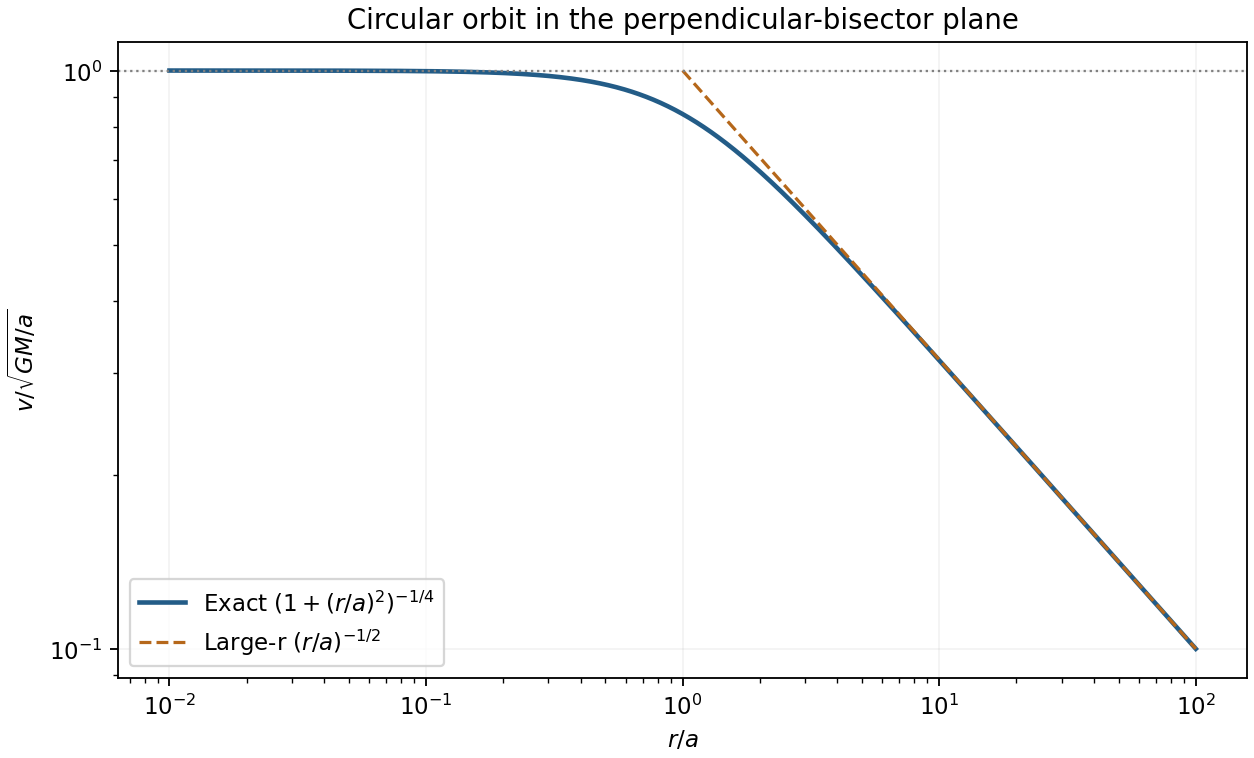
Circular speed around a uniform rod
. Original orbital speed normalized by sqrt(GM/a), against perpendicular orbit radius divided by the rod half-length. The small-radius plateau and large-radius Kepler asymptote are marked; the zero-thickness rod approximation requires orbit radius larger than the physical rod thickness. Details.
Articles by others on the same topic
There are currently no matching articles.