For a steady uniform jet, the mass flow rate is . The transported momentum flux and kinetic energy flux of a uniform jet areIncompressibility gives piston speed . Equating piston power to the jet's kinetic power givesThis ideal result neglects losses and the kinetic energy of fluid moving slowly inside the large cylinder. Retaining an inlet speed correction would multiply the pressure expression by .
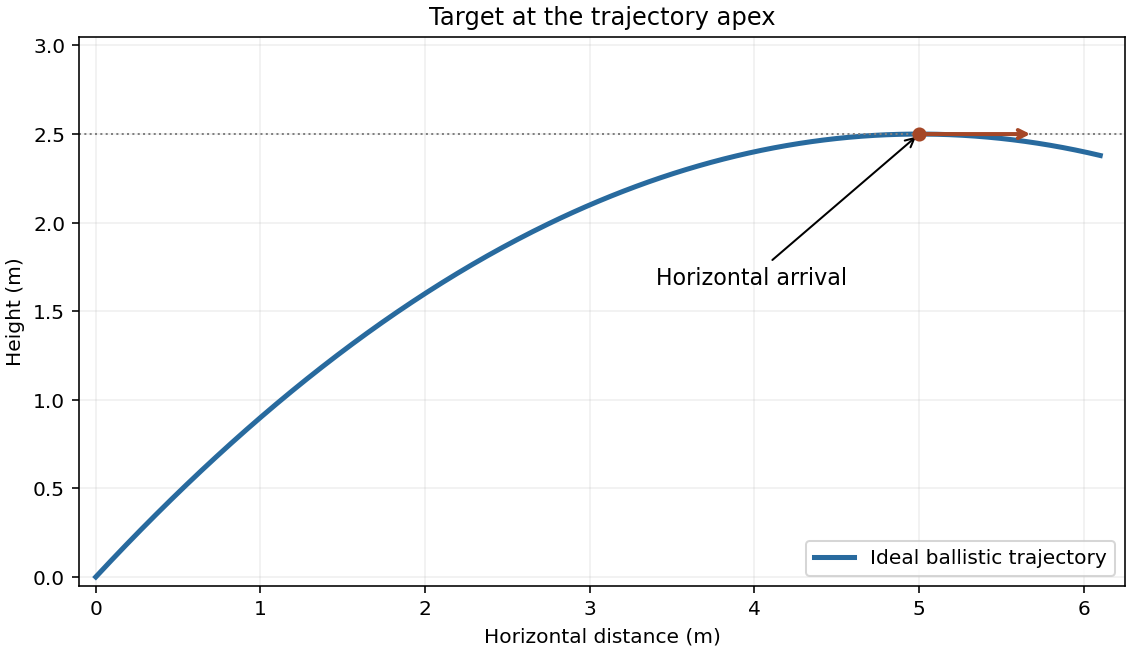
A horizontal impact occurs at the projectile apex. Write and . At its height h, and the flight time is , soHere and . The apex-target condition for a ballistic jet fixes both launch speed and angle.
If the target stops the horizontal momentum of the arriving water, the force isThis exceeds the limiting friction, so the target can be dislodged in the ideal stopping-impact model. The jet-area adjustment during ballistic slowing matters: the nozzle area sets ; replacing u by in that mass-flow factor would incorrectly assume unchanged jet area during deceleration. Reflection or a specified deflection would change the transferred momentum. Air drag, breakup and splash losses are excluded from the ballistic estimate.
The work-energy theorem gives for a point particle. For a conservative force, and its work is . Force is not generally a scalar derivative of total energy without specifying the displacement and the relevant energy.
The instantaneous mechanical power supplied by a force iswhere v is the velocity of its point of application in the chosen frame.
Power is the rate of energy transfer:Net mechanical power equals the rate of kinetic-energy change in the work–energy description.
The moment of inertia about an axis is . The parallel axis theorem states , where a is the perpendicular separation from a parallel axis through the centre of mass, and M is total mass.
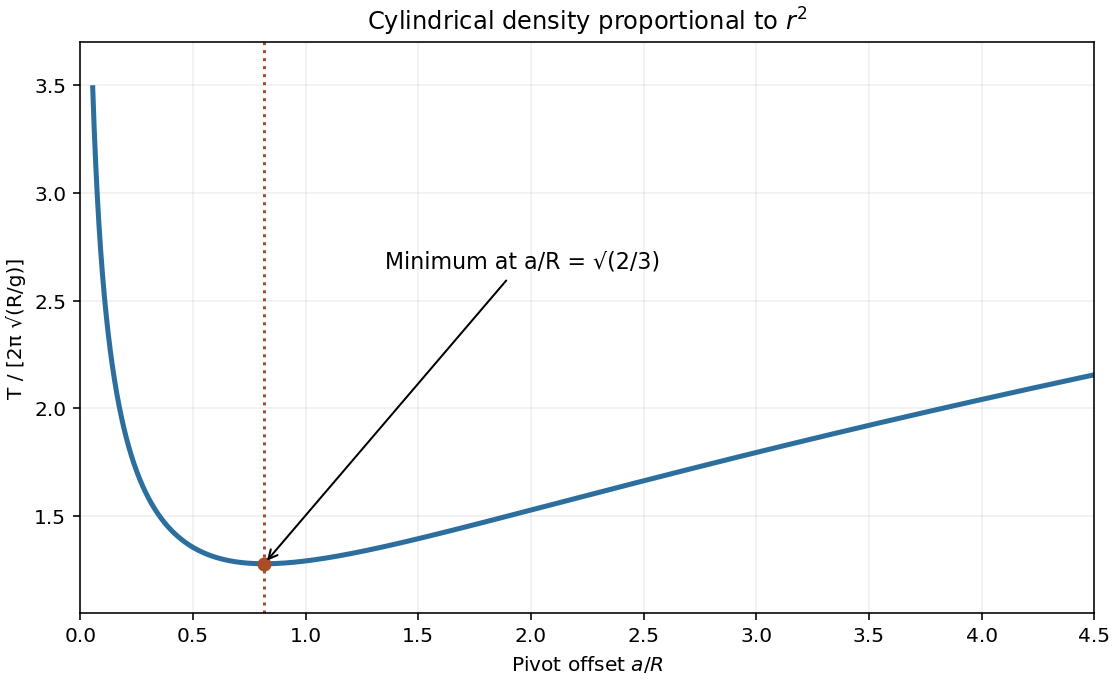
Since , the density coefficient has units . The density-power cylindrical moment of inertia follows from cylindrical shells:For an offset pivot, the physical pendulum equation is . At small amplitude,For the minimum-period offset of a physical pendulum, minimizing is equivalent to minimizing . Its derivative vanishes atThe second derivative is positive. The period diverges as near zero and grows as for large offset, giving one minimum. This assumes the stated ideal pivot can pass inside the body; an externally constrained pivot would restrict the allowable a. [ref]


For the stated standard configuration, the Lorentz transformation isDifferentiate along the moving object's worldline and divide by to obtain the velocity-addition formula:For a receding source, two emissions separated by proper time occur apart in S. The second signal travels an additional distance , so its reception interval is . Hence the longitudinal relativistic Doppler effect isThe inverse velocity transformation for the forward throw givesThe ball approaches the stationary receiver, so its forward light is blueshifted. The received wavelength is , in the ultraviolet. The stated monochromatic emission is outside the visible band. Other reflected or emitted frequencies have not been specified. [ref]
University Physics Volume 3 by Samuel J. Ling and others. §5.7, longitudinal light Doppler shift and approach/recession signs
Articles by others on the same topic
There are currently no matching articles.