Comparing with the standard wave equation gives the shallow-water wave speedTwice differentiating the proposed standing wave multiplies its spatial factors by and , and its temporal factor by . It solves the wave equation precisely whenTo obtain the local gravitational potential energy, integrate through a water column of height and unit horizontal area:The time averages are and . ThusThe constant is retained because the specified zero of gravitational potential is the tank bottom. This is local time-averaged potential energy, not the sum of potential energy and kinetic energy.
The no-normal-flow wall conditions are Neumann boundary conditions. Differentiating the cosine factors at the opposite walls givesNegative integers give the same cosine modes. The formal case has : it is a uniform change of the mean level, not a finite-frequency oscillation. In a closed tank with fixed water volume even that mean-level change is excluded from the oscillatory disturbance.
Since , the lowest finite frequency is the mode :It is uniform across the shorter direction, has opposite-sign displacement antinodes at the two ends of the longer direction, and a displacement node midway along it.
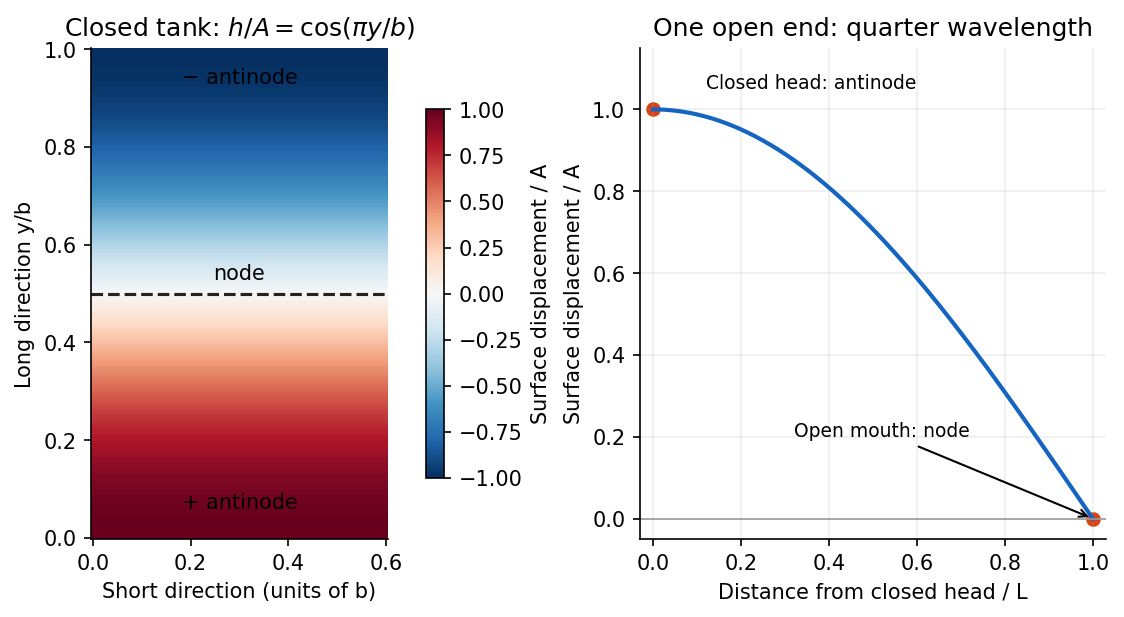

For the open-ended Bay of Fundy model, approximate the ocean mouth as a displacement node and the closed head as an antinode. The fundamental is a quarter-wave basin resonance, so its wavelength is andTaking a roughly -hour semidiurnal tide gives . Using the principal lunar period of approximately gives . The idealized estimate is therefore about . The lunar period is half of a roughly -hour -minute lunar day.[ref]
About Harmonic Constituents by National Oceanic and Atmospheric Administration. Examples M2 and S2: two lunar peaks per 24 hours 50 minutes, compared with two solar peaks per 24 hours
Articles by others on the same topic
There are currently no matching articles.