Comparing with the standard wave equation gives the shallow-water wave speedTwice differentiating the proposed standing wave multiplies its spatial factors by and , and its temporal factor by . It solves the wave equation precisely whenTo obtain the local gravitational potential energy, integrate through a water column of height and unit horizontal area:The time averages are and . ThusThe constant is retained because the specified zero of gravitational potential is the tank bottom. This is local time-averaged potential energy, not the sum of potential energy and kinetic energy.
The no-normal-flow wall conditions are Neumann boundary conditions. Differentiating the cosine factors at the opposite walls givesNegative integers give the same cosine modes. The formal case has : it is a uniform change of the mean level, not a finite-frequency oscillation. In a closed tank with fixed water volume even that mean-level change is excluded from the oscillatory disturbance.
Since , the lowest finite frequency is the mode :It is uniform across the shorter direction, has opposite-sign displacement antinodes at the two ends of the longer direction, and a displacement node midway along it.
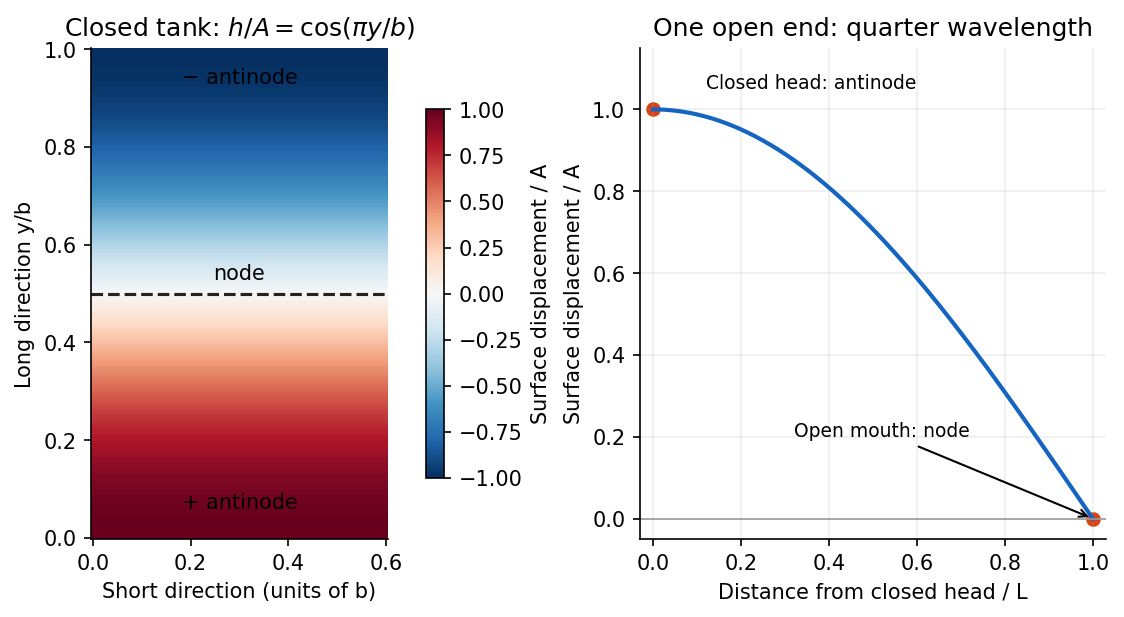

For the open-ended Bay of Fundy model, approximate the ocean mouth as a displacement node and the closed head as an antinode. The fundamental is a quarter-wave basin resonance, so its wavelength is andTaking a roughly -hour semidiurnal tide gives . Using the principal lunar period of approximately gives . The idealized estimate is therefore about . The lunar period is half of a roughly -hour -minute lunar day.[ref]
About Harmonic Constituents by National Oceanic and Atmospheric Administration. Examples M2 and S2: two lunar peaks per 24 hours 50 minutes, compared with two solar peaks per 24 hours
This estimate treats the mouth as an ideal open boundary and replaces the real basin by a uniform depth. The supplied large tidal height motivates resonance; it is not enough by itself to determine damping or an amplification factor in this model.
Snell's law is , with angles measured from the interface normal. The Huygens-Fresnel principle explains it by constructing the transmitted wavefront from secondary wavelets: during the same time interval, distances travelled in the two media are proportional to and . The geometry of the advancing plane wavefront then gives .
For incidence from index into vacuum, the transmitted angle is . The ray bends away from the normal, so its positive deviation isFor ,Thus the graph rises monotonically from zero to a finite endpoint with a vertical tangent:At the endpoint the transmitted ray grazes the interface. Beyond the critical angle for total internal reflection, no propagating transmitted ray exists and total internal reflection occurs.
Inside a prism, the two ray angles with the face normals sum to its apex angle. For the equilateral cross-section, they are and . The entry deviation equals the corresponding exit deviation under ray reversal. Adding the two changes of direction therefore givesThis is symmetric about . Symmetry alone gives a stationary point; to establish that it is a minimum, differentiate once more:within the transmitted-ray interval. The sum is therefore strictly convex, andThese expressions require for a non-grazing path through both faces; is a grazing limit, and admits no such two-face transmitted path. More explicitly, both internal angles must be at most , which is possible only if .
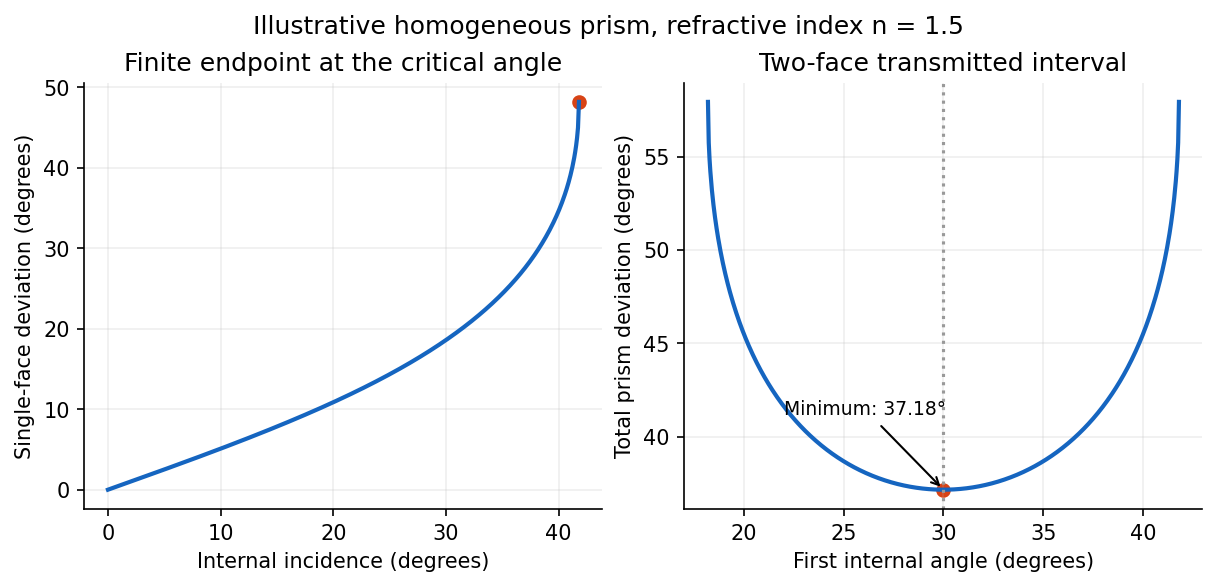
Single-interface deviation and the symmetric minimum of an equilateral prism, illustrated for index 1.5
. Details. 
Atmospheric hexagonal ice crystals can present pairs of faces with a angle, acting as small prisms. Their orientations turn the minimum-deviation cone around the Moon into an optical halo. No transmitted ray of this family is deflected less than the minimum deviation of a prism. Moreover, near the minimum, is quadratic in the departure from the symmetric ray, so a range of incident directions is compressed into a small outgoing angular range. This caustic makes the inner rim sharp and bright, with the ray density decreasing farther outside. The common 22-degree halo has an angular radius near about either the Sun or Moon, hence a diameter near .[ref]
Articles by others on the same topic
There are currently no matching articles.