The surface tension has dimensions , while and . ConsequentlyMatching the dimension of height gives , so . Dimensional analysis fixes this exponent but cannot determine a dimensionless prefactor or a contact-angle dependence.
Using the convention , the series RLC circuit has complex impedanceAt the stated frequency, and . ThusThe vector is in the resistance–reactance plane. Positive reactance means that the net circuit is inductive and current lags voltage. With the alternative convention the imaginary signs reverse, while the magnitude and physical phase relationship agree.
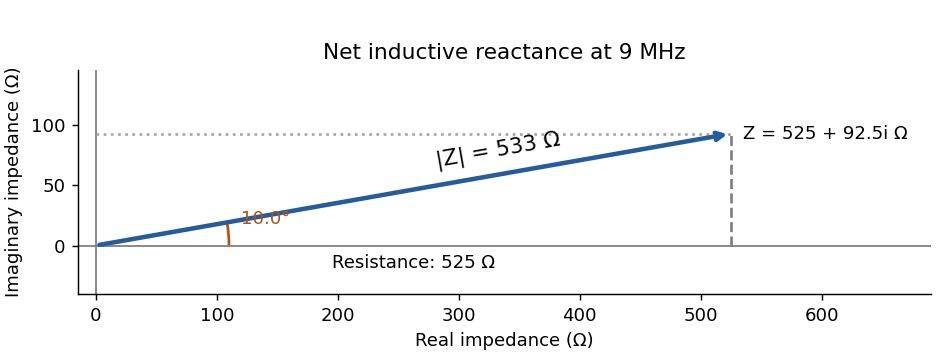
Series-circuit impedance in the resistance–reactance plane
. Details. 
The string's no-slip condition gives . Conservation of mechanical energy from release to the stated height drop yieldsSolving for the spool's moment of inertia,The axle does no work because its point of application is fixed, and the ideal string and axle introduce no losses. The spool mass is not needed to infer from this energy measurement.
The slit spacing is . At normal incidence, the diffraction grating maxima satisfy . ThereforeThe third order would require , so it cannot propagate. At fixed order and spacing, a longer wavelength requires larger . Green light has a larger first-order diffraction angle than blue light.
At closest approach the velocity is tangential. The conserved specific orbital energy and specific angular momentum areThe negative energy gives an elliptic orbit. Its semi-major axis isSince ,This treats the star as fixed, appropriate to . Equivalently, equate the energy at the two turning points using . The planet mass cancels; a circular-orbit relation would be inappropriate here.
Articles by others on the same topic
There are currently no matching articles.