A normal mode is a small motion in which all coordinates oscillate at one common angular frequency with fixed relative amplitudes. For conservative linearized motion, these are eigenvectors of the mass-weighted stiffness matrix.
All three springs are initially stretched from to , giving equal tension and zero resultant force on each mass. This prestress is essential for the transverse modes found below.
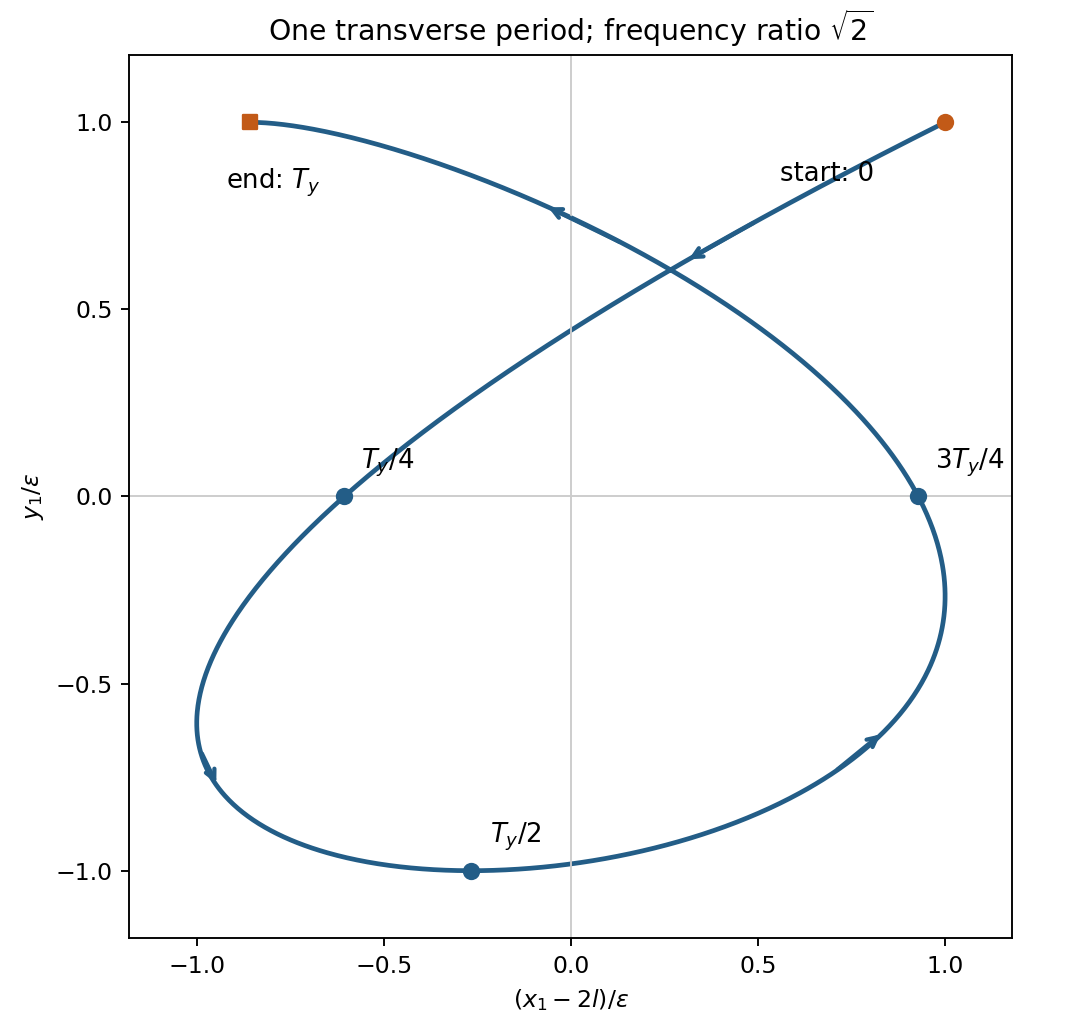
For the final mixed-axis trajectory of a prestressed spring pair, the initial displacements excite only the symmetric mode in each direction. Therefore, to first order in ,The second mass has the same displacements about . Over the first transverse period , write :The trajectory is not closed after , because the frequency ratio is . It ends at approximately in these scaled coordinates rather than .
Prestressed spring trajectory
. Original first-transverse-period trajectory of the first mass. Markers distinguish initial and final points and intermediate quarter-period positions; both normal-coordinate amplitudes equal the release displacement. Details.
Let be longitudinal displacements. Hooke's law givesThe symmetric and antisymmetric eigenvectors are respectively and , soOrdinary frequencies are these values divided by .
The transverse stiffness of a stretched spring follows because a spring of length develops transverse force to first order. Its extension changes only at second order, so the leading transverse stiffness comes from its existing tension, not from that extension change. Here , givingThe mode vectors are again and . Treating the springs as unstretched would incorrectly remove this linear restoring force.
Articles by others on the same topic
There are currently no matching articles.