Original paper: Public original PDF, physical pages 427–434; cover on page 427 and questions on pages 428–434.
The probability density is proportional to , not to the complex amplitude itself. For equal small intervals approached from inside the support,
Wavefunction normalization cancels in the ratio of integrals:A normalized version of the specified wavefunction is on its support.
For an elastic eccentric impact of a thin disc, take upward velocity as positive and let be the short upward impulse. The disc's moment of inertia about a horizontal diameter is . With impact offset ,The contact point has upward velocity . Unit restitution against the fixed post requires that velocity to be , soSince , and the centre's instantaneous speed is zero. The disc rotates with ; its rotational kinetic energy equals the entire initial energy. Gravity's impulse during the impact is neglected. Using the polar-axis moment of inertia would describe the wrong rotation axis.
Treat the repeated angles as independent measurements of one fixed angle. Their sample mean, sample standard deviation and standard error of the mean areFor , uncorrelated standard uncertainties giveInterpreting the stated 1% amplitude accuracy as a standard uncertainty,Use radians in the derivative. This is uncertainty in the result using the mean angle, not the spread of individual angle measurements; the latter convention would use and give about . An accuracy bound or systematic angular calibration error would require a different uncertainty model.
The photon wavelength is . The exact half-period zone radii for incident plane waves are chosen so that the path to the axial focus increases by per zone:Transmit alternate zones and block the others, with . For , . The number of zones is a design choice: 100 zones give outer radius and outermost width about . Adjacent open zones then arrive in phase at the principal focus.
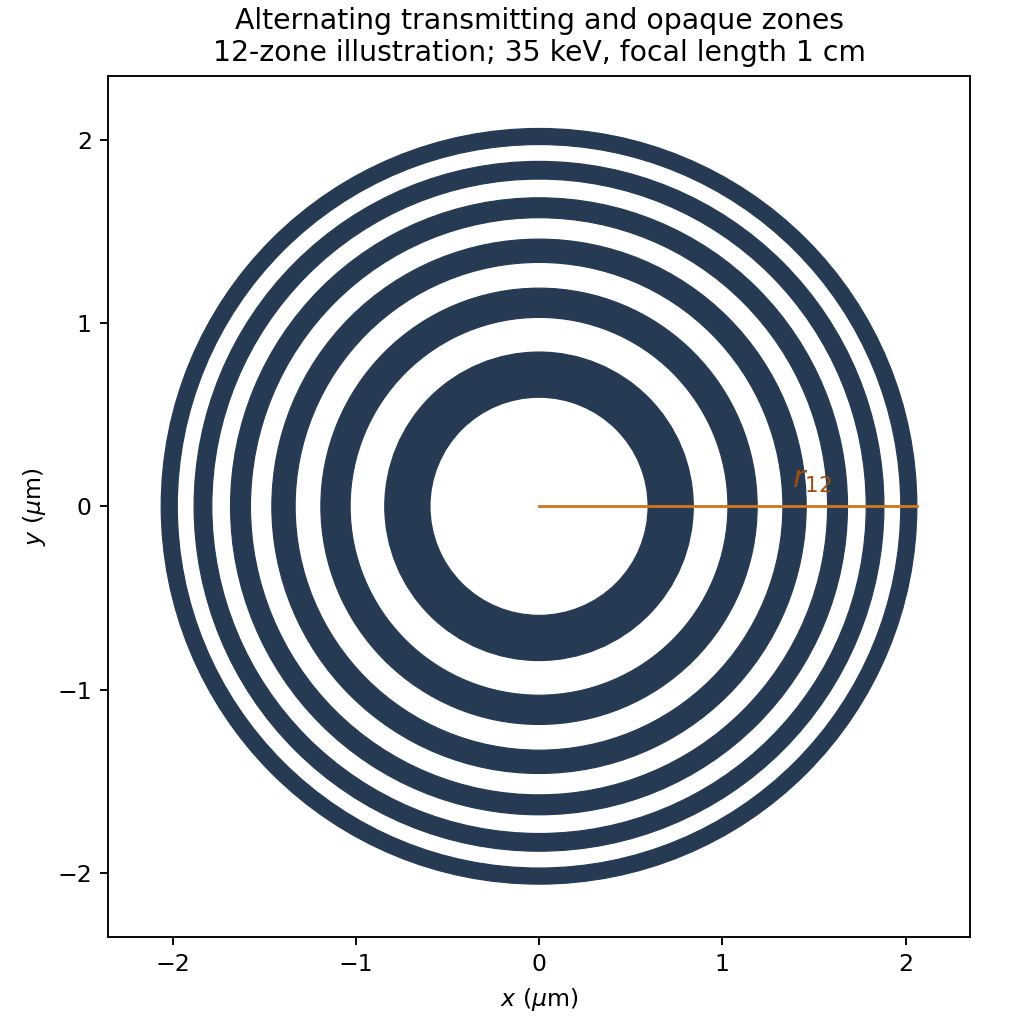

The blocking material must be sufficiently opaque at 35 keV; no attenuation coefficient or fabrication thickness is specified. A binary amplitude plate also has zero-order transmission and other odd-order foci, so an aperture/order stop may be needed. The principal focal length is chromatic, varying as for fixed radii.
The geostationary gravitational clock gain uses only the potential contribution, as requested. In the weak field, and . The geostationary radius follows from . Taking with , and sidereal day gives .The satellite clock gains time because it is at higher gravitational potential. This is not the combined gravitational-plus-kinematic correction; the orbital and surface rotational velocities are deliberately outside the requested potential contribution.
For a reversible refrigerator, zero net entropy production gives . ThusThe necessary work is . Irreversibility increases the heat dumped to the surroundings; is the minimum work, not the requested rejected heat.
For the usual nonrelativistic dispersion, the three-dimensional density of states is . Filling all states through the Fermi energy givesDegeneracy factors cancel. More generally gives ; an ultrarelativistic gas would give . The nonrelativistic result is the standard massive ideal-gas interpretation.
Prefer molecular rotational spectroscopy or rovibrational spectroscopy, because nuclear masses enter their reduced mass directly. For an isotopologue with nuclear reduced mass ,Isotope substitution therefore produces appreciable shifts and distinct sets of lines, assuming the same electronic potential and approximately unchanged bond length and force constant. A suitable heteronuclear molecule can provide electric-dipole rotational/vibrational spectra; other molecules may require Raman spectroscopy.
Atomic electronic energies instead depend on the electron-nucleus reduced mass , whose fractional change is suppressed by . High-resolution atomic spectroscopy can still detect isotope shifts, including nuclear-size and many-electron mass effects; it is not intrinsically incapable of identifying isotopes. Molecular spectra generally offer the stronger mass sensitivity for this purpose.
The vacuum wave equation gives . The cutoff frequency is . In a lossless empty guide, energy travels at group velocity,The larger phase velocity is not the speed of energy transport.
For a cylinder of radius in unbounded two-dimensional incompressible potential flow, a velocity potential is . It givesOn the surface . The points nearest the banks are the sides perpendicular to the stream, , hence the speed is at each. This is the inviscid outer-flow speed; a real no-slip boundary layer has zero velocity at the material surface. The small-radius/wide-river assumption neglects bank effects.
A normal mode is a small motion in which all coordinates oscillate at one common angular frequency with fixed relative amplitudes. For conservative linearized motion, these are eigenvectors of the mass-weighted stiffness matrix.
All three springs are initially stretched from to , giving equal tension and zero resultant force on each mass. This prestress is essential for the transverse modes found below.
For the final mixed-axis trajectory of a prestressed spring pair, the initial displacements excite only the symmetric mode in each direction. Therefore, to first order in ,The second mass has the same displacements about . Over the first transverse period , write :The trajectory is not closed after , because the frequency ratio is . It ends at approximately in these scaled coordinates rather than .
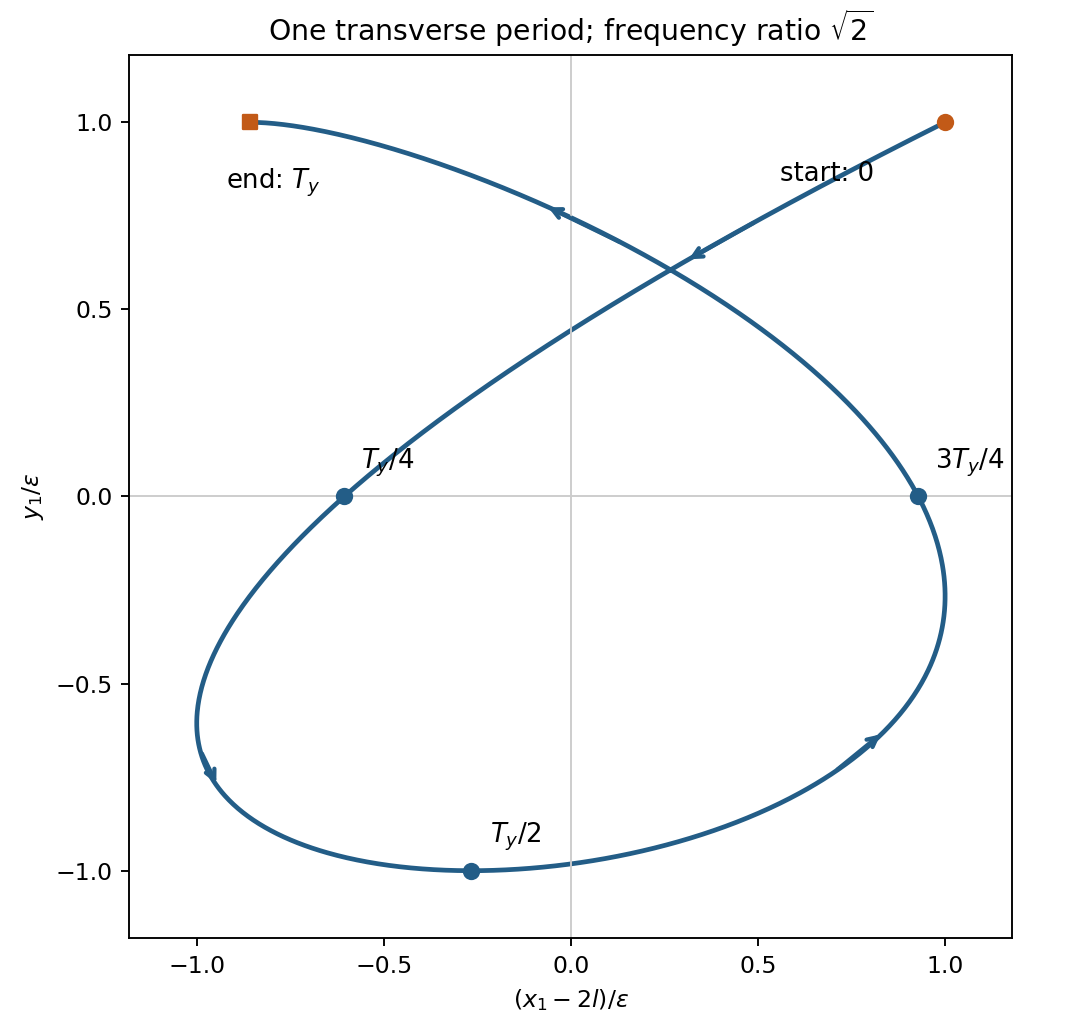
Prestressed spring trajectory
. Original first-transverse-period trajectory of the first mass. Markers distinguish initial and final points and intermediate quarter-period positions; both normal-coordinate amplitudes equal the release displacement. Details.
Let be longitudinal displacements. Hooke's law givesThe symmetric and antisymmetric eigenvectors are respectively and , soOrdinary frequencies are these values divided by .
The transverse stiffness of a stretched spring follows because a spring of length develops transverse force to first order. Its extension changes only at second order, so the leading transverse stiffness comes from its existing tension, not from that extension change. Here , givingThe mode vectors are again and . Treating the springs as unstretched would incorrectly remove this linear restoring force.
The first-order grating equation is , so , about lines per millimetre. For equally illuminated lines,Principal maxima stay at the same angles, their peaks scale as for fixed illumination per line, and their angular widths shrink as . The resolving power of a diffraction grating is . Thus first order needs and illuminated width .
The grating dispersion follows by differentiation: . With a detector centred on the chief ray, one pixel corresponds approximately toThis exceeds the nominal grating width. The practical resolution scale is therefore a few nanometres; two-pixel sampling gives about . Exact resolvability also depends on slit width and image sampling. Taking the detector coordinate as about the original axis instead changes the single-pixel estimate only to .
Use a lock-in amplifier for phase-sensitive detection: chop or otherwise modulate the source before the entrance slit, retaining a synchronous reference. At each grating setting amplify the photodiode output, multiply it by a reference and low-pass filter. For a signal and reference , the low-pass output is ; quadrature demodulation also recovers . Choose the modulation frequency above slow drift while within the source/detector bandwidth and away from strong electrical interference. Average for many cycles before changing the grating setting.
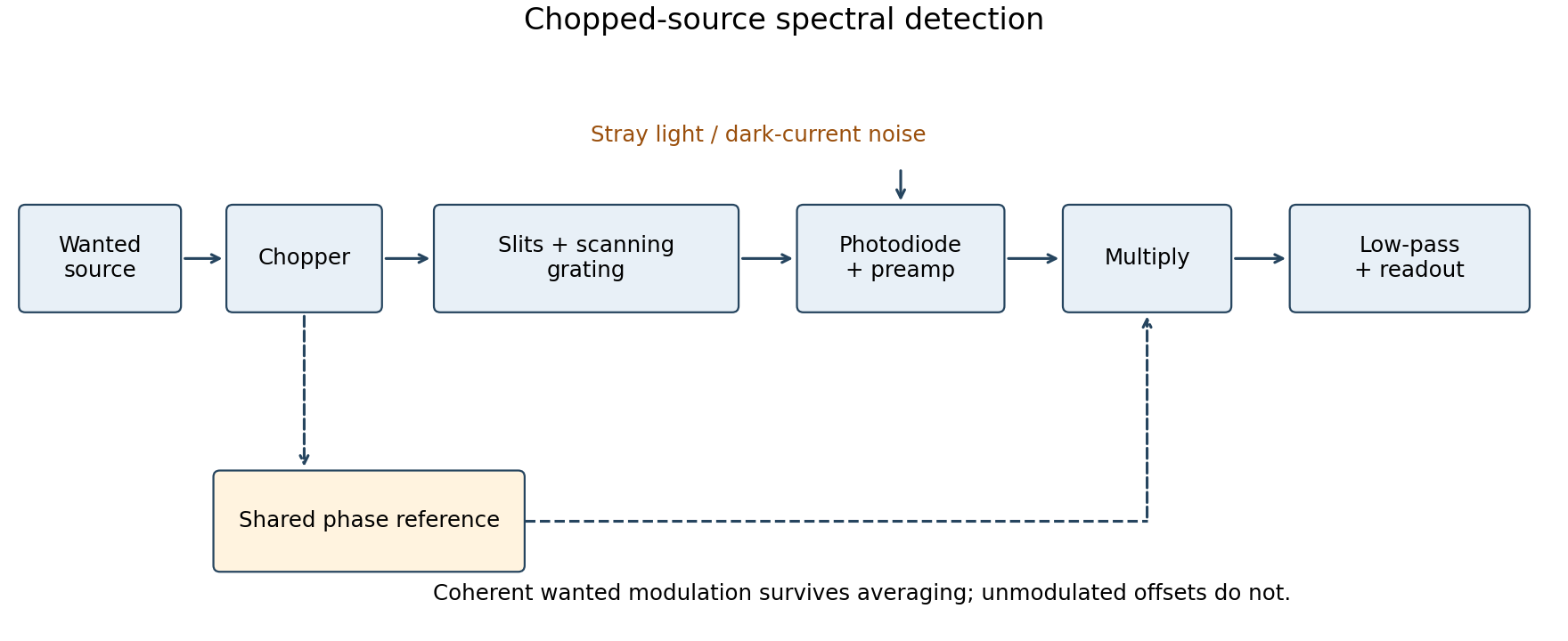
Chopped-source spectral detection
. Original functional diagram separates modulation of the wanted source from unmodulated detector dark current and stray light. A shared reference drives demodulation; low-pass averaging sets the detected bandwidth. Details.
This rejects steady backgrounds and reduces low-frequency noise through narrow-band detection. It does not remove random dark-current/stray-light shot noise within that bandwidth, nor a background modulated coherently with the source. The chopping geometry must therefore distinguish wanted light from stray paths.[ref]
About Lock-In Amplifiers by Stanford Research Systems. physical pp. 1–2: phase-sensitive multiplication, low-pass filtering, bandwidth and quadrature outputs
With microstate energies held fixed when differentiating,Since ,The canonical ensemble fixes volume and particle number, and any other external Hamiltonian parameters. Thus the derivative is ; pressure-fixed fluctuations would naturally involve enthalpy in a different ensemble.
The translational and two-level energy variance follows because translation and internal states factorize for this dilute classical gas:Differentiating twice yieldsThe terms are independent translational and two-level binomial variances. At , excitation freezes out exponentially and translation dominates. At , the internal variance tends to while the translational variance grows as ; the internal heat capacity consequently tends to zero. Fractional total-energy fluctuations are of order for large . The low-temperature statement presumes translation is still nondegenerate; at strictly zero temperature the classical-gas model fails.
Use energy units , , and . The soft-photon resonant capture threshold follows from four-momentum conservation:For fixed proton energy the left side is largest at head-on incidence. Its threshold is . Combining that with givesEquality is allowed for a head-on photon. Here , soA very soft photon needs an enormous proton Lorentz factor to reach the specified invariant mass. A true thermal photon distribution and a finite-width resonance would smear this monoenergetic threshold.
For , , whereas , so production is impossible. For each nonzero angle, sufficiently large energy is possible, and givesTo find the maximum deflection in soft-photon capture, note that the final particle's transverse momentum comes entirely from the photon:Writing , maximization gives and the interior maximum . Therefore, to the same extraordinarily accurate ultrarelativistic order,The neglected relative corrections are of order and , both around . The final particle is effectively collinear with the proton despite a large photon incidence angle.
In the weak-field Zeeman effect, spin-orbit coupling keeps good and a level shifts by . At fields large compared with fine-structure coupling but still within the linear electronic Zeeman approximation, and decouple: the Paschen-Back effect gives shifts . Electric-dipole transitions obey , in that limit, recovering an orbital triplet pattern. Intermediate fields mix the coupled states.
For the weak-field sodium D-line Zeeman pattern, the given Landé g-factor formula givesAllowed photon shifts are with . ThusThese are the four- and six-component patterns. Both and components are represented, so an observation strictly along the field, which removes emission, would not show this complete pattern. Hyperfine structure is neglected.
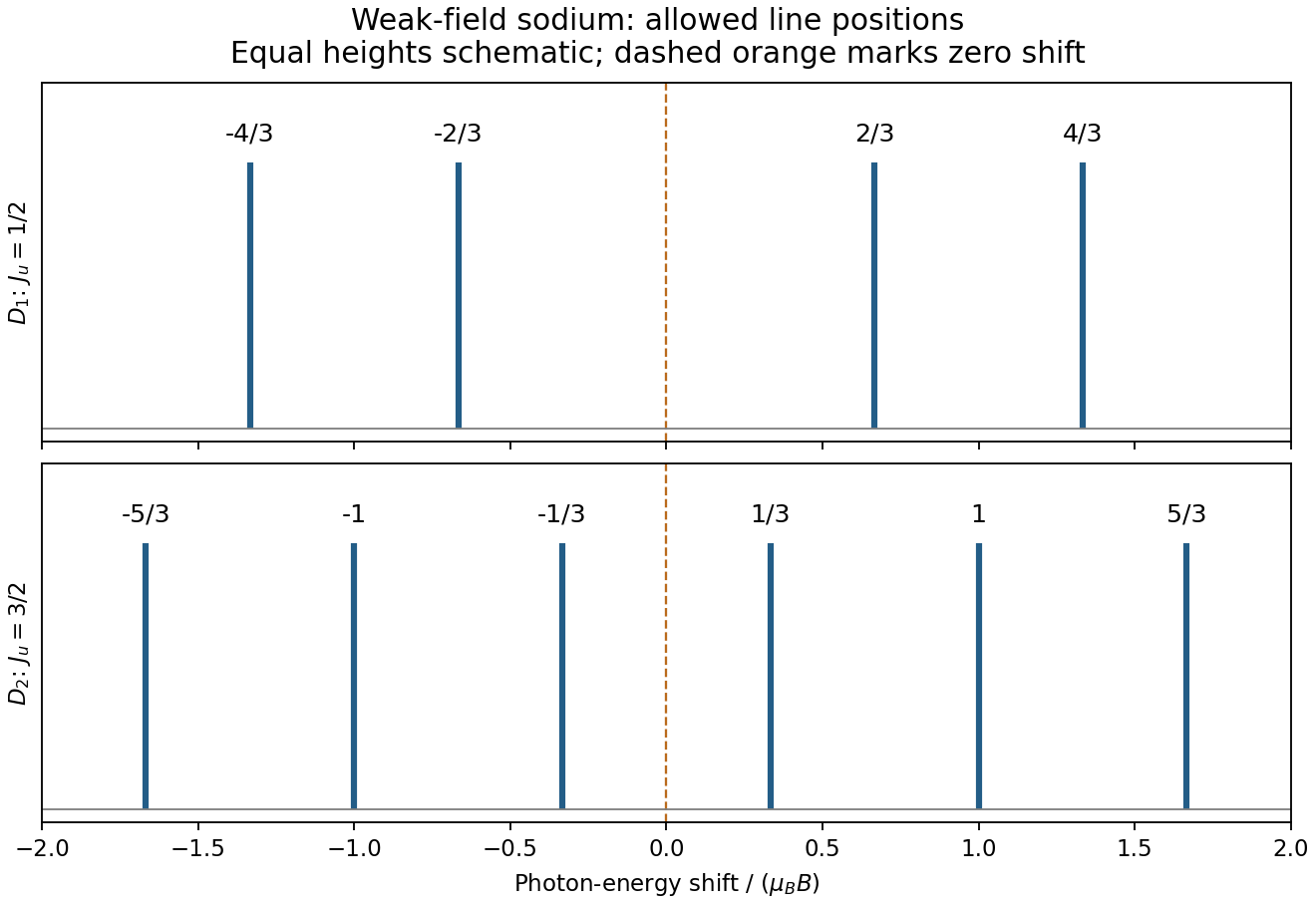
Calculated sodium Zeeman shifts
. Original stick positions calculated from selection rules and Landé factors, in units of magnetic energy. Equal plotted stick heights are illustrative and do not assert equal transition intensities. No source spectral figure is copied. Details.
To determine the magnetic field from a Zeeman diagram, the unsplit separation provides its energy scale:The smallest adjacent split spacing is approximately of that separation in the sketch. ThereforeThis is a graphical estimate; the drawing does not warrant high precision. Its splitting energy is small compared with , consistent with the weak-field approximation.
For Doppler resolution of a Zeeman pattern, thermal velocities give Gaussian Doppler broadening with widthAt , the photon-energy FWHM near is . Equating the smallest adjacent Zeeman spacing to this width gives for loss of individually resolved components. There is no sharp Gaussian resolution threshold; using whole-pattern width instead gives a smaller field of order – for complete disappearance into a single envelope. Instrumental and collisional broadening would also affect the estimate.
For the quantum harmonic oscillator, using , direct multiplication givesThe commutators areThus each ladder operation shifts energy by one quantum. The ladder operator norms and , with conventional phases, giveLet . In position space , so becomes . Normalizing and then applying givesTheir overlap vanishes because is odd on the full real line; the Gaussian second moment verifies .
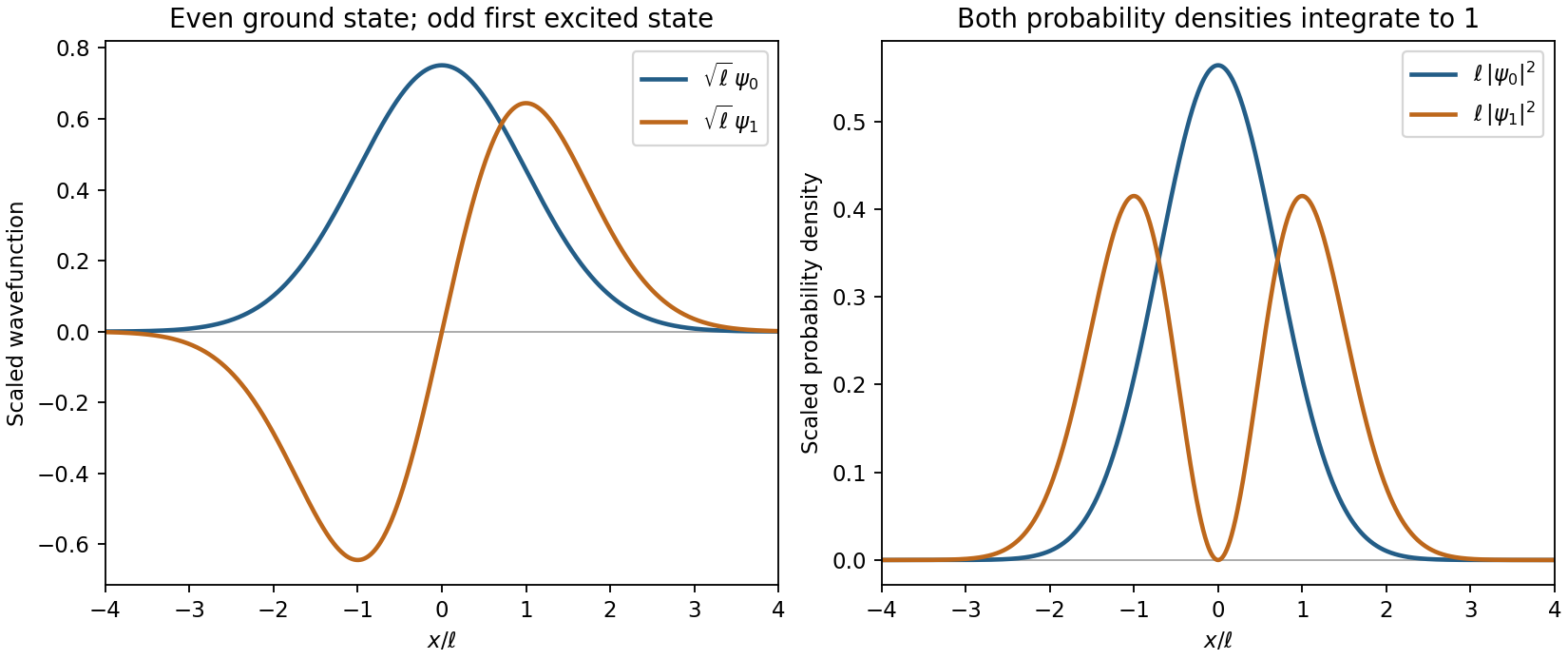
Oscillator ground and first states
. Original normalized oscillator wavefunctions show even ground-state parity, odd first-excited parity and one interior node in the excited state. Details.
For a normal from medium 1 to 2, the magnetic boundary conditions areWithout a free surface current, tangential is continuous. To obtain the magnetization of a permeable sphere of radius and permeability , choose magnetic scalar potentialsTangential continuity gives , and normal continuity gives . HenceThe fields are uniform inside. For negative susceptibility, magnetization is antiparallel to the applied field; the scalar formula retains its negative sign.
For a small weakly magnetic body, the induced magnetic energy is . The factor one-half accounts for building the induced moment. The vertical force is . Balancing gravity therefore givesA diamagnet needs a field decreasing in magnitude with height for an upward force. For diamagnetic levitation in an inverse-height field,The force falls as , giving a restoring vertical derivative at equilibrium. Full lateral stability would require the transverse field geometry, which is not specified.
The far fields obey . The radial component of their Poynting vector is . Averaging and integrating givesFor a small isotropically polarizable particle, and incident intensity is . Thus the total Rayleigh scattering cross-section isEach incident linear polarization gives the same integrated power; averaging unpolarized light does not add another factor of two. The scalar real polarizability approximation neglects absorption and molecular anisotropy.
For Rayleigh attenuation from refractivity in dilute air, polarization density is . Consequently and, with and ,The ideal-gas number density at the supplied pressure and temperature is , yielding . For an explicit representative visible wavelength ,Direct-beam intensity follows . Equivalently . Its strong wavelength dependence gives roughly – across – if refractivity is held fixed. This is a uniform-density dry-air scattering estimate, not absorption or transmission through a vertically stratified atmosphere; aerosols and molecular depolarization corrections are outside the given model.
Articles by others on the same topic
There are currently no matching articles.