The Stefan–Boltzmann law gives the radiated luminosityFor radiative mass loss at fixed luminosity, using mass-energy equivalence, the mass-loss magnitude and one-percent time areThe numerical constants are the external CODATA 2014 and ; years here mean 365.25 days.[ref]
CODATA recommended values of the fundamental physical constants 2014 by National Institute of Standards and Technology. Stefan-Boltzmann constant and vacuum light speed
This estimates radiative mass loss with the supplied radius and temperature held constant. It does not predict a real stellar lifetime or include solar-wind mass loss.For this molecular escape-speed temperature estimate, . Equating this to the surface escape-speed square givesThis evaluation keeps the paper's and , and uses externally documented , and .[ref]
Earth Fact Sheet by National Aeronautics and Space Administration. Bulk parameters: gravitational parameter GM
[ref]CODATA recommended values of the fundamental physical constants 2014 by National Institute of Standards and Technology. Atomic mass constant and Boltzmann constant
The corresponding escape speed is about .This is the requested speed-scale comparison. Atmospheric escape can occur from the high-speed tail at lower temperature; molecular dissociation and ionization also prevent treating an actual gas at this temperature as unchanged neutral nitrogen molecules.
For the potential of an inverse-radius spherical charge density, assume there is no additional point charge at the origin and choose . The enclosed charge is for , and outside. Gauss's law then givesIntegrating the field inward from infinity,The potential and its first radial derivative are continuous at , since there is no surface charge there. The integrable density singularity has a finite potential limit .
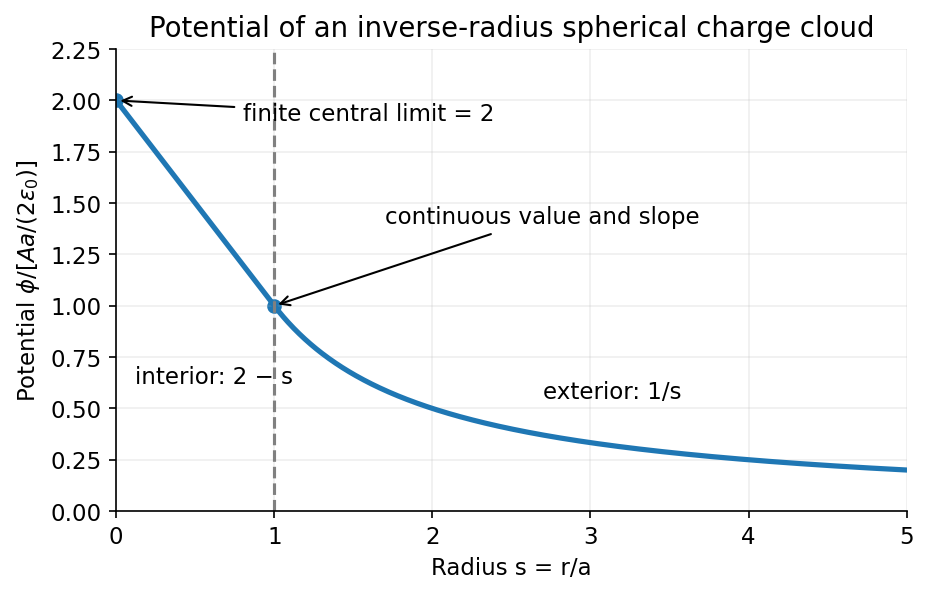
The potential falls linearly inside the inverse-radius charge cloud and joins a reciprocal-radius exterior tail
. Source. Details. 
For the ultrarelativistic magnetic bending radius, the Lorentz force supplies the transverse momentum change, so . At this energy the proton is ultrarelativistic, giving andThe electronvolt-to-joule conversion cancels the elementary-charge factor numerically. This uses external CODATA light speed and charge definitions.[ref]
CODATA recommended values of the fundamental physical constants 2014 by National Institute of Standards and Technology. Vacuum light speed and electronvolt conversion
If the stated beam energy means total energy, ; if it means kinetic energy, . Either interpretation gives the quoted radius at the precision of the supplied numbers.For contact loss on a smooth sphere, let be the angle from the upward vertical. In the limit of an infinitesimal initial displacement, conservation of energy gives . The inward radial equation isContact is lost at , so and . The distance travelled along the sphere is thereforeThe vertical drop is instead ; it is not the requested arc length. Exact rest at the unstable top would persist in the ideal mathematical solution, so the infinitesimal-displacement limit in the question is essential.
For the focal length of a rotating liquid mirror, consider steady rigid rotation at angular frequency . The free surface is an equipotential of . HenceA paraboloidal mirror has , givingThe numerical estimate uses the conventional standard acceleration , rather than an asserted local measurement or a recovered handbook entry.[ref]
NIST Guide to the SI, Footnotes by National Institute of Standards and Technology. Footnote 23: conventional standard acceleration of free fall
The mercury density cancels; the ideal surface shape follows from gravity and rotation.The first ideal linear polarizer transmits half of an unpolarized beam. Each subsequent polarizer is from the preceding transmitted polarization, so Malus's law givesIntensities, rather than coherent field amplitudes for different input polarization components, are averaged for the unpolarized beam. The output is polarized along the last polarizer's axis.
The wave numbers before and after the drop are and . Continuity of and at the finite step givesThus the reflected probability flux fraction isThe transmission probability is , rather than simply . Reflection is possible at a downward potential step even though both sides are classically allowed.
For hyperfine coupling for a spin-one nucleus, let the electron spin be and the nuclear spin . First couple , giving , then , giving .
| Allowed | ||
|---|---|---|
For each , the projection is ; electron projections similarly satisfy . Summing gives 18 states for and 30 for , agreeing with .
Notation qualification: if the printed leading “2” denotes the principal quantum number, a hydrogenic bound state does not exist because ; a physical state needs . If a doublet term symbol or was intended, its leading 2 instead means , and the angular-momentum table applies without fixing . The answers above use the explicitly specified values, while retaining this ambiguity.[ref]
Quantum Mechanics by David Tong. Three-dimensional angular momentum and hydrogenic quantum-number restrictions
The fastest clearly resolved late oscillations occupy roughly – per cycle when compared with the major-tick spacing. Thus is of order – and the Nyquist–Shannon sampling theorem requiresA sampling rate of order is the estimated lower boundary for the plotted signal bandwidth; practical acquisition needs anti-alias filtering and margin. This is not a determination of LIGO's actual acquisition rate.[ref]
What the Nyquist Criterion Means to Your Sampled Data System Design by Walt Kester. MT-002: bandwidth-limited sampling and anti-alias filtering
The bit-depth requirements for waveform digitization need a specified precision. The numerical bit depth is underdetermined by the figure. If the digitizer covers a full-scale range and the required quantization step is at most , thenFor a uniform quantizer its ideal quantization-noise rms is approximately . No permitted quantization error, noise criterion or calibrated digitizer range is specified. The plotted reconstruction band does not itself define one. Therefore no unique finite bit count, or exact lossless digitization of an arbitrary real-valued waveform, follows from the supplied data.
Articles by others on the same topic
There are currently no matching articles.