The dilute Köhler curve follows because the Kelvin equation multiplies the planar-solution saturation pressure by the curvature correction. Combining it with Raoult's law therefore givesFor a dilute chemical solution and a small curvature correction, and . A first-order Taylor expansion givesThus the simplified Köhler theory relation isThe curvature term raises the required ambient vapor pressure; the solute term lowers it. These laws combine multiplicatively before linearization, so the displayed simplified relation is an approximation, not an exact identity.
For , differentiating the simplified Köhler theory curve givesThe derivative is positive below and negative above it, so is the Köhler activation radius, the unique maximum. At that point , givingThe curve crosses at , reaches at , and approaches from above as . Its formal divergence to negative values as is outside the dilute-chemical solution approximation; a finite dry solute core and composition-dependent properties must replace that extrapolation.
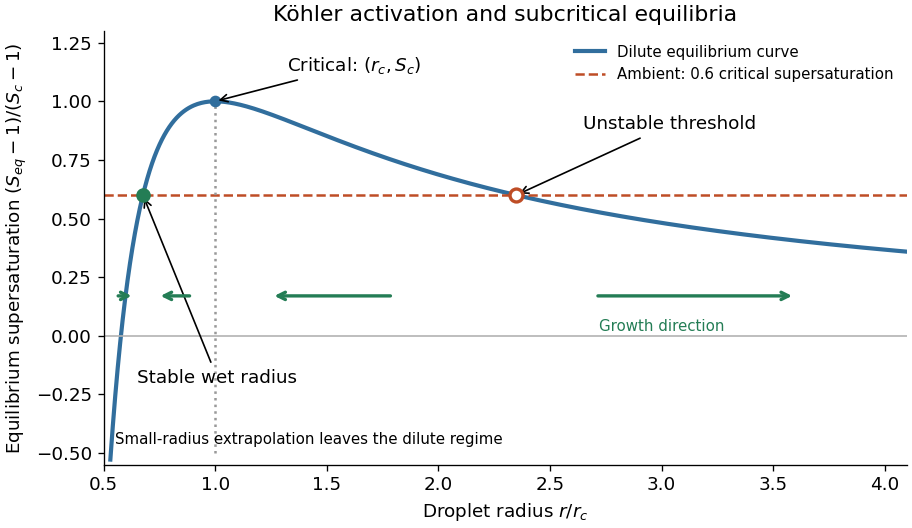
Köhler equilibrium curve and growth directions at subcritical supersaturation
. Details. 
Let be the ambient saturation ratio. There are two equilibrium radii: . Condensation occurs if ; evaporation occurs if . Therefore droplets with grow towards , while those with shrink towards . The smaller equilibrium is stable.
Above , droplets with still undergo evaporation and ultimately approach . Droplets with grow, and the larger equilibrium is unstable. Merely exceeding is therefore not sufficient for continued growth at subcritical ambient atmospheric supersaturation. For example, if , the two intersections have approximately and ; a droplet of radius undergoes evaporation. If instead , there is no equilibrium barrier in this approximation and droplets activate into growing cloud droplets.
Köhler theory explains activation of cloud condensation nuclei, rather than rapid production of atmospheric precipitation. Diffusion-controlled droplet growth is limited by diffusion of water vapor and removal of released latent heat; approximately is proportional to the ambient atmospheric supersaturation. It slows in radius and tends to narrow a droplet size distribution. The available water vapor, changing temperature and shared depletion of atmospheric supersaturation also invalidate unlimited growth at prescribed . Formation of rain-sized drops normally requires collision-coalescence, while colder clouds can additionally use cloud ice nucleation versus ice growth.
At the Köhler activation radius, the two coefficients satisfyConverting the atmospheric supersaturation to a fraction gives , not . Henceand the supplied curvature coefficient gives the temperatureThe coefficient and the stated radius consistently use a radius convention; replacing radius by diameter without changing the coefficient would introduce a factor-of-two error.
Articles by others on the same topic
There are currently no matching articles.