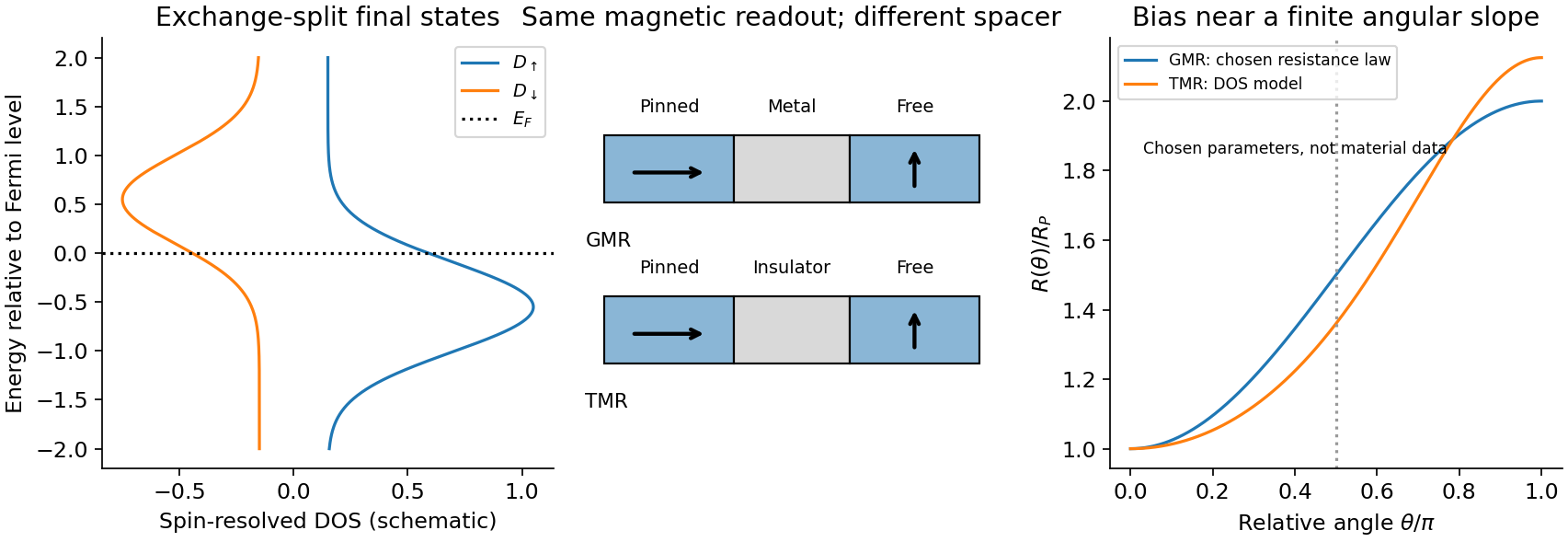
Exchange-split bands in a ferromagnet generally give a different spin-resolved density of states for each spin branch, and . If spin is approximately conserved across a multilayer, its two spin channels conduct in parallel. A spin valve combines a comparatively fixed reference-layer magnetization with a soft free layer that rotates in a small applied field. Its readout depends on the relative angle, not simply the absolute spin population. Biasing the layers near a perpendicular alignment gives a useful linear response instead of operating at the flat parallel/antiparallel extrema.
In giant magnetoresistance, a metallic spacer separates ferromagnetic layers. Spin-dependent bulk and interface scattering make their channel resistances unequal. The density of available final states influences scattering of more mobile states; however, a large total density of states does not by itself guarantee a large conductivity. The scattering-weighted spin-channel asymmetry also involves velocity and scattering matrix elements. In the elementary identical-layer two-current resistor model, let each magnetic layer have resistances in the two spin channels and neglect spacer resistance. Parallel moments give channels and , while antiparallel moments give in each channel. ThereforeOne favorable spin channel traverses both aligned layers efficiently; reversal removes that common easy path. A conducting spacer adds resistance, and spin mixing weakens the separate-channel approximation. The channel asymmetry is material/interface dependent, so positive magnetoresistance is not a theorem for every pair of different ferromagnets.[ref]
Spin dependent transport: GMR & TMR by Alain Schuhl and Daniel Lacour. §§2.1–2.2, pp.947–948, spin-dependent scattering and two-current construction
In tunnelling magnetoresistance, the spacer is an ultrathin insulator and current flows across a magnetic tunnel junction. In the simple spin-conserving density-of-states tunnelling magnetoresistance model, assume spin-independent matrix elements and low voltage. Available initial and final states giveWriting and , these become and . ThusThe effective tunnelling polarization can depend on the barrier and orbital symmetry, not just a bulk density-of-states sketch. Crystalline MgO junctions exploit symmetry-selective transmission, so the elementary product model is not a quantitative universal formula for them.[ref]
Giant room-temperature magnetoresistance in Fe-MgO-Fe junctions by Shinji Yuasa and others. 2004 publisher abstract, crystalline MgO junctions and large room-temperature response
Both devices convert a free-layer rotation into an electrical change. A useful approximate GMR interpolation is ; the elementary tunnelling model instead gives . The spin-valve small-field sensitivity is a chain rule,magnetic anisotropy, biasing and pinning set the rotation susceptibility. Conducting-spacer GMR usually offers low resistance and supports current-in-plane or current-perpendicular geometries. TMR uses perpendicular tunnelling, often offers a larger fractional signal and a larger resistance-area product, but demands uniform, stable barriers and has bias dependence and breakdown limits. Neither is automatically the better small-field sensor: heating, Johnson and low-frequency noise, domain switching, hysteresis and stability set the detectable field. Reverse sweep direction, vary current and temperature, and independently test reference-layer pinning to distinguish a reproducible magnetic signal from drift or heating.

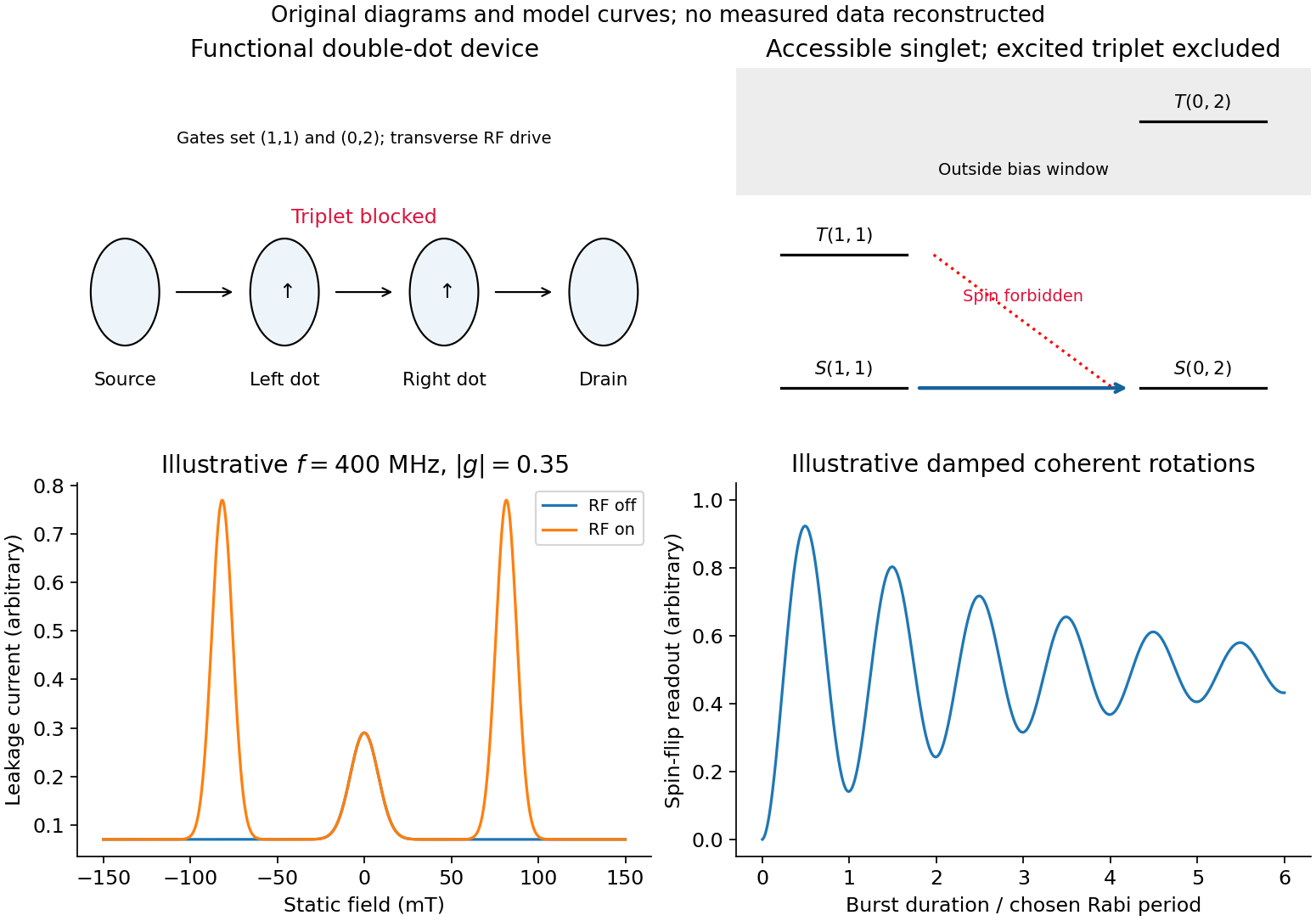
For a double quantum dot, write for occupation. Tune a bias window allowing the cycle . Two electrons in the same lowest orbital must form a singlet state by the Pauli exclusion principle. The triplet requires an excited orbital, with an energy cost above the accessible window. Approximately spin-conserving tunnelling transfers into , but cannot transfer into that singlet. Once a triplet loads, transport stops until spin relaxation or mixing occurs: this is Pauli spin blockade. The reverse bias can avoid trapping in this sequence, producing rectification. Coulomb charging sets the allowed occupancies, but the extra blockade is a spin-selection restriction, not merely an energetically forbidden charge state.
magnetically driven spin-blockade lifting uses electron paramagnetic resonance. A transverse oscillating magnetic field drives spin transitions atFlipping one spin in gives , which has a singlet component and can resume charge transfer. A perfectly uniform simultaneous rotation of two identical spins preserves their triplet character; effective relative rotation needs unequal local resonance conditions or another singlet–triplet mixing mechanism. In a real GaAs double dot, inhomogeneous nuclear fields can supply that difference. Hyperfine mixing, spin-orbit effects, cotunnelling and ordinary relaxation also produce leakage and must be distinguished from driven resonance.
A demonstrated device used surface Ti/Au gates to define two dots in a GaAs/AlGaAs electron gas below the surface. An insulated on-chip gold coplanar stripline supplied the oscillating magnetic field. With the dots biased in spin blockade, RF excitation produced current peaks at the two field polarities satisfying resonance. Peak positions varied linearly with frequency, giving . RF applied to a side gate instead gave negligible response, testing magnetic rather than electric excitation. Gate pulses and RF bursts further produced coherent spin-rotation oscillations in the charge readout.[ref]
An ideal isolated resonant spin has Rabi oscillation probability . For a linearly oscillating field of peak amplitude , the rotating-wave convention is . Repeated initialization, isolated manipulation and blockade-sensitive readout can therefore map a damped oscillatory singlet yield into an average current. Nuclear fluctuations, readout rates and dephasing change the envelope and contrast; an ideal sine squared is not a reconstruction of experimental data. Compare RF on/off, resonance tracking with frequency, drive-amplitude dependence and detuning controls. Current enhancement alone does not prove coherent rotations; the pulse-duration oscillations provide the further time-domain test.
Spin blockade and magnetic resonance
. Details. 
Articles by others on the same topic
There are currently no matching articles.