Charge carrier mobility measures weak-field drift speed per electric field. For electrons and electron holes,Both mobilities are positive, with SI units ; the opposite drift signs reflect the opposite carrier charges. In a simple isotropic relaxation-time model, electron mobility is and hole mobility is . These are momentum relaxation times, not the minority carrier lifetime for electron-hole recombination.
Scattering by phonons, ionized impurities and defects limits mobility. Increasing phonon populations commonly lowers mobility at high temperature; ionized-impurity scattering can dominate at low temperature and high semiconductor doping. Approximate addition of independent inverse relaxation times is the Matthiessen's rule. At sufficiently strong field, velocity saturation invalidates the constant-mobility drift law.
The Hall effect provides a measurement: a current-carrying bar in a perpendicular magnetic field develops a transverse voltage. In a one-carrier model and , combining the transverse voltage with longitudinal electrical conductivity. Multiple carrier types and scattering-dependent Hall factors require a more detailed interpretation.
Generation increases the mobile electron or hole populations; interband excitation creates an electron-hole pair. Thermal excitation and absorbed photons are important sources, and impact ionization can multiply carriers in a strong field. Ordinary single-photon interband absorption needs enough photon energy to bridge the band gap, with the required momentum balance.
Electron-hole recombination removes a pair. Radiative electron-hole recombination emits a photon, with simple rate ; trap-assisted electron-hole recombination uses localized defect levels and transfers energy to the lattice; Auger recombination transfers the electron-hole recombination energy to another carrier. The last process becomes especially important at high injection because its rate contains products such as and . The detailed band structure and available defects determine which channel dominates.
At thermal thermodynamic equilibrium, generation and electron-hole recombination continue at equal rates. For the simple radiative model the net electron-hole recombination rate is , enforcing the semiconductor mass-action law. Under weak excitation with the majority density nearly fixed, an excess minority density often decays as , defining its minority carrier lifetime.
A short light pulse followed by time-resolved electrical conductivity or luminescence measures the relaxation. Spatial diffusion, trapping and instrumental response must be separated from electron-hole recombination before identifying a single fitted decay constant with the intrinsic lifetime. These processes control photodetector response and light-emitting-device efficiency.
An n-channel MOSFET has two heavily n-doped source and drain regions in a p-type body, with an insulated gate above the intervening surface. A positive gate voltage first depletes surface electron holes and then induces an electron semiconductor inversion layer. Above threshold this layer connects source to drain. Gate voltage controls the channel charge through the oxide capacitance, while the insulating gate permits a very small steady gate current.
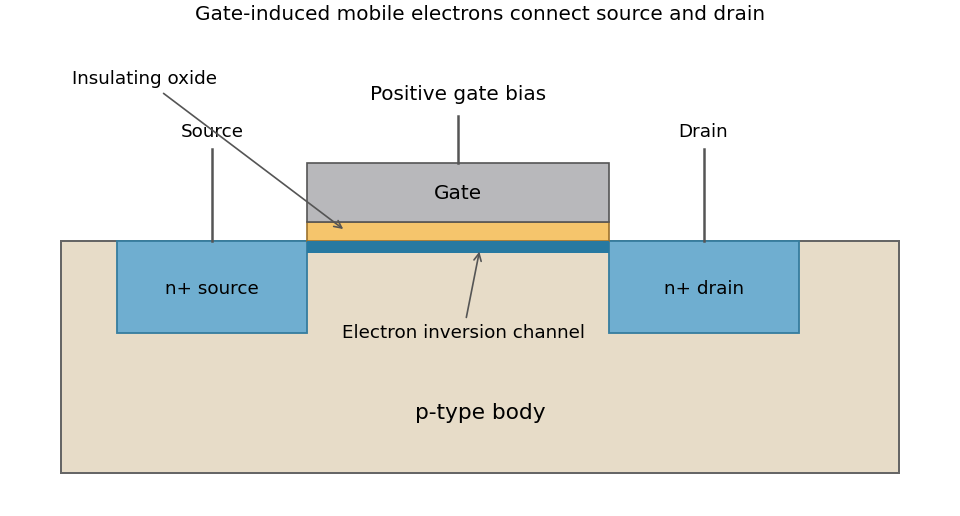

For the long-channel MOSFET current law, let be oxide capacitance per area, channel width and length, and use constant mobility . In the gradual-channel approximation,At larger drain voltage the ideal channel pinches off near the drain and the current saturates atCarriers still flow through the pinch-off region; pinch-off does not mean zero drain current. These formulas neglect channel-length modulation, short-channel effects and velocity saturation. A p-channel device reverses the carrier type and operating polarities. Gate control makes MOSFETs useful as electronic switches and amplifiers.
Articles by others on the same topic
There are currently no matching articles.