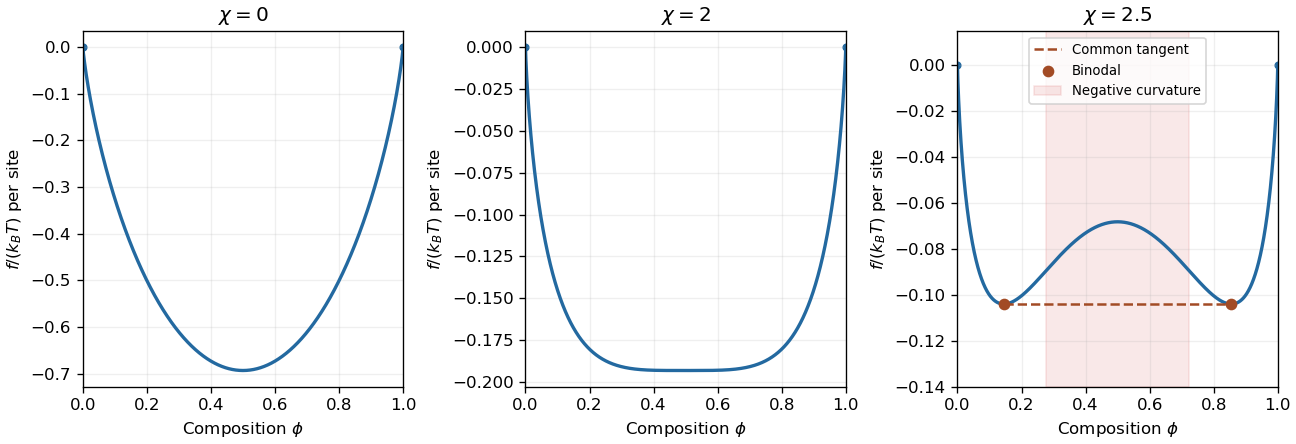
For equal-size molecules, let be the mixing Helmholtz free energy per lattice site. Flory–Huggins solution theory reduces to the regular solution model:The first two terms are minus the combinatorial entropy of mixing; the last is the excess cost of unlike contacts. A positive Flory interaction parameter penalizes such contacts. Additive terms linear in composition change the chosen pure-component reference but do not change stability.
A small composition fluctuation at fixed mean composition costs energy proportional to . Thus local stability requires , and the spinodal isInside this curve, and arbitrarily small composition fluctuations grow. The minimum of is at , giving the critical value . At the thermodynamic critical point, while .
For , is strictly convex with its minimum at . At , the central quadratic term vanishes but a positive quartic term remains. At , there are two minima and a central maximum; the spinodal compositions are . The common-tangent construction gives coexisting compositions and , satisfying . Between a binodal endpoint and the spinodal, the homogeneous state is locally stable but metastable; global stability requires the convex envelope of .

For two species of chains with the same polymerization degree , the number of independently translating objects per occupied site is reduced by . The symmetric Flory-Huggins polymer blend hasThe symmetry still places the thermodynamic critical point at , but nowThe entropy of mixing per monomer is much smaller than for simple liquids, so even a weak unfavorable interaction can cause phase separation for long chains. If the energetic interaction parameter is with , this model gives ; the conclusion relies on that specified temperature law.
With polymer degree and single-site solvent molecules, Flory–Huggins solution theory gives . Expanding the solvent entropy at low concentration gives the dilute-polymer free-energy expansionThe linear term sets a reference chemical potential. The quadratic term controls the leading effective two-segment excluded volume, for site volume .
In a good solvent, and positive excluded volume swells a dilute chain: the Flory approximation gives in three dimensions. In a poor solvent, favors segment contacts and a sufficiently long isolated chain forms a polymer globule, with compact scaling up to density-dependent factors.
At the theta temperature, the leading two-segment interaction cancels, in this model, and the long-chain conformation is approximately an ideal chain, . The positive cubic term remains. The critical point of a Flory–Huggins polymer solution at finite has ; its limiting value, rather than every finite-chain critical point, is the theta condition.
Write for the lattice coordination number and for contact energies. Counting the excess of unlike contacts relative to the unmixed reference gives the Flory interaction parameterUnlike contacts that are less favorable than the mean like contact give . For temperature-independent contact energies, is proportional to , so heating weakens this energetic preference relative to the entropy of mixing. Effective parameters in real solutions can also include entropic terms, often represented schematically by ; the pure contact-energy model does not explain every possible temperature dependence.
Articles by others on the same topic
There are currently no matching articles.