A protein is synthesized as a polypeptide whose sequence constrains its possible interactions. Protein folding is the acquisition of a functional three-dimensional structure: local hydrogen bonds organize secondary structure, while packing, electrostatic interactions and burial of nonpolar groups through the hydrophobic effect stabilize the overall fold. Some proteins also form protein disulfide bonds. Folding reduces the chain's conformational entropy, but the relevant balance includes the entropy of the surrounding water; it is the total Gibbs free energy that is minimized at fixed pressure and temperature.
A folding funnel describes a biased but rugged energy landscape: increasingly native-like conformations become favorable, while barriers can trap intermediates. The chain therefore does not have to test every possible conformation in a uniform random search. Molecular chaperones can prevent protein aggregation and help escape kinetic traps; some proteins remain disordered or require partners, so a unique isolated compact fold is not universal.
The ribonuclease A refolding experiment connects this thermodynamic account to a measurement. Unfolding the enzyme with urea while reducing its disulfide bonds removes activity; suitable removal of the denaturant and restoration of disulfide bonds recover activity. Oxidizing while the chain remains unfolded instead produces incorrectly paired disulfides and little activity. Thus sequence, solvent conditions and the route past kinetic traps all matter; restoration of enzyme activity provides a functional test of folding.
An amphiphile contains a solvent-compatible head and a solvent-avoiding tail. In water, aggregation can lower the Gibbs free energy by reducing exposed hydrocarbon area through the hydrophobic effect. This competes with loss of translational entropy, head-group repulsion and the cost of deforming the tails. Above the critical micelle concentration, added amphiphiles mainly enter aggregates rather than continuing to increase the isolated-molecule concentration proportionally.
The amphiphile packing parameter compares tail volume , preferred head area and tail length . Rough geometric ranges favor spherical micelles for , cylindrical aggregates for , and lipid bilayers for . These are organizing estimates rather than universal sharp phase boundaries. A bilayer can close into a vesicle to eliminate exposed edges; concentration, salt and temperature can change the preferred aggregate.
A simple experimental test varies concentration and measures surface tension: its slope against log concentration changes near the critical micelle concentration, while light scattering detects the appearance of larger aggregates. These observations distinguish the concentration threshold from an assumption that every molecule forms an aggregate at arbitrarily low concentration.
The fluctuation-dissipation theorem relates spontaneous fluctuations in thermal equilibrium to the dissipative part of the linear response to a weak conjugate force. For an overdamped trapped coordinate, the Langevin equation isThe fluctuation-dissipation relation for a Langevin particle fixes the noise strength from the same drag coefficient that dissipates motion. With a drive proportional to , the linear response function is . The two-sided angular-frequency power spectral density then obeysIts integral agrees with the equipartition theorem. Without a restoring force, the same noise-drag relation gives the diffusion-mobility relation .
In thermal calibration of an optical trap, record a bead's spontaneous displacement fluctuations and compare their spectrum with its response to a weak calibrated oscillatory force. The overdamped harmonic-trap power spectrum and the dissipative response must be consistent with the same temperature and drag. The equilibrium and weak-drive conditions are essential: an actively driven bath need not obey this equilibrium relation.
A liquid crystal has some molecular order while retaining liquid-like motion. The distinction between orientational and positional order separates its main phases.
A nematic liquid crystal has long-range orientational order about a nematic director , with and equivalent for apolar molecules, but no periodic density lattice. Its nematic order parameter is , where measures molecular alignment with the director. A cholesteric liquid crystal is a chiral nematic whose director rotates in space, producing a helical pitch while remaining locally nematic.
A smectic phase adds a periodic density modulation in one direction, forming layers with liquid-like motion within each layer. In a smectic A phase, the director is perpendicular to the layers; in a smectic C phase, it is tilted relative to the layer normal. A columnar liquid crystal instead has columns with a two-dimensional positional lattice and comparatively fluid motion along them.
These orders have different experimental signatures. Birefringence under crossed polarizers reveals orientational anisotropy, while X-ray diffraction can detect a smectic layer spacing through a peak near . Optical anisotropy alone does not establish a layer lattice.
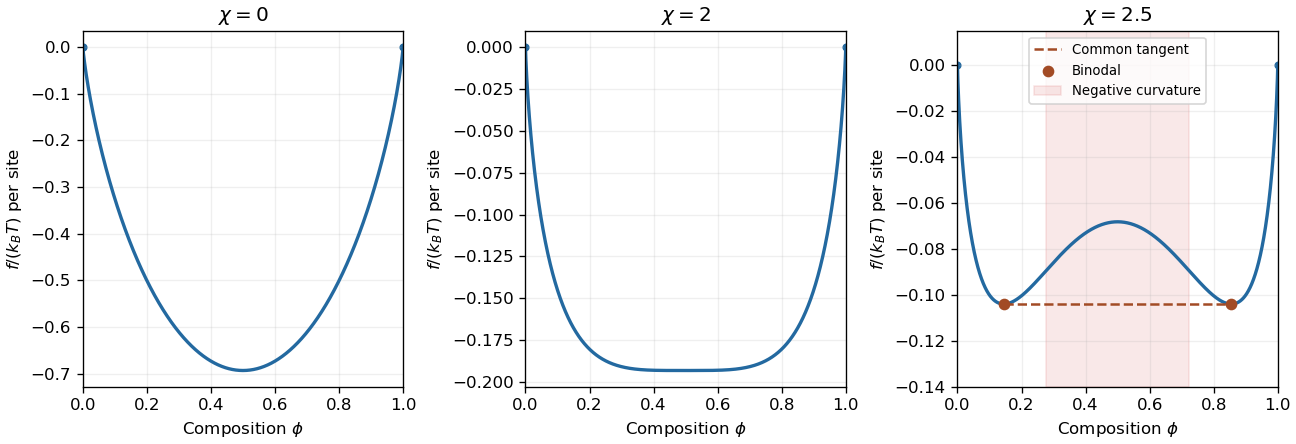
For equal-size molecules, let be the mixing Helmholtz free energy per lattice site. Flory–Huggins solution theory reduces to the regular solution model:The first two terms are minus the combinatorial entropy of mixing; the last is the excess cost of unlike contacts. A positive Flory interaction parameter penalizes such contacts. Additive terms linear in composition change the chosen pure-component reference but do not change stability.
A small composition fluctuation at fixed mean composition costs energy proportional to . Thus local stability requires , and the spinodal isInside this curve, and arbitrarily small composition fluctuations grow. The minimum of is at , giving the critical value . At the thermodynamic critical point, while .
For , is strictly convex with its minimum at . At , the central quadratic term vanishes but a positive quartic term remains. At , there are two minima and a central maximum; the spinodal compositions are . The common-tangent construction gives coexisting compositions and , satisfying . Between a binodal endpoint and the spinodal, the homogeneous state is locally stable but metastable; global stability requires the convex envelope of .
For two species of chains with the same polymerization degree , the number of independently translating objects per occupied site is reduced by . The symmetric Flory-Huggins polymer blend hasThe symmetry still places the thermodynamic critical point at , but nowThe entropy of mixing per monomer is much smaller than for simple liquids, so even a weak unfavorable interaction can cause phase separation for long chains. If the energetic interaction parameter is with , this model gives ; the conclusion relies on that specified temperature law.
With polymer degree and single-site solvent molecules, Flory–Huggins solution theory gives . Expanding the solvent entropy at low concentration gives the dilute-polymer free-energy expansionThe linear term sets a reference chemical potential. The quadratic term controls the leading effective two-segment excluded volume, for site volume .
In a good solvent, and positive excluded volume swells a dilute chain: the Flory approximation gives in three dimensions. In a poor solvent, favors segment contacts and a sufficiently long isolated chain forms a polymer globule, with compact scaling up to density-dependent factors.
At the theta temperature, the leading two-segment interaction cancels, in this model, and the long-chain conformation is approximately an ideal chain, . The positive cubic term remains. The critical point of a Flory–Huggins polymer solution at finite has ; its limiting value, rather than every finite-chain critical point, is the theta condition.
Write for the lattice coordination number and for contact energies. Counting the excess of unlike contacts relative to the unmixed reference gives the Flory interaction parameterUnlike contacts that are less favorable than the mean like contact give . For temperature-independent contact energies, is proportional to , so heating weakens this energetic preference relative to the entropy of mixing. Effective parameters in real solutions can also include entropic terms, often represented schematically by ; the pure contact-energy model does not explain every possible temperature dependence.
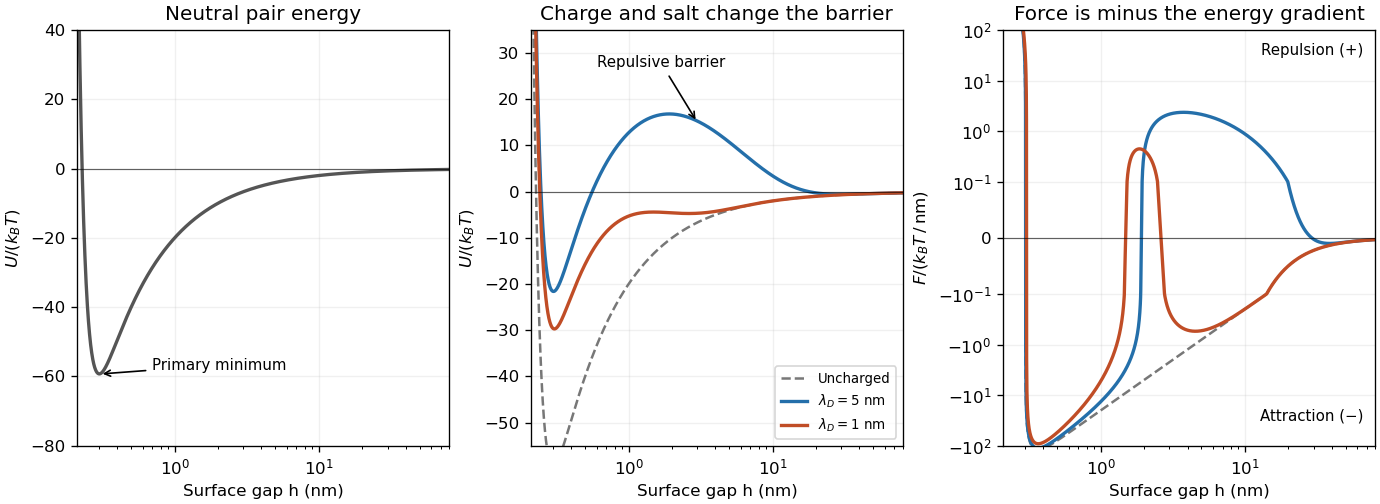
For smooth uncharged spheres, the basic attraction is the Van der Waals force, arising from correlated electric fluctuations. The Hamaker constant incorporates the particles and intervening medium. For equal spheres of radius separated by a surface gap , the near-contact van der Waals attraction of spheres isHere positive force means repulsion, and the attractive case has . At molecular separation, strong short-range repulsion prevents overlap and replaces the continuum divergence with a deep primary minimum. The energy approaches zero from below at large separation; an uncoated, uncharged attractive pair has no electrostatic barrier.
For illustration, , and give at . These are chosen scales, not universal material constants. Such a well can trap particles after a thermal encounter and cause particle aggregation, unless another mechanism such as steric stabilization intervenes. The neutral curve in the figure below shows the attraction regularized by an illustrative contact repulsion.
Use the colloidal probe technique: attach a sphere of known radius to the cantilever of an atomic force microscope and approach a chemically matched planar surface in the same liquid as the suspension. A laser reflected from the cantilever measures its deflection ; calibration of the spring constant converts this to force, . The surface separation is reconstructed from piezo motion after correcting for cantilever bending and defining the contact position. Slow approach reduces hydrodynamic drag; residual surface charge, roughness and hydration must be controlled when identifying a dispersion force.
The Derjaguin approximation accounts for the geometry. With interaction free energy per area between flat plates, , where for a sphere and plane but for equal spheres. Since , the sphere-plane force is ; divide it by two to infer the equal-sphere result in the same near-contact approximation. Attractive force gradients can produce a jump to contact, limiting the directly accessible approach curve.
An actual demonstration attached a silica sphere of radius to an AFM force sensor and measured its interaction with a plane in sodium chloride solutions. Its double-layer contribution and short-distance deviations show why charge and surface conditions must be measured rather than simply presumed absent.[ref]
Distinguish the fixed surface charge density from the mobile-ion charge magnitude . Let be the bulk number density of each species in a symmetric electrolyte, choose bulk potential zero, and write . This convention removes the ambiguity between the surface charge and ion valence in the wording.
Constancy of each ionic electrochemical potential gives the Boltzmann distribution in the local electric potential:Positive potential repels positive ions and attracts negative counterions. The coordinate measures distance from a locally planar surface; the same local relations hold for a spherical potential with its appropriate radial coordinate.
Multiplying each ion number density by its signed charge gives the local charge densityThe fixed surface charge is supplied separately as a boundary condition; it is not part of this mobile charge density in the liquid.
Substitution into Poisson's equation, , gives the Poisson-Boltzmann equationFor a plane, ; for a sphere, it is . The bulk conditions are and . At a planar wall with negligible internal field and normal pointing into the liquid, Gauss's law imposes ; alternatively, a prescribed surface potential gives .
The Debye–Hückel approximation linearizes the hyperbolic sine, giving withThe planar Debye-Hückel double layer has . For an isolated sphere of radius , the Debye-Hückel potential of a charged sphere is outside the sphere; the factor accounts for spherical spreading as well as screening.
The Debye–Hückel screening length is the characteristic distance over which the ion cloud suppresses a weak surface potential. Adding salt increases ionic strength and therefore increases , shortening the interaction range. Linearization requires , particularly near the surface where the potential is largest. It means the ionic electrostatic energy is small compared with thermal energy; for monovalent ions near room temperature, . This condition alone does not remove other limitations of point-ion mean-field theory at high concentration or strong correlations.
The force is determined by the total normal stress of the ionic liquid. The ions contribute osmotic pressure because confining an excess number density costs translational entropy. The osmotic stress in a symmetric electric double layer, relative to the bulk reservoir, isThe second term is the normal electrostatic stress. The Poisson-Boltzmann equation makes this combination independent of position between planar surfaces. At the midpoint of identical equally charged surfaces, symmetry gives , soCalculating only the repulsion of bare surface charges would omit both the screening ion cloud and its entropic stress. Evaluating the total stress at the midpoint packages their combined force in a particularly simple form.
For equal spheres, assume , , weak surface potential and weak overlap, with prescribed . Then gives . Integrating once gives the planar interaction energy per area, , and the Derjaguin approximation gives the repulsive sphere force. Combining it with the near-contact van der Waals attraction of spheres yields the DLVO theory approximationPositive force is repulsive. The exponential term can produce a repulsive barrier in the corresponding pair energy; the short-range attraction leads to a primary minimum, while a shallower secondary minimum may occur farther out. Adding salt shortens the repulsion and can destroy the barrier, allowing particle aggregation. Molecular contact requires a repulsive-core correction, and changing the charge-regulation boundary condition changes the electrostatic prefactor.


Articles by others on the same topic
There are currently no matching articles.