A solid stores thermal energy in lattice vibrations and, when available, electronic and other excitations. For a nonmagnetic insulating crystal at sufficiently low temperature, the gap suppresses mobile electronic excitations and the leading bulk contribution normally comes from acoustic phonons. The three-dimensional Debye heat capacity isThe vibrational density of states scales as , so only a fraction proportional to of the modes is thermally active at low temperature. The two limiting forms areThe high-temperature value is the Dulong-Petit law, or per mole of atoms. Optical phonons add thermally activated contributions as their characteristic energies become accessible. A multiatom cell has more branches, but still three vibrational degrees of freedom per atom.
A normal metal has an additional low-temperature electronic heat capacity. The Pauli exclusion principle restricts excitations to a shell of width about around the Fermi energy. The number of thermally active Electrons is therefore proportional to , rather than the total Electron number contributing a classical heat capacity. With spin-summed electronic density of states for the whole specimen,For a three-dimensional free-electron gas, and . Only a small fraction of the classical electronic value is accessible when , even though the electronic term dominates the phonon term as in a normal gapless metal.
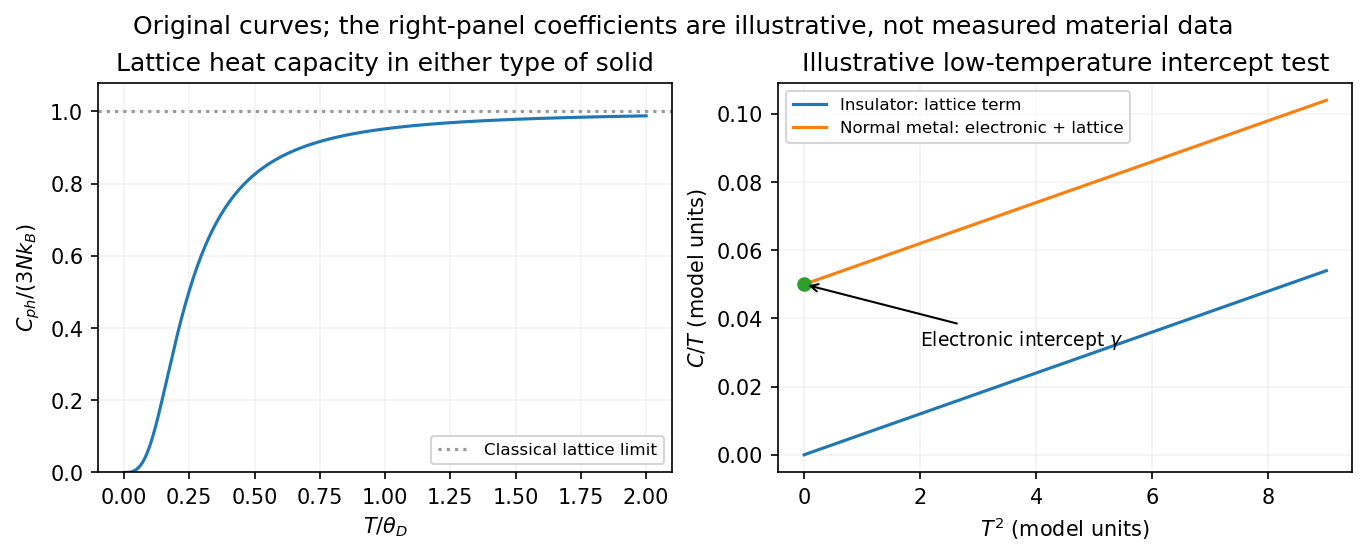

Plotting against gives a straight line with intercept and slope in the appropriate low-temperature range. This separates the electronic density-of-states information from the acoustic-phonon scale. In a Fermi liquid, the interacting quasiparticle density of states replaces the free value, so an enhanced effective mass enhances .
The qualifications matter experimentally. Superconductivity can gap electronic excitations, magnetic order adds magnetic excitations, defects can generate additional low-temperature terms, and low-dimensional or very small specimens need not obey the bulk cubic law. The Debye expression is for constant-volume heat capacity; constant-pressure heat capacity differs through thermal expansion, although the difference is often small at low temperature. Thus the normal-metal and ordinary insulating limits are useful leading behaviors, not universal formulas for every solid in every phase.
Articles by others on the same topic
There are currently no matching articles.