A solid stores thermal energy in lattice vibrations and, when available, electronic and other excitations. For a nonmagnetic insulating crystal at sufficiently low temperature, the gap suppresses mobile electronic excitations and the leading bulk contribution normally comes from acoustic phonons. The three-dimensional Debye heat capacity isThe vibrational density of states scales as , so only a fraction proportional to of the modes is thermally active at low temperature. The two limiting forms areThe high-temperature value is the Dulong-Petit law, or per mole of atoms. Optical phonons add thermally activated contributions as their characteristic energies become accessible. A multiatom cell has more branches, but still three vibrational degrees of freedom per atom.
A normal metal has an additional low-temperature electronic heat capacity. The Pauli exclusion principle restricts excitations to a shell of width about around the Fermi energy. The number of thermally active Electrons is therefore proportional to , rather than the total Electron number contributing a classical heat capacity. With spin-summed electronic density of states for the whole specimen,For a three-dimensional free-electron gas, and . Only a small fraction of the classical electronic value is accessible when , even though the electronic term dominates the phonon term as in a normal gapless metal.
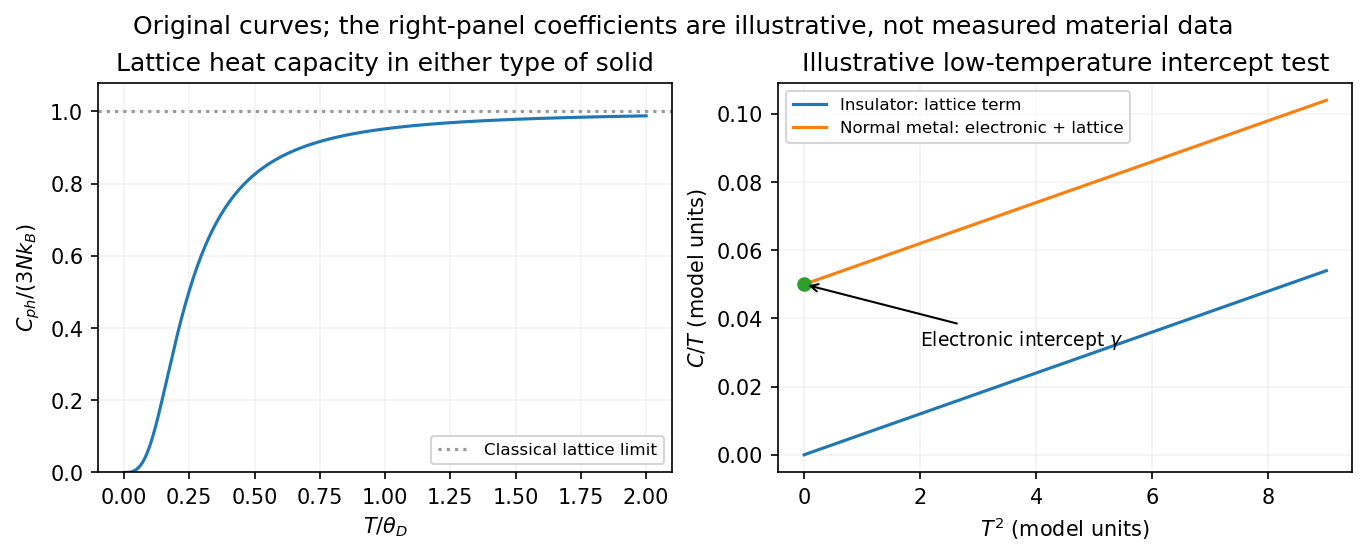
Plotting against gives a straight line with intercept and slope in the appropriate low-temperature range. This separates the electronic density-of-states information from the acoustic-phonon scale. In a Fermi liquid, the interacting quasiparticle density of states replaces the free value, so an enhanced effective mass enhances .
The qualifications matter experimentally. Superconductivity can gap electronic excitations, magnetic order adds magnetic excitations, defects can generate additional low-temperature terms, and low-dimensional or very small specimens need not obey the bulk cubic law. The Debye expression is for constant-volume heat capacity; constant-pressure heat capacity differs through thermal expansion, although the difference is often small at low temperature. Thus the normal-metal and ordinary insulating limits are useful leading behaviors, not universal formulas for every solid in every phase.
A Peierls distortion is a spontaneous lattice modulation that can lower the energy of a one-dimensional metal by opening a gap at its Fermi points. The associated change from metallic to gapped electronic behavior is a Peierls transition. The key wavevector is : it couples states near and , which otherwise have the same energy.
Consider a spin-degenerate chain with one orbital per atom at spacing and one Electron per atom. The band is half filled and . A distortion of period alternates short and long bonds, doubles the primitive cell, and folds the original Fermi points onto the new zone boundary. The distortion can therefore mix the degenerate states precisely where the occupied and empty states meet.
An explicit dimerized tight-binding chain has alternating hopping amplitudes and , where . In the reduced zone ,There are two Electrons per doubled cell, including spin, so the lower band is filled and the upper one empty. Splitting the degenerate states pushes occupied levels downward and empty ones upward, giving an electronic energy gain.
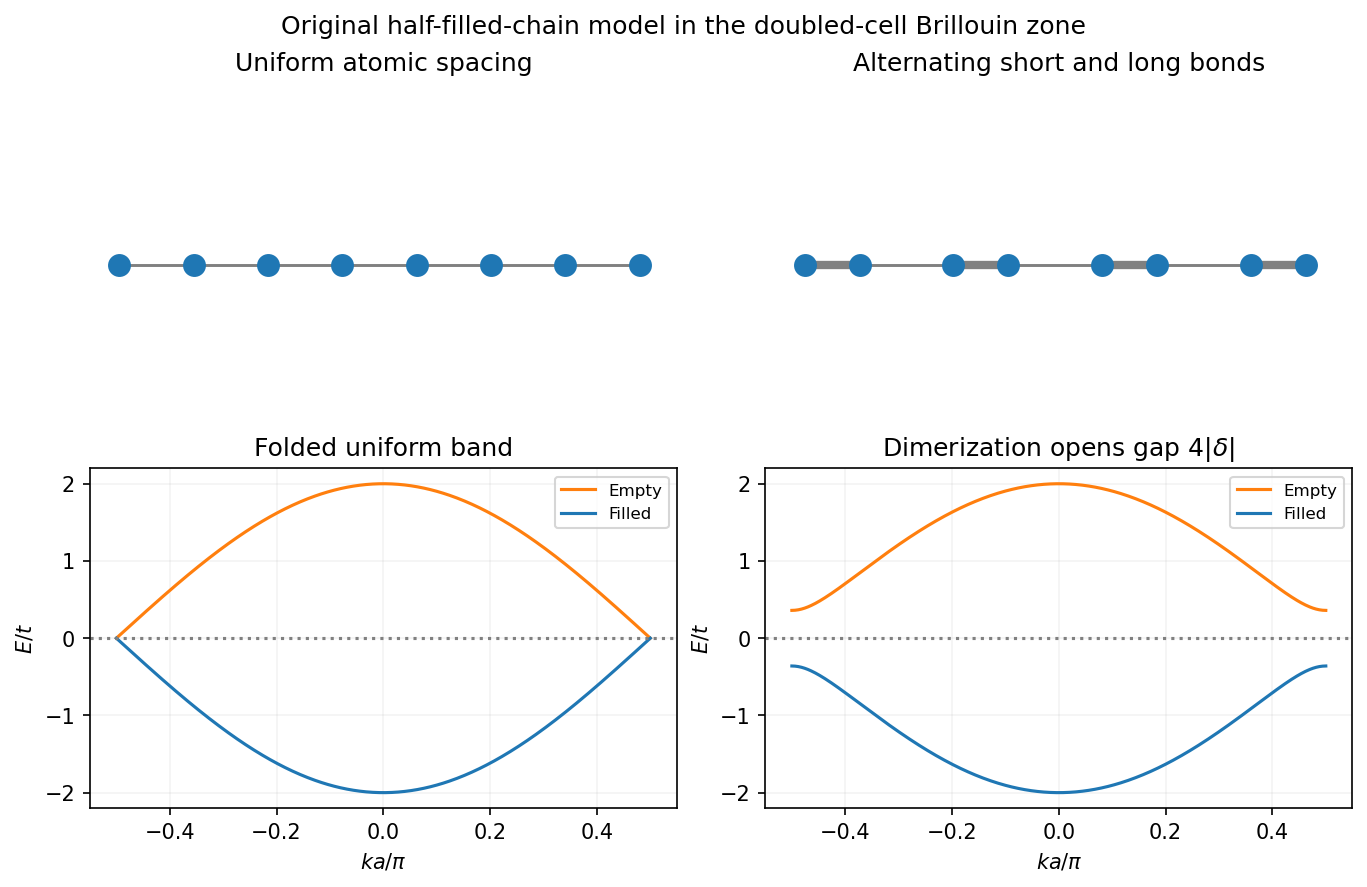


In weak coupling the electronic gain per length has the characteristic form , with . The elastic cost of moving the ions is proportional to . The logarithm makes the undistorted ideal one-dimensional zero-temperature metal unstable to a small distortion even when the electron-lattice coupling is weak. A self-consistent balance selects a finite distortion amplitude. Two opposite dimerization patterns have the same energy for a translation-symmetric isolated chain.
The basic picture links structural modulation to electronic bond order or charge-density modulation, and can open an insulating gap. It does not assert that every real chain has exactly one Electron per atom or period doubling: away from half filling, a modulation at need not be commensurate with two lattice spacings. Temperature, finite chain length and fluctuations cut off the ideal logarithmic response. Interchain coupling and the real lattice dynamics determine whether a macroscopic finite-temperature ordered phase actually forms. The strictly one-dimensional zero-temperature instability alone is not a proof of finite-temperature long-range order.
A normal Fermi liquid describes an interacting fermion system whose low-energy excitations remain continuously connected to adding particles to or removing particles from a Fermi gas. The elementary long-lived excitation is a Landau quasiparticle: adding a particle also changes the surrounding many-body state. Its energy, velocity and interactions are renormalized, even though its electric charge and spin remain those appropriate to the excitation.
Near an isotropic Fermi surface,Residual interactions make the quasiparticle energy depend on the occupations of other quasiparticles, expressed by the Landau quasiparticle energy functional. Its angular components give the Landau parameters controlling density and spin responses. Thus the successful particle picture does not mean that interactions have become zero.
Pauli blocking restricts the final states available for low-energy collisions. In an ordinary three-dimensional Fermi liquid with regular interactions, a representative decay law isAt , the width vanishes faster than , so an excitation becomes increasingly sharp as it approaches the Fermi surface. Its coherent spectral weight is the quasiparticle residue , and the physical Electron occupation has a discontinuity of height at zero temperature. Incoherent spectral weight accounts for the remainder. The quasiparticle occupations themselves obey a Fermi-Dirac distribution.
Several leading thermodynamic signatures retain their gas-like form but have interaction-dependent coefficients. In particular,for an isotropic spin-one-half model, with the spin-summed quasiparticle density of states per volume. effective mass changes , while the dimensionless interaction parameters separately change the spin susceptibility and compressibility. Collisionless collective density motion can propagate as zero sound, distinct from the single-particle excitations.
The quasiparticle scattering rate often underlies a low-temperature contribution to metallic electrical resistivity, but a mechanism relaxing electrical electric current is needed. In a clean Galilean-invariant continuum, electron-electron collisions conserve total momentum and do not alone give a finite dc electrical resistivity. Crystal Umklapp scattering or other current-relaxing processes change that conclusion.
Normal liquid helium-3 and many metals motivate the Fermi-liquid framework. Pairing, magnetic ordering or other transitions can reconstruct the low-energy states. Generic interacting one-dimensional fermion systems instead form a different low-energy state, so the three-dimensional quasiparticle conclusions should not simply be transferred to a chain.
Articles by others on the same topic
There are currently no matching articles.