Use and . Operators on different sites commute, and expanding the two products gives . Therefore the quantum XX chain hasEach exchange moves a reversed spin between neighbours, conserving the total number of reversed spins. The factor of one half follows from defining without a normalizing square root.
The spin commutation relations give . Using the product rule for a commutator,and the conjugate term also vanishes. The longitudinal field commutes with every , so . The Hamiltonian is invariant under the global spin rotation : its continuous symmetry group is . Simultaneous energy and total-magnetization eigenstates can be chosen, and evolution preserves each fixed-magnetization sector. Local magnetization can still flow between sites; generally . In the fermion representation the conserved number will be .
Use the canonical anticommutation relations and . In particular, is a projector, so . Define . Then , , and commutes with and . Taking the adjoint of the given raising operator gives . HenceAlso and imply . For different sites, exchanging two fermion operators contributes one minus sign and commuting an operator through the other site's parity string contributes another; their product is positive. Thus distinct spin algebras commute. The string supplies precisely the signs required for the Jordan–Wigner transformation. The fermion vacuum corresponds to spin up, while one occupied site corresponds to spin down; this convention fixes subsequent signs.
For a bulk bond, and . Reordering the remaining different-site operators then givesThe periodic spin boundary condition requires separate attention. Set . The end bond becomes , with the conjugate relation for its adjoint. Consequently the exact finite-ring Hamiltonian isfermion parity is conserved, so diagonalize in a sector . There the end bond can be written like every other bond provided . This parity-dependent boundary condition of the Jordan-Wigner chain is antiperiodic for even fermion number and periodic for odd fermion number. Simply assuming periodic fermions in both sectors changes the finite-size spectrum.
In a fixed fermion-parity sector use lattice spacing one and the unitary discrete Fourier transformThe allowed momenta satisfy : they are for and for , with distinct values modulo . The hopping and number sums become and . ThusHere is the energy of the all-up spin configuration, not generally the ground-state energy. The dispersion has minimum at , maximum at , and positive curvature at its minimum. Since the fermions do not interact, each mode can be occupied zero or one time. A negative-energy occupation lowers the many-body energy, so in the thermodynamic limitThis is a filled Fermi sea containing many fermions; it is not obtained by putting a single particle into the band minimum. For every mode has positive energy and the vacuum is the ground state. Its spin interpretation is complete longitudinal polarization. At the zero-momentum one-particle excitation first becomes gapless.
For an exact finite ring use parity-consistent filling of a free-fermion band. In each momentum grid fill negative-energy levels, check that their particle number has the chosen parity, and if necessary toggle a mode with the smallest . Compare the two sector energies. A zero-energy mode allows degenerate occupations. This restores the physical spin Hilbert space without changing the stated band.
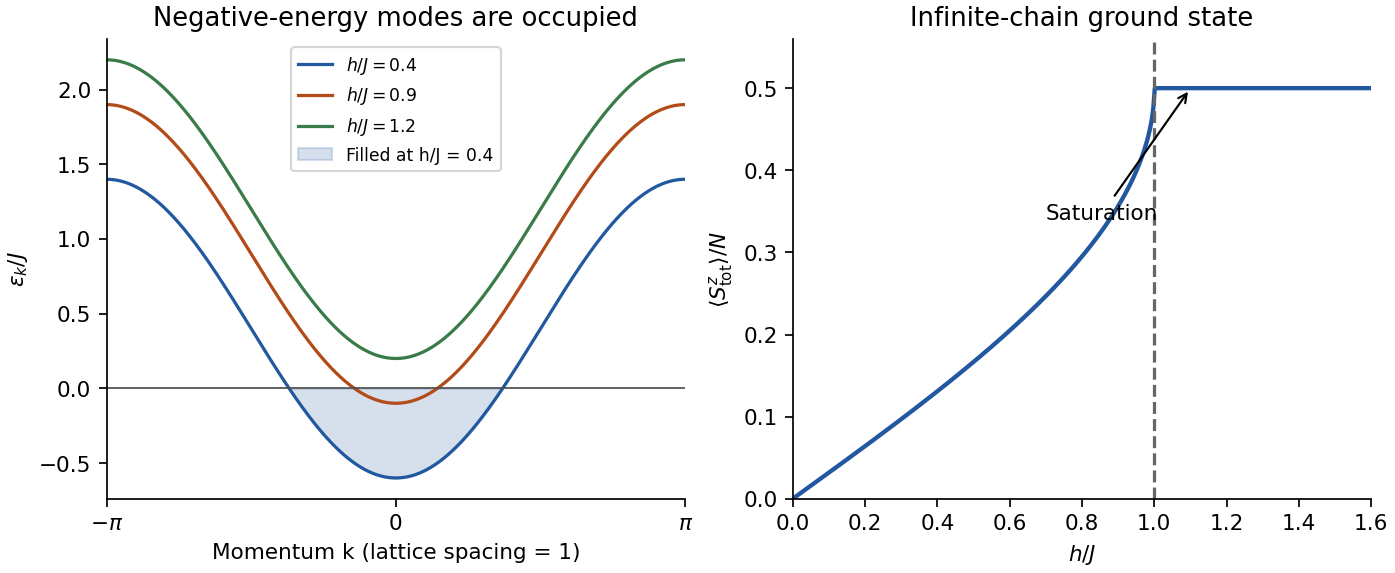
Original XX-chain dispersion, occupied interval and thermodynamic magnetization; illustrative field ratios
. Details. 
Because , the exact finite-size answer is , with determined by the parity-consistent filling above. For the thermodynamic magnetization of the quantum XX chain, the occupied fraction is the length of the negative-energy interval divided by the Brillouin-zone length:ThereforeThe zero-field limit has zero magnetization and the high-field limit has all spins up. The finite-ring curve consists of magnetization steps approaching this continuous limit. Strictly above the fully polarized ground state is unique; exactly at a zero-energy spin-flip state can be degenerate with it. This finite-size qualification does not alter the saturation field or limiting magnetization density.
Articles by others on the same topic
There are currently no matching articles.