Original solutions covering every option, including all three essay alternatives. [ref]
https://www.whatdotheyknow.com/request/natural_science_tripos_physics_e_2/response/2340776/attach/2/FOI%202023%20399%20Zahid%20materials.pdf?cookie_passthrough=1#page=724. Original public PDF, physical pages 724–727; dated 14 January 2015
Use and . Operators on different sites commute, and expanding the two products gives . Therefore the quantum XX chain hasEach exchange moves a reversed spin between neighbours, conserving the total number of reversed spins. The factor of one half follows from defining without a normalizing square root.
The spin commutation relations give . Using the product rule for a commutator,and the conjugate term also vanishes. The longitudinal field commutes with every , so . The Hamiltonian is invariant under the global spin rotation : its continuous symmetry group is . Simultaneous energy and total-magnetization eigenstates can be chosen, and evolution preserves each fixed-magnetization sector. Local magnetization can still flow between sites; generally . In the fermion representation the conserved number will be .
Use the canonical anticommutation relations and . In particular, is a projector, so . Define . Then , , and commutes with and . Taking the adjoint of the given raising operator gives . HenceAlso and imply . For different sites, exchanging two fermion operators contributes one minus sign and commuting an operator through the other site's parity string contributes another; their product is positive. Thus distinct spin algebras commute. The string supplies precisely the signs required for the Jordan–Wigner transformation. The fermion vacuum corresponds to spin up, while one occupied site corresponds to spin down; this convention fixes subsequent signs.
For a bulk bond, and . Reordering the remaining different-site operators then givesThe periodic spin boundary condition requires separate attention. Set . The end bond becomes , with the conjugate relation for its adjoint. Consequently the exact finite-ring Hamiltonian isfermion parity is conserved, so diagonalize in a sector . There the end bond can be written like every other bond provided . This parity-dependent boundary condition of the Jordan-Wigner chain is antiperiodic for even fermion number and periodic for odd fermion number. Simply assuming periodic fermions in both sectors changes the finite-size spectrum.
In a fixed fermion-parity sector use lattice spacing one and the unitary discrete Fourier transformThe allowed momenta satisfy : they are for and for , with distinct values modulo . The hopping and number sums become and . ThusHere is the energy of the all-up spin configuration, not generally the ground-state energy. The dispersion has minimum at , maximum at , and positive curvature at its minimum. Since the fermions do not interact, each mode can be occupied zero or one time. A negative-energy occupation lowers the many-body energy, so in the thermodynamic limitThis is a filled Fermi sea containing many fermions; it is not obtained by putting a single particle into the band minimum. For every mode has positive energy and the vacuum is the ground state. Its spin interpretation is complete longitudinal polarization. At the zero-momentum one-particle excitation first becomes gapless.
For an exact finite ring use parity-consistent filling of a free-fermion band. In each momentum grid fill negative-energy levels, check that their particle number has the chosen parity, and if necessary toggle a mode with the smallest . Compare the two sector energies. A zero-energy mode allows degenerate occupations. This restores the physical spin Hilbert space without changing the stated band.
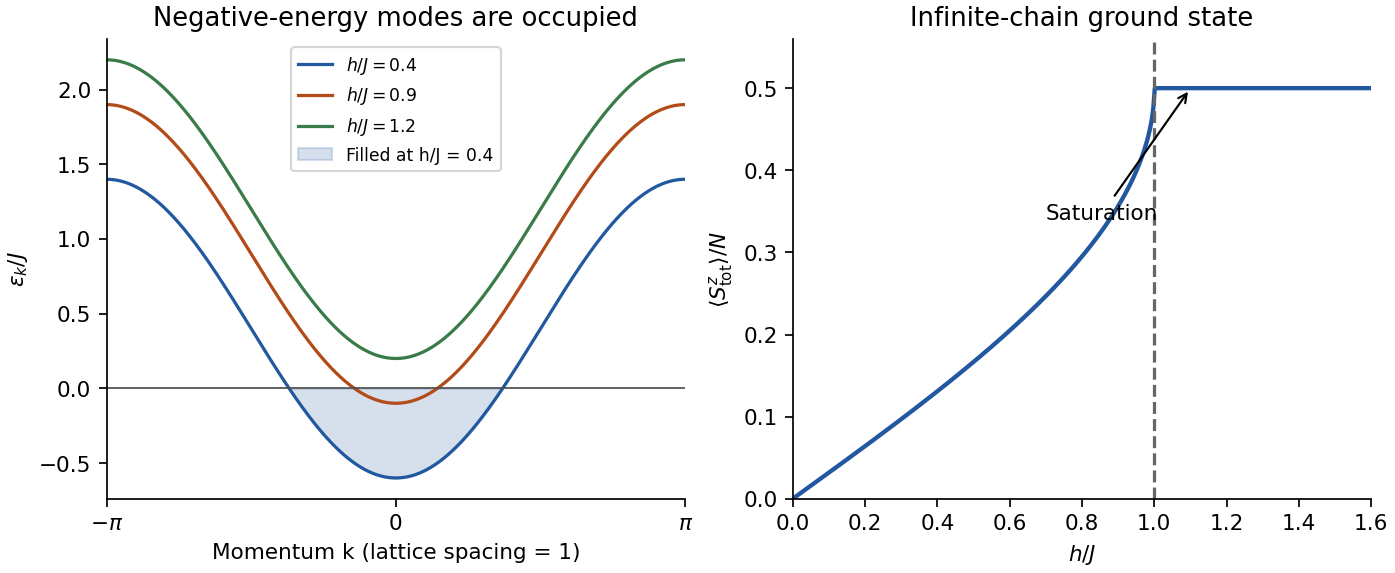
Original XX-chain dispersion, occupied interval and thermodynamic magnetization; illustrative field ratios
. Details. Because , the exact finite-size answer is , with determined by the parity-consistent filling above. For the thermodynamic magnetization of the quantum XX chain, the occupied fraction is the length of the negative-energy interval divided by the Brillouin-zone length:ThereforeThe zero-field limit has zero magnetization and the high-field limit has all spins up. The finite-ring curve consists of magnetization steps approaching this continuous limit. Strictly above the fully polarized ground state is unique; exactly at a zero-energy spin-flip state can be degenerate with it. This finite-size qualification does not alter the saturation field or limiting magnetization density.
The Holstein–Primakoff transformation converts a spin algebra into bosonic operators while retaining the finite physical spin Hilbert space. With , writeThe Holstein–Primakoff occupation constraint is . Acting on , the raising matrix element is and the lowering element is . Their squared difference is , reproducing . Operator ordering inside the square roots is essential. For low boson occupation relative to , expand them to obtain and . Keeping quadratic terms gives the linear spin-wave approximation; higher terms describe magnon interactions. Large helps control the expansion, but a low-dimensional infrared divergence can invalidate it even at large finite .
For the ferromagnet choose , , with unit lattice spacing and . Expand around the all-up state. A longitudinal bond contributes , and the transverse exchange contributes . After a Fourier transform,These are ferromagnetic magnons. The polarized vacuum is an exact ground state of the full ferromagnetic Hamiltonian: every bond is in its maximum total-spin sector, minimizing that bond energy. It therefore has no quantum zero-point reduction of its magnetization. The one-magnon dispersion is also exact, although interacting many-magnon states need not be free bosons. Rotating the polarization generates the maximum-total-spin ground-state multiplet. Selecting a definite direction in a thermodynamic symmetry-breaking description breaks to ; the two transverse spin components form a canonical pair, producing a single quadratic type-B Goldstone boson. A small aligning field gaps it by the Zeeman energy.
At nonzero temperature the one-dimensional ferromagnet is different: its thermal magnon number contains , with infrared behaviour . The divergent magnetization reduction signals the absence of finite-temperature long-range order in an infinite short-range isotropic chain, consistent with the Mermin-Wagner theorem. It does not disallow the polarized zero-temperature ground states just constructed.[ref]
For the antiferromagnet use , still , on an even bipartite chain. The classical reference state alternates up and down. Rotate one sublattice through so that both local quantization axes point along their reference spins. In unrotated physical components, to leading order , , and . Choosing Fourier phases using the actual site positions givesThe reduced Brillouin zone has momenta and length . The pair creation and annihilation terms express the fact that an antiparallel reference product state is not an eigenstate. A bosonic Bogoliubov transformation with , , diagonalizes each two-mode block. With the sign convention and , the result isThus the harmonic antiferromagnetic modes have linear, rather than quadratic, long-wave dispersion. In an unfolded Brillouin-zone description the same result is represented by zeros at both zero and the antiferromagnetic wavevector; these are not extra independent degrees of freedom beyond the two-sublattice accounting.
The Bogoliubov vacuum has no or excitations but contains original spin bosons, with . Its staggered magnetization is . This quantum depletion of Néel order diverges logarithmically at small in one dimension. Linear spin-wave theory therefore does not establish a stable ordered antiferromagnetic ground state for this chain. Its nominal gapless dispersion is a result of expanding around an invalid ordered reference, not a general proof of the exact excitation spectrum. For the nearest-neighbour isotropic chain, integer-spin systems have a Haldane gap, whereas half-integer-spin systems are gapless; the spin-one-half chain in particular has fractional spin excitations rather than a simple dilute gas of ordered-state magnons. This distinction requires physics beyond the harmonic expansion, including the topological term in the continuum theory.[ref]
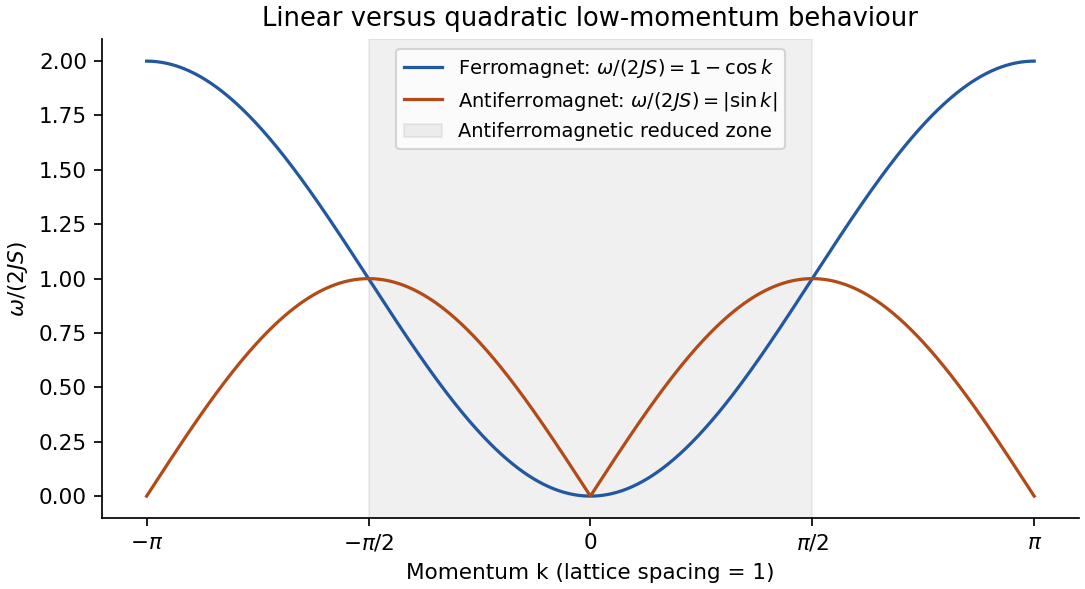
Original harmonic chain dispersions; the antiferromagnetic curve is a spin-wave approximation, not the exact spectrum for every spin
. Details. For one coordinate with Hamiltonian , the propagator is , where . Divide into intervals , use the Trotter product formula to separate kinetic and potential evolution, and insert complete position and momentum bases at each slice. The momentum integral is Gaussian:Multiplying the short-time kernels gives the time-sliced configuration-space path integral,with , . Continuum notation abbreviates this limit as , where . The measure includes the displayed normalization; it is not an unweighted count of paths. A small damping or analytic-continuation prescription defines the oscillatory integrals. The paths contribute complex amplitudes, so alternative histories interfere before probabilities are calculated. This is the central difference from a classical statistical mixture of trajectories.[ref]
Space-Time Approach to Non-Relativistic Quantum Mechanics by Richard Feynman. pp.367–374, action phases and construction of the propagator
When actions vary rapidly relative to , stationary phase selects classical paths. Put , with zero at the endpoints. Vanishing first variation gives . The quadratic term isThe resulting Gaussian fluctuation determinant is the semiclassical propagator prefactor. In one dimension, away from caustics,The branch convention makes for a direct free-particle path before any caustic. The Maslov index tracks the phase changes as fluctuations pass through a focal singularity. In several dimensions replace the endpoint derivative by the Van Vleck determinant. The approximation sums all relevant classical paths; real-time action need only be stationary, not a minimum. It fails in this simple form at a caustic or coalescing saddles, where a uniform approximation is needed. Quadratic actions have no higher fluctuation terms, making their Gaussian evaluation exact. For example gives the exact free-particle kernel . Tunnelling involves classically forbidden regions and can be described by imaginary-time saddles rather than real classical trajectories.
Quantum statistical mechanics follows by Wick rotation . The imaginary-time evolution operator is , with Euclidean actionTaking a thermal trace identifies and integrates the endpoint positions:This thermal trace as a closed Euclidean path integral explains the periodic imaginary-time direction. A density-matrix element instead retains open endpoints. For many identical particles the trace also sums over endpoint permutations, with a plus sign for bosons and permutation parity for fermions. In coherent-state language this becomes periodic bosonic fields and antiperiodic Grassmann fields, with corresponding Matsubara frequencies.
The Euclidean weight resembles a classical Boltzmann weight. A time-sliced local quantum field in spatial dimensions becomes a classical-looking field model in dimensions, with anisotropic couplings and extra extent . Thus zero-temperature quantum criticality can be treated using an infinitely extended imaginary-time direction, while nonzero temperature imposes a finite thickness. The dynamical scaling of time need not equal the spatial scaling: the dynamical critical exponent specifies their relationship. This quantum-to-classical imaginary-time mapping requires qualification when weights have signs or imaginary terms; such a functional integral is not automatically an ordinary positive classical probability distribution. Even with a positive weight, the mapping concerns equilibrium statistics, not literal dissipative real-time trajectories. For a free particle the Euclidean kernel is a diffusion kernel with diffusion coefficient , illustrating the mathematical correspondence.
The classical high-temperature limit is a further approximation, rather than simply another name for imaginary time. If quantum level spacings and exchange effects are negligible, a one-particle partition function in dimensions becomesFor indistinguishable particles there is a factor in the dilute classical gas, and exchange is negligible when the number density times the thermal de Broglie wavelength to power is small. For a harmonic oscillator, the exact quantum result tends to as , recovering the classical phase-space integral. stationary phase explains classical mechanics; the short imaginary-time, weak-exchange limit explains classical statistical mechanics. These are related but distinct limits of the same quantum formulation.
Consider a conventional spin-singlet, weak-coupling, three-dimensional superconductor. Set in the microscopic action and restore electromagnetic units below. An attraction in an energy shell about the Fermi surface gives a Grassmann actionThe attractive sign permits pairing even when the single-particle Fermi gas is otherwise stable. A complex Hubbard–Stratonovich transformation introduces a pair field proportional at the saddle to . The action is then quadratic in fermions. Integrating them out gives the BCS pairing-field effective actionHere the trace uses one independent Nambu spinor pairing block; a fully doubled particle-hole representation instead carries its corresponding one-half factor. At a uniform saddle the Bogoliubov--de Gennes Hamiltonian can be written asThe negative branch describes the paired vacuum; excitations are Bogoliubov quasiparticles mixing particles and holes. Extremizing the effective action givesThe physical cutoff or a renormalized interaction is part of the microscopic model; an unregulated contact integral must not be used indiscriminately. With constant density of states per spin and shell half-width , the zero-temperature weak-coupling solution is . The exponentially small scale follows from the logarithmic pairing susceptibility of states near the Fermi surface. For this ideal weak-coupling model, . The microscopic theory relates the gap, pairing and thermodynamic transition.[ref]
Theory of Superconductivity by John Bardeen and others. pp.1175–1177 and the energy-gap and finite-temperature developments
Close to a continuous transition, for fields varying slowly compared with microscopic scales, expand the effective action in powers and gradients of . Its static part is the Ginzburg-Landau theory of superconductivity:The normalization of fixes the coefficients; here changes sign at . The uniform minimum has for , condensation free-energy density , and characteristic coherence-length scale . Above the transition the minimum is at zero. The quartic stabilization and gradient cost are precisely the ingredients of Landau theory for a complex order parameter. This controlled near-transition expansion supplies a bridge between microscopic BCS theory and macroscopic magnetic response; its coefficients and validity depend on the material and fluctuation regime.[ref]
Microscopic Derivation of the Ginzburg-Landau Equations in the Theory of Superconductivity by Lev Gor'kov. pp.1364–1367, microscopic expansion near the transition
Write . The radial fluctuation has positive local restoring curvature, whereas the phase has no local potential in a neutral theory with global symmetry. Freezing the amplitude givesThe neutral case supports a gapless collective phase mode. In the charged case the electromagnetic field couples to this phase rigidity. Under and , the displayed combination is invariant. Locally choosing a gauge with constant phase leaves a quadratic term in . Varying the free energy gives the transverse London current and magnetic screening scale,Combining this relation with static Maxwell equations gives exponential field penetration, the Meissner effect. Single-valuedness of the pair field around a loop with negligible current gives flux in units . These are gauge-invariant physical consequences of the condensate stiffness.
For the dynamics, the neutral phase and density mode is reorganized by the Coulomb interaction and the dynamical electromagnetic field. In a bulk three-dimensional system the long-wave longitudinal mode has a plasma gap, rather than remaining the neutral sound mode. This is the Anderson-Higgs mechanism in a superconductor: a phase coordinate becomes part of the electromagnetic collective response instead of surviving as an independent massless physical particle. Local gauge transformations are redundancies of the description, so a literal breaking of a local redundancy is not an observable. Phase coherence, current response and magnetic screening provide the physical statements.[ref]
Plasmons, Gauge Invariance, and Mass by Philip Warren Anderson. pp.439–442, plasma oscillations and the charged versus neutral matter spectrum
A static Landau functional alone cannot determine that full dynamical spectrum. A two-dimensional film, for example, need not have the same long-wave plasma dispersion as a bulk charged system. Nor does a positive radial curvature automatically guarantee a sharp Higgs amplitude resonance: coupling to quasiparticles and other modes can damp it. The chosen mean-field phase is also a thermodynamic symmetry-breaking description; an isolated finite system can be formulated with definite particle number. The microscopic pairing saddle, the near-transition Landau expansion and the electromagnetic Anderson-Higgs response describe successive scales of the same superconducting state, with distinct assumptions at each step.
For a normal-ordered bosonic Hamiltonian, insert coherent-state resolutions between short imaginary-time evolution factors. The overlaps generate and the Hamiltonian symbol is obtained by replacing creation and annihilation operators by and . Including the chemical potential gives, in the stated convention,The trace imposes periodic imaginary-time boundary conditions,so bosonic Matsubara frequencies are . The two complex coherent-state integration variables are treated independently before imposing the physical saddle contour. There is no extra zero-point ordering term: the supplied interaction is already normal ordered.
The spatial confinement is not specified beyond the volume. The uniform bulk results below use a homogeneous box with periodic spatial boundaries, or the interior of a large vessel where boundary effects can be neglected. A hard wall instead requires a vanishing field at that wall and an inhomogeneous saddle near it. Temporal periodicity follows from the thermal trace and does not by itself impose periodic spatial boundaries.
For a uniform time-independent saddle, extremizing the action gives . Its grand-potential density is , with . Since , the minimum at positive density for isFor the uniform mean-field minimum is the vacuum, rather than a positive-density condensate. At fixed nonzero density in the weakly interacting condensed regime, the saddle relation sets . The mean-field one-body density matrix factorizes as , giving macroscopic occupation of the uniform mode. Depletion corrections are omitted at this stage.
The action has the global particle-number symmetry , . Choosing one saddle phase breaks this symmetry; the degenerate mean-field minima form the circle . There is no energetic preference for a uniform value of , but spatially varying phase costs gradient energy. Consequently a neutral condensate has a gapless Goldstone mode and a nonzero phase stiffness. The mode becomes sound once density dynamics is included. With the superfluid velocity is , so a single-valued field allows circulation in units around a closed loop that avoids zeros of the amplitude. This phase coherence and rigidity are the physical content of the broken-symmetry description.
The claim is a mean-field saddle statement, not an assertion that every and temperature in the question supports true long-range order. In a finite number-conserving system ; the symmetry-breaking order parameter is defined with the thermodynamic limit taken before an infinitesimal source is removed. In a homogeneous infinite short-range gas at nonzero temperature, infrared phase fluctuations prohibit true condensation in . In one dimension they also destroy true condensate long-range order at zero temperature. A two-dimensional gas can nevertheless have superfluidity and algebraically decaying correlations below a Berezinskii–Kosterlitz–Thouless transition. A finite trap can have substantial coherence without contradicting these thermodynamic statements.[ref]
Existence of Long-Range Order in One and Two Dimensions by Pierre Hohenberg. abstract and pp.383–386; finite-temperature restriction
On the physical density-phase contour put . Direct differentiation givesIntegrating the Laplacian by parts with the stated bulk boundary convention, and dropping the periodic total derivative of , produces the density-phase action of a Bose gas,Write and , where is constant. To quadratic order,The uniform static density fluctuation has positive curvature . Its inverse static susceptibility at wavevector is , which remains nonzero at . This is the sense in which the amplitude or density fluctuation is massive. The phase has no term proportional to without derivatives; a uniform phase rotation costs no action. It is the massless direction required by global symmetry.
The term shows density-phase conjugacy. It is important to distinguish static density stiffness versus an excitation gap: the density and phase do not form two independent normal-mode branches with one gapped and one gapless particle. In this nonrelativistic first-order theory they supply the conjugate variables of one positive Bogoliubov branch, derived below. The omitted cubic terms include and corrections from the density-gradient denominator.
There is also a background term . It vanishes for smooth fluctuations with zero temporal winding. Periodicity of , however, permits . The compact phase winding term must be retained when such sectors are included; it is not generally the same constant in all sectors. The local Gaussian phonon calculation concerns the smooth zero-winding sector and does not describe vortices or points where the density vanishes.
At wavelengths with , neglect the density-gradient term in the quadratic density-phase action. Complete the square in its remaining density terms:The convergent Gaussian integral can be performed by a contour shift or by its Fourier-transform identity. Its determinant is independent of at this order. Combining that normalization with the saddle action into a constant givesThe saddle contribution to is ; the additional measure-dependent constant need not be assigned an invented numerical value. The density Gaussian extends the fluctuation integration beyond its exact positivity domain, which is justified only while fluctuations around are small. The smooth zero-winding assumption is also required as discussed above. A constant global phase zero mode gives a finite compact-group volume, handled separately from nonzero phonon modes.
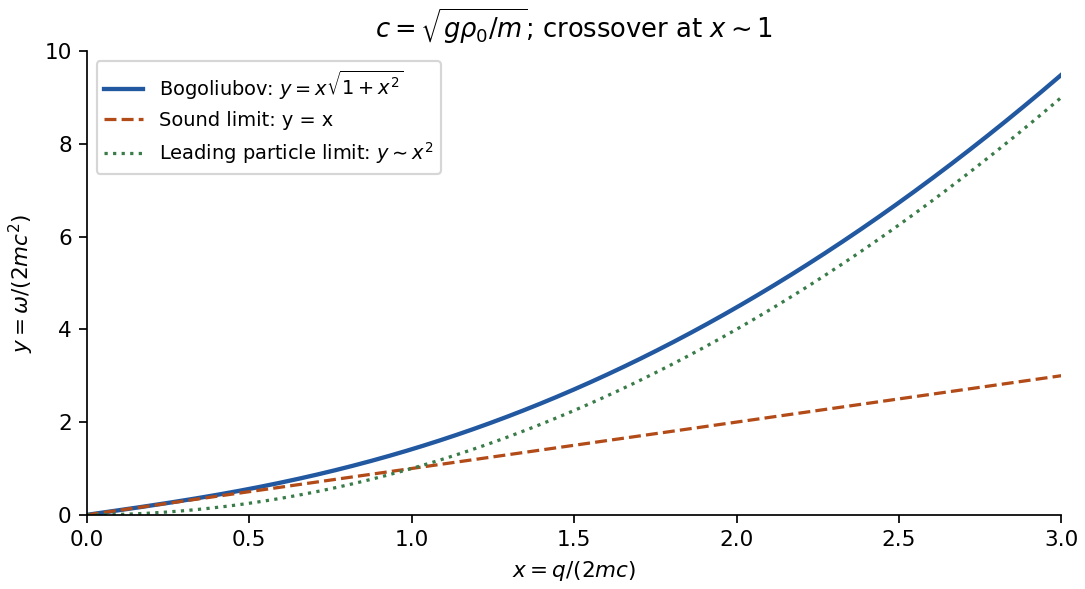
Fourier transforming the Bose-gas phase-only action gives a kernel . Analytically continuing gives its real-frequency poles,In the present units the excitation energy equals . Each real Fourier coordinate is a harmonic oscillator with inertia coefficient and spring coefficient , hence frequency equal to the square root of their ratio. This is the direct relation to a quantum harmonic chain. The mode is a gapless sound phonon; its finite speed reflects both the compressibility and the phase stiffness .
Retaining the density-gradient term provides a useful check. Its integration instead gives a temporal coefficient , soThis is the Bogoliubov spectrum. Its small- limit is the derived sound branch; at large within the contact model it crosses towards particle-like behaviour. The crossover in the squared dispersion is , precisely the scale beyond which the discarded density gradient is not small.
The same action checks the dimensional restriction in the saddle analysis. At nonzero temperature its zero Matsubara mode gives phase fluctuations proportional to ; at zero temperature integrating the frequency gives . Their infrared divergences invalidate uniform true long-range order for at nonzero temperature and for at zero temperature. The long-wave collective description can remain useful for correlations even where a global condensate saddle is not a literal symmetry-broken state. The contact coupling here is an effective low-energy parameter; this calculation does not determine ultraviolet renormalization or trap-specific surface modes.


Articles by others on the same topic
There are currently no matching articles.