The Fermi sea is the zero-temperature many-fermion quantum state with every one-particle state below the Fermi energy occupied and every state above it empty. For a uniform isotropic Fermi gas, the occupied region in momentum space is a solid sphere; its boundary is the Fermi surface. These are momenta, not positions: filling the sphere does not put the particles in a ball in ordinary space. Opposite momentum contributions cancel, so the gas at rest has zero total momentum even though its total kinetic energy is positive.
The filled states are forced upward in energy by the Pauli exclusion principle. This is different from the zero-point energy of one particle confined by a boundary. At fixed number density, the Fermi energy remains positive as the box grows to the thermodynamic limit, while the lowest box confinement energy tends to zero. Low-energy excitations move particles from occupied states near the Fermi surface into nearby empty states; deep states have no nearby available destination. This explains why only a small fraction of electrons contribute to the low-temperature electron heat capacity.[ref]
3 Quantum Gases. Statistical Physics by David Tong; §§3.6.2–3.6.3, filled sea and thermally active surface shell
For the uniform noninteracting electron model with two spin states and kinetic energy of nonrelativistic particles , count all available one-particle states up to an energy :This extensive density of states has units of inverse energy; is the density of states per unit volume. Availability and occupation are different: is positive above , but at zero temperature those states are empty. The occupied energy distribution is , with the Fermi-Dirac distribution reduced to below and above it. The convention at the exact boundary does not affect a continuum integral.
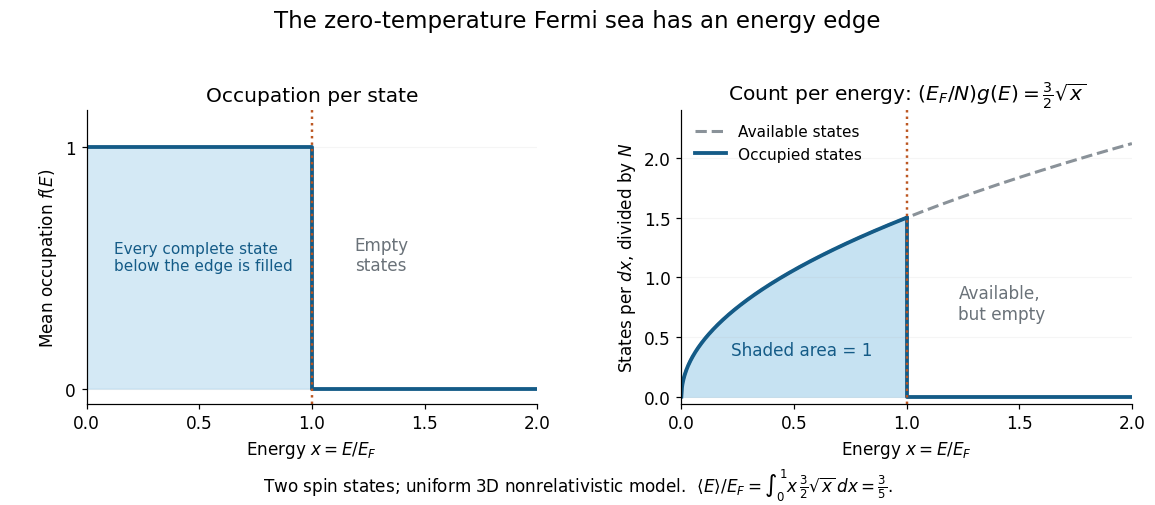
At zero temperature occupation cuts off at the Fermi energy although the density of available states keeps growing
. Details. 
With the dimensionless quantity , the occupied count per , divided by the total particle number, is for . Its area is one. Weighting this by gives the internal energy and its mean per particle:Thus the highest occupied energy and the mean energy differ. For the Fermi energy of a model electron gas, . At fixed , , so the derivative gives the electron degeneracy pressure . The same state-counting geometry therefore predicts a nonzero pressure at zero temperature.
Articles by others on the same topic
There are currently no matching articles.