Distinct gamma matrices anticommute, and , for . Moving a particular through the other three factors in gives three minus signs. ThereforePairing equal factors in the square involves interchanges. The Clifford algebra consequently givesIn particular ; replacing it by the conventional chirality matrix would change this answer.
The trace is unchanged by a similarity transformation. Since and , cyclic property of the trace gives . AlsoThus
The mass dimensions are , , . Up to total derivatives, power counting allows local counterterms of mass dimension at most four. A convenient basis for the counterterm Lagrangian compatible with the actual parity symmetry in quantum field theory and Dirac fermion number conservation isThe optional constant renormalizes the vacuum energy density. The wavefunction renormalization, mass counterterms and Yukawa coupling renormalization correct the terms already present. The quartic interaction must also be included: the fermion loop with four external bosonic legs is logarithmically divergent, even if the renormalized quartic coupling is set to zero at one chosen renormalization scale. The displayed original interactions alone do not form a closed set of counterterms.
If “most general” is interpreted before imposing the parity symmetry in quantum field theory examined in d, Lorentz invariance, a Hermitian action and Dirac fermion number conservation also allowHere all coefficients can be real in the paper's gamma matrix convention; the last term is Hermitian in the action up to a total derivative. It is an axial kinetic normalization, which could alternatively be removed by a suitable perturbative field redefinition. Every term in is odd under the actual parity symmetry in quantum field theory, so its coefficient vanishes in a symmetry-preserving renormalization scheme. Listing these terms makes explicit which assumption excludes a tadpole counterterm, a cubic scalar term, a scalar Yukawa interaction, a pseudoscalar Dirac mass term and an axial kinetic term.
Expanding gives the Feynman vertexThere is one scalar leg and a continuous oriented fermion line; no extra factor is absorbed into . The Dirac propagator is , where . Each closed fermion loop supplies a minus sign.
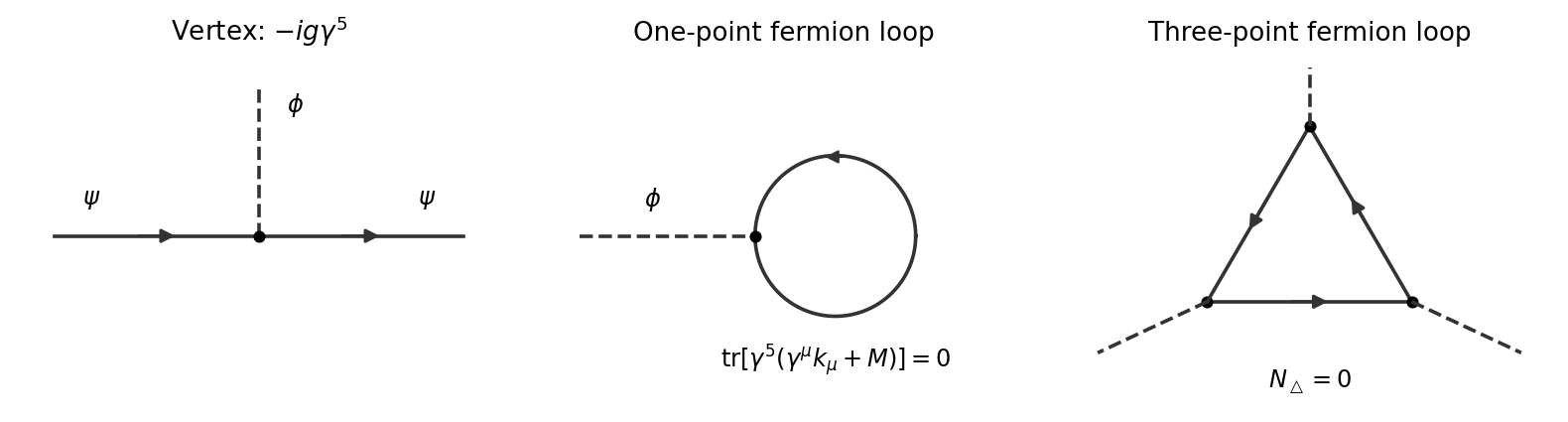
Pseudoscalar Yukawa vertex and the vanishing one-loop bosonic one-point and three-point diagrams
. Details. 
The tadpole diagram is proportional tobecause both numerator traces vanish by a. This is zero before the loop momentum integration.
For either orientation of the triangle Feynman diagram, let be its three internal four-momenta. Its numerator trace isAfter using cyclic property of the trace, each expanded term is a trace of times at most three ordinary gamma matrices. Such traces vanish in four dimensions. For an odd number of ordinary gamma matrices, conjugation by changes the sign. For two ordinary gamma matrices, the contracted Clifford algebra identity givesThe zero-matrix case is a. Hence both the one-point and three-point one-loop bosonic vertices vanish, independently of their external momenta. No cancellation between different loop orientations or delicate shift of a divergent integral is needed.
Writing , the standard parity transformation of a Dirac field isSince , the fermion bilinear changes sign. Invariance of the pseudoscalar Yukawa interaction therefore requiresThus is a pseudoscalar, despite having the usual scalar-form kinetic term and mass term. In this convention , but is Hermitian because of the additional in the Dirac adjoint. A real is consequently consistent with a Hermitian Lagrangian density.
In perturbation theory about the parity-invariant vacuum state, renormalization can preserve this non-anomalous parity symmetry in quantum field theory. Every local counterterm must then be parity even, at every loop order. The allowed terms are precisely in b; all coefficients in are zero. In particular, no or counterterm is generated, whereas is allowed and required. The one-point and three-point pure-boson vertices also vanish to all orders: a parity-odd Lorentz scalar cannot be formed from their at most two independent external four-momenta. This last reasoning is specific to these low-point vertices; it does not assert that parity symmetry in quantum field theory is an independent internal symmetry with the fermions held fixed.
Articles by others on the same topic
There are currently no matching articles.