Introduce the reduced radial wavefunction . Multiplying the radial Schrödinger equation for a central potential by givesFor the decaying bound state, take and put . Differentiation yieldsSince , the two constant multiples of cancel. Dividing by the nonzero exponential givesThis separates the large-radius exponential decay from the remaining Coulomb bound state equation.
Apply the Frobenius method at the origin. The lowest power in is , with coefficientThe terms and start at power and therefore cannot cancel a nonzero coefficient. Because , the indicial equation isIts roots are and . Since , their leading behaviors are respectively and . The physical choice isThis is the Coulomb radial origin condition. For , the other branch is not even locally normalizable: its radial probability integral behaves as , which diverges.
For , the singular behavior is locally square-integrable with the measure , so local wavefunction normalization alone would not reject it. The ordinary three-dimensional Coulomb potential problem additionally requires the regular boundary condition . A branch violates that condition and has divergent kinetic energy integral . Thus it is excluded from the physical energy domain as well. The regular choice gives in every case.
For brevity write . With the physical indicial root , substitute into the equation from part (i). The coefficient of isThe indicial equation has already canceled the still lower power . Rearranging gives the recurrence relationIts denominator is for every .
To impose wavefunction normalization at infinity, first suppose that the series never terminates. ThenThis is the exponential-series growth associated with , which would overwhelm the factor in . A direct lower-bound argument makes the conclusion precise. All sufficiently late recurrence ratios are real and positive, so after a common global phase choice the tail coefficients have one sign. For any , there is an index such thatInduction then bounds the tail below by a positive multiple ofThe finitely many earlier terms form a polynomial and cannot cancel this exponential growth. Thus grows at least as a positive multiple of for large , contradicting wavefunction normalization. This proves that the regular series must terminate.
Since the denominator never vanishes, termination requires the numerator to vanish at some nonnegative integer :Then and every later coefficient is zero. Consequently is a polynomial of degree , with a factor ; equivalently,where has degree . This is series-termination quantization of the Coulomb radial equation. If denotes the principal quantum number, the associated energy eigenvalues areHere counts the degree of the remaining radial polynomial; it is not the principal quantum number itself.
The smallest energy eigenvalue in part (iii) occurs at the smallest possible principal quantum number, . Since , this forces and . Therefore , andFor the spherically symmetric ground state, the full three-dimensional wavefunction normalization uses . Integrating over the solid angle givesPut and use the supplied factorial integral:Thus . Choosing the positive global phase convention givesThis is the radial normalization of the hydrogen ground state convention in which the angular factor is absorbed into the spherically symmetric function. If instead one writes with the normalized spherical harmonic , then . Both conventions describe the same normalized three-dimensional quantum state.
The radial probability density includes the spherical-shell volume factor:Consequently the radial expectation value isKeeping and fixed, the hydrogenic ground-state radius scaling is therefore : the state has half the mean radius of the state. Equivalently, with , the mean radii are and . For the physical electron-nucleus Coulomb potential, is the Bohr radius of the fixed-nucleus hydrogen atom model.
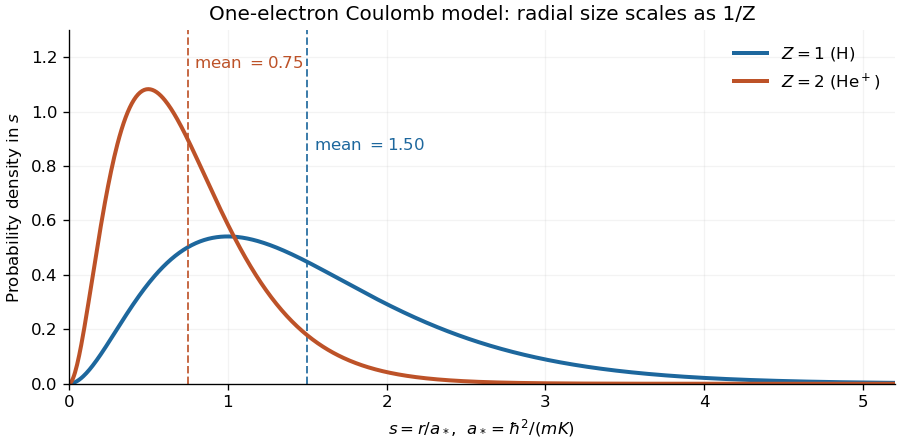
Radial probability densities for the one-electron and Coulomb bound states; dashed lines mark their mean radii
. The horizontal coordinate is . The normalized densities are , so their means are . Details.
The exact comparison in this one-electron model describes the hydrogen-like ion . A neutral helium atom has two electrons; its exact size also depends on their mutual Coulomb interaction and is not determined by this one-electron calculation. The stated half-radius conclusion is the prediction of the model supplied in the paper.
Articles by others on the same topic
There are currently no matching articles.