Take and work in a connected patch with . Setting the line element to zero givesThese are the two families of Rindler null geodesics. They remain on the same side of and approach it only at infinite coordinate time. itself is not an additional geodesic within this chart, since the metric is degenerate there.
The paths can also be written . In two dimensions a null direction has only one independent orthogonal null direction, namely itself, so each smooth null curve is a geodesic after reparametrization. More explicitly, the transformation in part (d) makes these paths straight null lines. The coordinate is generally not an affine parameter.
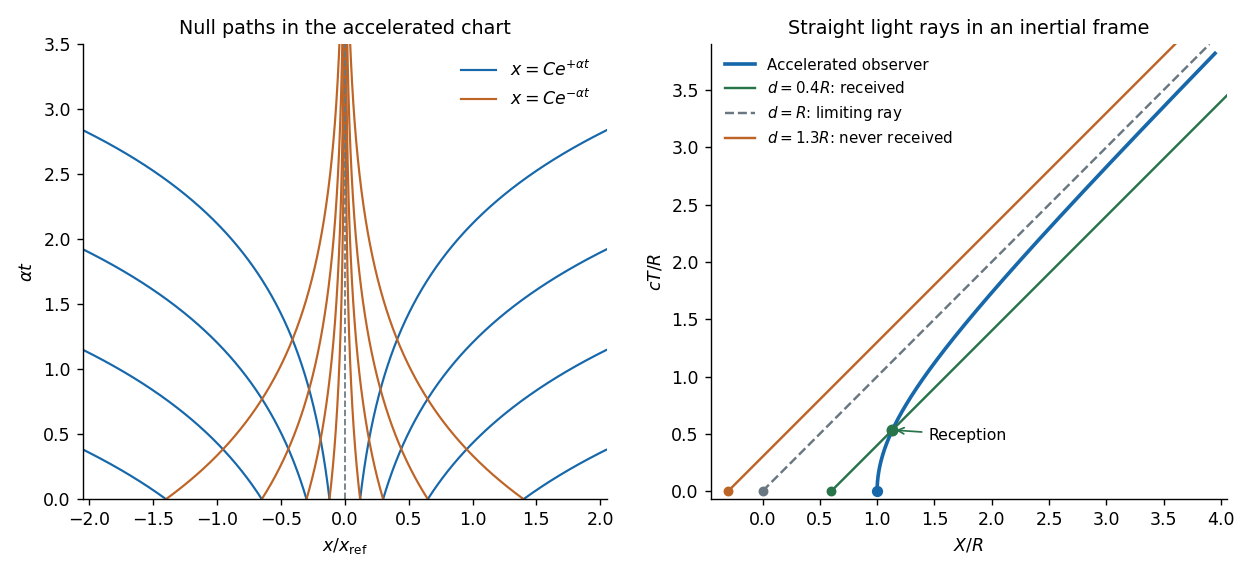
Rindler light rays and the reception horizon of a uniformly accelerated observer
. Original diagrams. The left panel shows the two exponential null families on both sides of the excluded chart boundary. The right panel uses inertial coordinates: a hyperbolic observer receives a signal emitted within its horizon, but cannot receive the horizon ray or a ray emitted farther behind. Length and time are normalized by . Details.
Put and . Radial null geodesics of the Schwarzschild metric obeyNear the horizon, satisfies describes the exterior and the interior. The exponential approach in Schwarzschild coordinate time resembles part (a), but is not a proper radial distance.
Outside, set and retain the leading near-horizon terms. The radial metric becomes the Rindler limit of a Schwarzschild horizon:It agrees with part (a) for , . Accordingly , while explains the factor two in its exponent.
Inside, write . The leading radial metric is insteadHere the radial coordinate is timelike and the Schwarzschild coordinate is spacelike. Thus in the Rindler metric does not represent the black-hole interior: stays positive on both Rindler wedges. In the black-hole interior all future-directed radial light rays move towards decreasing ; the two signs of do not mean opposite future radial directions because is no longer time.
The horizon is a coordinate singularity in Schwarzschild coordinates and in the accelerated chart, not a curvature singularity. The full Schwarzschild geometry nevertheless has genuine tidal forces; the flat Rindler metric captures its leading local radial near-horizon structure.
For coordinates the inverse metric is , . Only is nonzero, giving the Christoffel symbolswith all remaining components zero.
On the specified constant- worldline, assume . The four-velocity is , , and its norm is , so is indeed proper time. The coordinate components are constant, but the covariant acceleration is nonzero:The proper acceleration of a static Rindler observer isThe acceleration has constant components in this accelerated chart and constant invariant magnitude. It is not a covariantly constant vector: its inertial-frame components change along the hyperbolic trajectory. For , the magnitude is , with the appropriate choice of future time orientation.
Differentiating the supplied coordinates givesSubtract the squares. The cross terms cancel and , yieldingThe spacetime is flat Minkowski spacetime in Rindler coordinates. covers , the right Rindler wedge, while covers the left wedge ; neither is the whole spacetime.
The null combinations areFor the first is constant; for the second is constant. Thus part (a)'s exponentials are simply the inertial light rays . Their coordinate-time asymptotes reflect the chart's Rindler horizon, not a failure of light to move at in an inertial frame.
Let be the constant proper acceleration away from the emitter and set . Take the signal emission to be simultaneous, in the initial inertial frame, with the ship being at rest and its clock reading . Place that initial ship event at , . Its hyperbolic motion isA photon emitted from at towards the departing ship follows . At reception,Therefore light reception by a uniformly accelerated observer occurs afterThe same result follows in Rindler coordinates: the ship stays at , the emitter starts at , and the right-moving null ray has . The onboard lapse converts its coordinate catch-up time to the expression above.
If , the ray lies on the limiting null horizon and never intersects it at finite proper time; if , it never reaches the ship. The reception time diverges as the emitter approaches this Rindler horizon. For , , recovering the inertial light-travel time. A different emission time or initial relative velocity would require specifying that extra datum; the formula uses the initial-rest simultaneous-emission convention stated above.
Articles by others on the same topic
There are currently no matching articles.