Write . In the equatorial plane, the geodesic Lagrangian is . The cyclic coordinates and give the conserved quantitiesThe squared tangent norm is constant along an affinely parametrized geodesic, since metric compatibility gives . HenceFor a massive particle parametrized by proper time, ; a photon has a null tangent, so . This denotes the tangent norm, not the photon's physical energy. A future-directed exterior photon has , proportional to its positive Killing energy. Its affine parameter can be rescaled, so there is no mass-shell normalization fixing to a particular positive value.
Set in part (a), substitute the two conserved quantities, and multiply the normalization by :Consequently the null effective potential in Schwarzschild spacetime isOnly radii where the total radial energy is at least this effective potential are accessible.
For , the effective potential vanishes at , rises to a maximum, and then falls to zero as . Its derivative is , so the only circular null geodesic hasThe second derivative there is , proving instability by the effective potential stability criterion. These circular orbits make up the photon sphere. If the formula is continued inside the horizon, the potential is negative and diverges to as . For purely radial light, , the potential is identically zero and there is no circular orbit.
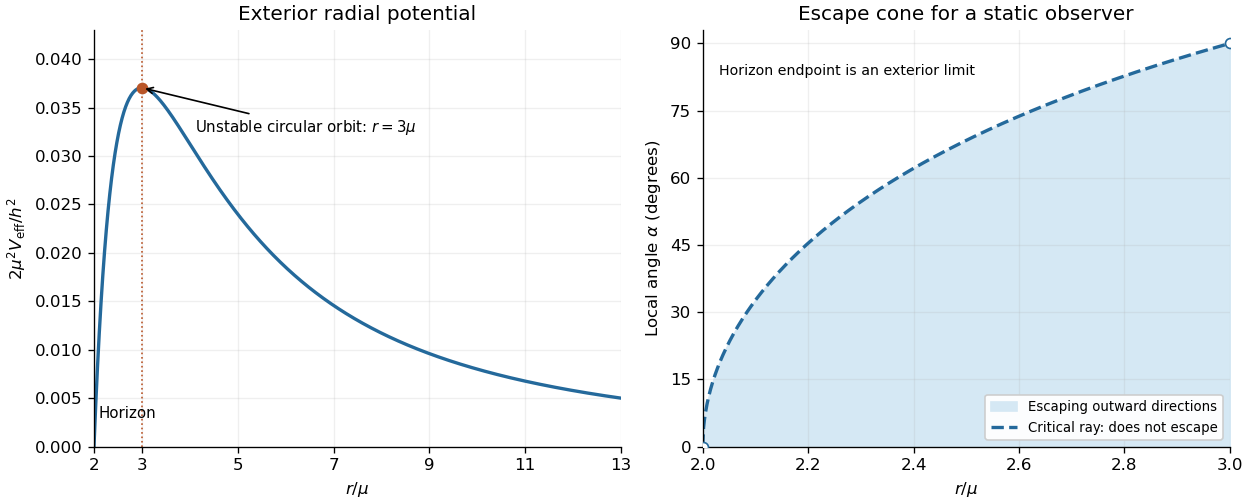
Schwarzschild null radial potential and the static-observer escape cone inside the photon sphere
. Original dimensionless plots. The left panel shows the exterior potential and its maximum at ; the right panel shows the critical escape half-angle for . The horizon endpoint is a limit of exterior static observations. Details.
A photon arriving from infinity crosses the barrier precisely when exceeds the maximum in part (c):At infinity its spatial tangent has speed in affine-parameter units , while is its angular momentum per unit affine normalization. A straight asymptotic ray with impact parameter therefore has . ThusAt equality, the incoming ray approaches the unstable photon sphere asymptotically and is not captured. A larger impact parameter gives an outer turning point and scattering back to infinity.
Measure in the orthonormal tetrad of a static observer at . This specifies the local frame needed to define an angle. If is the conserved photon energy, gravitational redshift gives . The tangential local momentum is , so the impact parameter isInside the photon sphere, an outward ray must have to cross the potential barrier. The Schwarzschild photon escape cone therefore has critical half-angleThe upper bound is strict: a critical ray only approaches the circular orbit. At , the critical half-angle is , and exactly tangential light is circular. As , the cone shrinks to zero opening. No static observer exists exactly on the Schwarzschild event horizon, and no future-directed photon emitted there escapes to exterior infinity; the zero-angle result is an exterior limit.
Articles by others on the same topic
There are currently no matching articles.