A fundamental observer follows the coarse-grained cosmological matter, with fixed comoving coordinates. The cosmological principle asserts spatial homogeneity and cosmological isotropy on large scales for this family of observers. A moving observer generally sees a preferred direction, for example a Doppler dipole in the cosmic microwave background, even when the underlying cosmology is isotropic.
In an FLRW metric, these worldlines are orthogonal to homogeneous spatial slices. Synchronize their clocks to define cosmic time , which is their proper time. Along a fixed spatial label, , giving . Orthogonality of the spatial coordinate directions to the observers' four-velocity gives . Thus, in the metric signature,where the spatial matrix is negative definite. Spatial homogeneity and cosmological isotropy further restrict it to , with a constant-curvature spatial metric.
For radial motion, use the geodesic LagrangianThe Euler-Lagrange equation for gives . Since is a cyclic coordinate, its conjugate momentum is constant. HenceFor a massive particle, take as proper time; the four-velocity normalization is . For a photon, use an affine parameter rather than proper time, and the corresponding tangent is a null vector. ThereforeThe normalization of the null affine parameter remains arbitrary.
Choose the null affine parameter so that the photon tangent is its four-momentum . A fundamental observer has in cosmic-time coordinates, so the measured energy is . The null normalization and conserved radial quantity in part (b) giveThus redshifting of peculiar momentum gives . Since , with the Planck constant, the received-to-emitted frequency ratio is . By the definition of cosmological redshift,
A nearby fundamental observer measures radial proper distance and proper time . Thus the signed radial peculiar velocity isSubstitute and the massive normalization from part (b):Equivalently, for velocity at scale factor ,This is the exact law of redshifting of peculiar momentum. In the nonrelativistic limit, ; an initially relativistic speed stays below and decreases as the universe expands.
Write . In the equatorial plane, the geodesic Lagrangian is . The cyclic coordinates and give the conserved quantitiesThe squared tangent norm is constant along an affinely parametrized geodesic, since metric compatibility gives . HenceFor a massive particle parametrized by proper time, ; a photon has a null tangent, so . This denotes the tangent norm, not the photon's physical energy. A future-directed exterior photon has , proportional to its positive Killing energy. Its affine parameter can be rescaled, so there is no mass-shell normalization fixing to a particular positive value.
Set in part (a), substitute the two conserved quantities, and multiply the normalization by :Consequently the null effective potential in Schwarzschild spacetime isOnly radii where the total radial energy is at least this effective potential are accessible.
For , the effective potential vanishes at , rises to a maximum, and then falls to zero as . Its derivative is , so the only circular null geodesic hasThe second derivative there is , proving instability by the effective potential stability criterion. These circular orbits make up the photon sphere. If the formula is continued inside the horizon, the potential is negative and diverges to as . For purely radial light, , the potential is identically zero and there is no circular orbit.
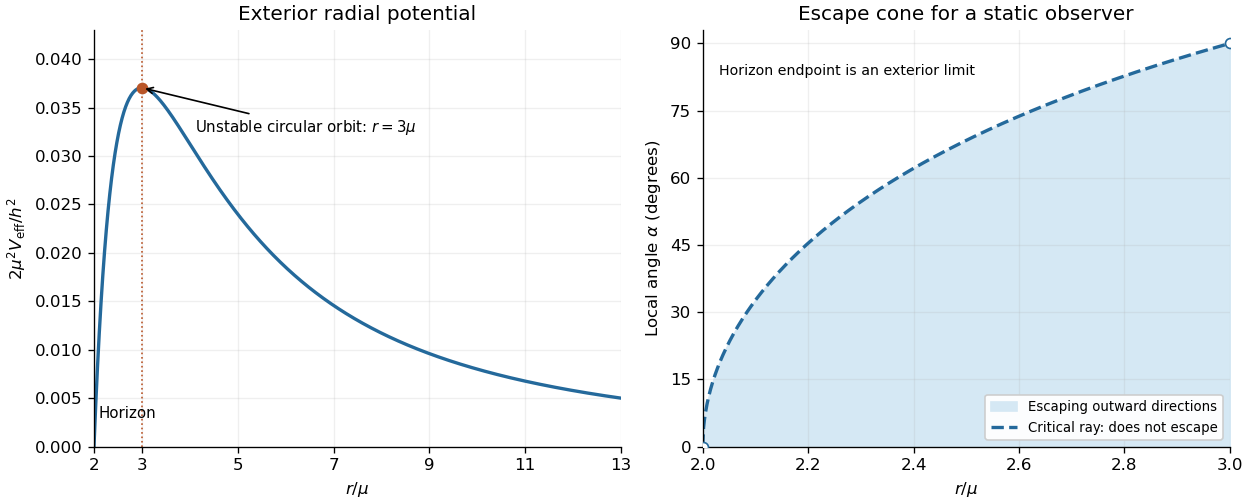
Schwarzschild null radial potential and the static-observer escape cone inside the photon sphere
. Original dimensionless plots. The left panel shows the exterior potential and its maximum at ; the right panel shows the critical escape half-angle for . The horizon endpoint is a limit of exterior static observations. Details.
A photon arriving from infinity crosses the barrier precisely when exceeds the maximum in part (c):At infinity its spatial tangent has speed in affine-parameter units , while is its angular momentum per unit affine normalization. A straight asymptotic ray with impact parameter therefore has . ThusAt equality, the incoming ray approaches the unstable photon sphere asymptotically and is not captured. A larger impact parameter gives an outer turning point and scattering back to infinity.
Measure in the orthonormal tetrad of a static observer at . This specifies the local frame needed to define an angle. If is the conserved photon energy, gravitational redshift gives . The tangential local momentum is , so the impact parameter isInside the photon sphere, an outward ray must have to cross the potential barrier. The Schwarzschild photon escape cone therefore has critical half-angleThe upper bound is strict: a critical ray only approaches the circular orbit. At , the critical half-angle is , and exactly tangential light is circular. As , the cone shrinks to zero opening. No static observer exists exactly on the Schwarzschild event horizon, and no future-directed photon emitted there escapes to exterior infinity; the zero-angle result is an exterior limit.
At any event on a massive observer's worldline, choose an orthonormal tetrad with timelike basis vector . Its components obey , so locally : the Minkowski metric. A local inertial frame can also remove the Christoffel symbols at that event. Curvature cannot be removed on a finite region, and a frame following an accelerated observer need not remain inertial in its neighbourhood.
In general coordinates, labels the trajectory, while the four-velocity and four-acceleration areCoordinate values are not themselves a vector under arbitrary nonlinear coordinate changes; their tangent is. For fixed rest mass , the four-momentum is and the four-force is . With the metric signature,where is the proper acceleration. The middle identity follows by differentiating the constant velocity norm; in the instantaneous rest frame, and , proving the last identity.
The inverse transformation is , . ThusThe metric tensor in these light-cone coordinates is thereforeBoth off-diagonal entries are needed, since the quadratic line element sums over both index orders.
The Lorentz transformation is , in units . Adding and subtracting givesSince and the other factor is its reciprocal,Here is the boost rapidity. Their product is unchanged, as required by invariance of the Minkowski interval.
The proper time normalization of the astronaut's four-velocity gives . In the light-cone coordinates this isThe four-acceleration has squared norm , because is the constant proper acceleration. The same coordinate change therefore givesEquivalently write , . Their second derivatives give , so the rapidity form of one-dimensional proper acceleration makes , with sign fixing the acceleration direction.
For the stated outward-accelerating hyperbola, take positive signed proper acceleration and an initially stationary spaceship. Then , so and . The initial values are , . Integration givesTaking their half-sum and half-difference yields the hyperbolic motionThe printed position data alone do not specify the initial velocity. If the initial rapidity is an arbitrary , the equally valid positive-acceleration solution isThus the requested special expression implicitly selects .
Use the specified hyperbolic trajectory. The emitted right-moving photon follows , so its retarded null coordinate is . Interception at astronaut proper time requiresThe astronaut has velocity relative to the star and . The collinear relativistic Doppler effect givesThis is the Doppler shift for a uniformly accelerated receiver. A finite reception time exists precisely when , so the limiting emission time is , approached from below. At the photon lies on the Rindler horizon and never reaches the astronaut. If reception is restricted to , the full emission range is ; for emission after , it is .
Articles by others on the same topic
There are currently no matching articles.