Molecular area from the adsorption slope. The supplied Gibbs adsorption equation identifies the surface excess number density throughThe logarithm is understood relative to a fixed concentration unit or reference concentration; only concentration ratios enter its differences. The pure-water point supplies a baseline surface tension, but cannot be included in .
An estimate near the later working concentration uses its two bracketing points:Taking room temperature as ,This corresponds to about adsorbed molecules per . The data are not perfectly linear in , so the inferred molecular area depends somewhat on the concentration range: a fit to all five positive-concentration points gives about , while the higher-concentration region gives roughly . An effective area of order – is justified; a concentration-independent exact value is not.
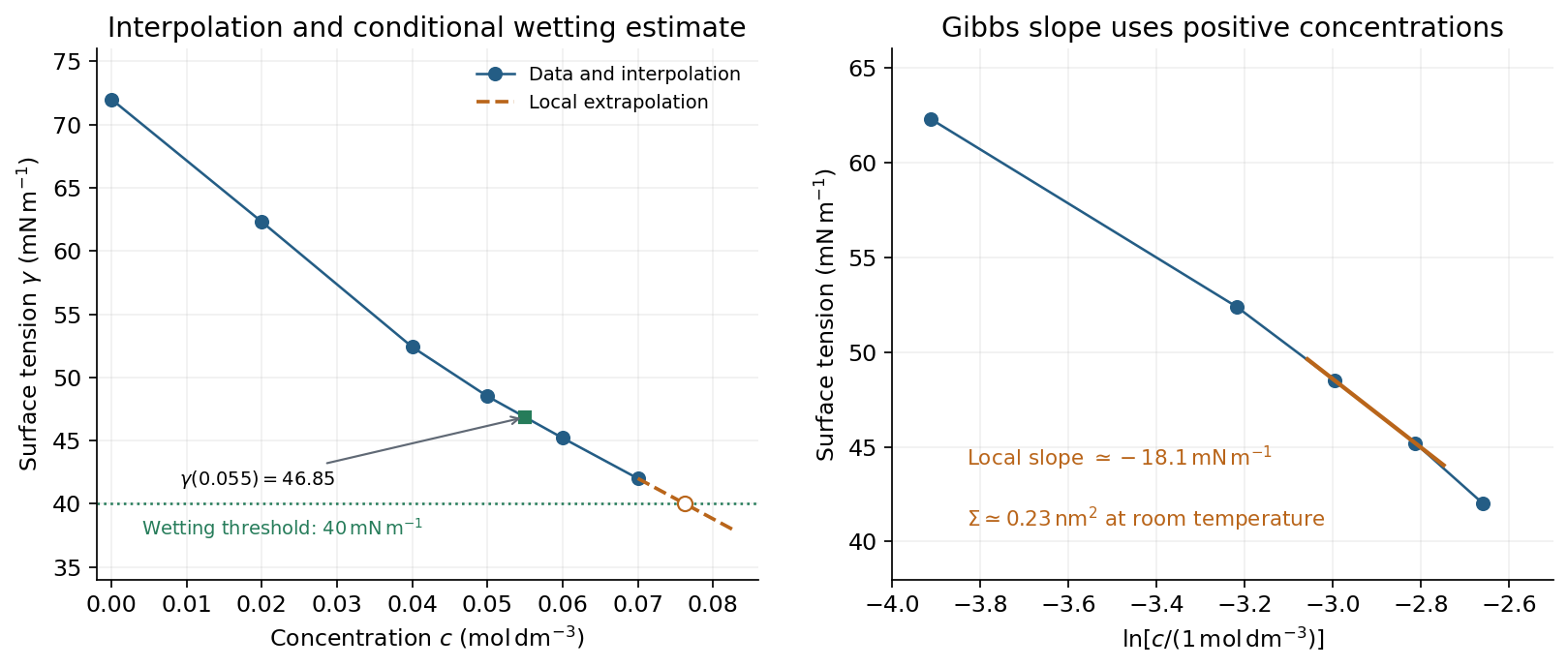
Surface-tension interpolation and extrapolated wetting threshold, alongside the local Gibbs adsorption slope
. Details. 
Contact angle. Linear interpolation between and gives . For an ideal equilibrium contact angle measured through the liquid, Young's equation isThe supplied solid-vapour and solid-liquid values have difference . HenceThis assumes clean homogeneous equilibrium interfaces, negligible contact-angle hysteresis, and the stated solid interfacial energies applicable to the solution.
Complete wetting. The spreading coefficient is . The onset of complete wetting occurs at , or , if the solid interfacial energies remain unchanged. The last measured value is still , so this requires extrapolation beyond the table.
Continuing the last local slope in concentration, per , givesContinuing a constant local Gibbs slope in instead gives approximately . Thus the data suggest a threshold near under continued-trend assumptions, rather than fixing one exactly. A surface-tension plateau caused by micellization, or a change in , could prevent or shift this threshold; no such extra data are given.
Capillary rise. For a circular capillary of radius , vertical surface-tension force balances the weight . Thus capillary action givesUsing , and ,This is the height above the reservoir level in the ideal static capillary approximation; meniscus-volume corrections and contact-angle hysteresis are neglected. The positive gives a rise, rather than a depression.
Articles by others on the same topic
There are currently no matching articles.