The Reynolds number compares inertial and viscous effects:where is fluid mass density, a characteristic swimming speed, a characteristic body length, and the dynamic viscosity. Both swimmers are in the same fluid, so the fluid properties cancel from the ratio:For an order-of-magnitude estimate, take , , and . With water values and , these giveand henceThe dimensions and swimming speeds are estimates, so this ratio is not a universal species-independent constant. Its physical significance is robust: viscous forces dominate the bacterium's motion, whereas fluid inertia is crucial for the whale.
There is a source error to resolve first. For a drag coefficient defined by , the velocity relaxation time is . The mass and drag coefficient in the PDF's exponential are interchanged: is dimensionless, whereas is not. The consistent mean relaxation law is therefore .
A mean relaxation law alone does not determine a variance. Use the usual thermal Langevin equation, with a bath at temperature and the fluctuation-dissipation relation for a Langevin particle:Here the calculation is for one component in Cartesian coordinates. With fixed initial position and velocity, integration gives the mean displacementIntegrating the stochastic part of the velocity once more gives the centered displacementThe delta correlation reduces its variance to a single integral:This is the integrated Ornstein-Uhlenbeck displacement for a prescribed initial velocity. Its short-time variance is ; at long times it is . Thus the diffusion coefficient isIf the requested mean-squared fluctuation instead refers to the conventional equilibrium mean squared displacement, the initial velocity is also averaged over its thermal distribution, with and . Its contribution adds , givingThis has the ballistic limit and the same diffusive limit . For fixed nonzero , the uncentered mean square instead equals the first boxed variance plus . In three independent spatial dimensions, the centered variances add, and the long-time result is . Stating the initial-velocity convention is necessary to distinguish these finite-time formulas.
Two examples are sodium dodecyl sulfate, with a negatively charged sulfate head and a hydrocarbon tail, and cetrimonium bromide, with a positively charged ammonium head and a hydrocarbon tail. Both are amphiphiles: one region is hydrophilic and another is hydrophobic.
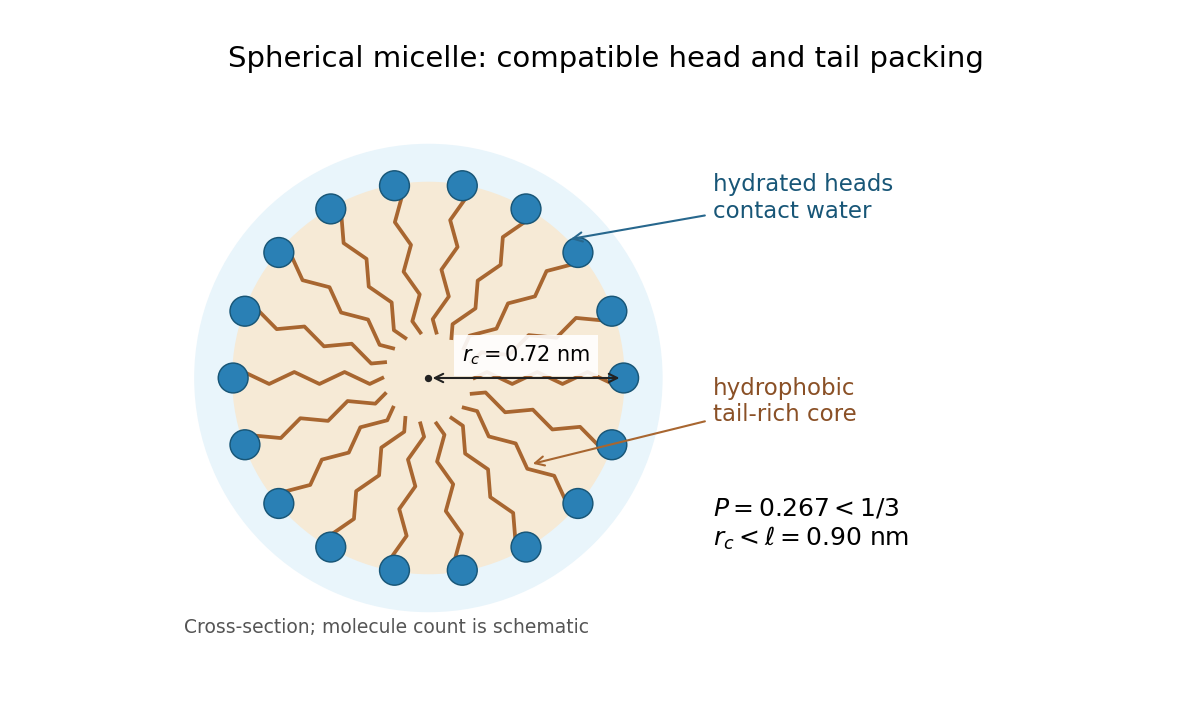
In water, the hydrophobic effect favors association of the tails into a core, reducing their exposed area while the hydrated heads remain outside. This can lower the total Gibbs free energy despite loss of translational entropy. Head-group repulsion, interfacial cost and chain-packing constraints oppose unlimited growth, so finite micelles are favored under suitable conditions above the critical micelle concentration.
The appropriate geometric measure is the amphiphile packing parameter:For a spherical micelle with tails and core radius , the volume and area relations are and . Dividing gives , so a sphere fits without overextending a tail if . Here andThus the packing model predicts spherical micelles. This is a preferred aggregate geometry, not a claim that concentration, temperature or ionic conditions can never alter the morphology.

Articles by others on the same topic
There are currently no matching articles.