Source: released examination bundle,
Part C 2007 11.pdf, pages 372–377. All six questions in both halves are covered. No mark allocations are printed.Write the stochastic differential equation in integral form and replace the unknown integrand by the preceding Picard iterate. With the deterministic initial vector , the recursion isEach iterate is a continuous adapted process. The Itô isometry inductively gives its square integrability on every bounded time interval, so all these Itô integrals are well defined.
Use for the dummy integration variable in the printed integral. The Itô isometry givesThe assumed second-moment bound also proves the integrability needed to apply the Itô isometry. The extra time integration is the source of the factorial improvement.
Set , where the norms are operator norms, and . Independence of the Brownian coordinates and the vector Itô isometry giveInduction, as in part (b), yields the Factorial Picard estimate for a linear stochastic differential equationFor , the triangle inequality in therefore bounds any tail of the iterates by the corresponding tail ofThis numerical series converges by the ratio test: successive terms have ratio . Thus the iterates are Cauchy in , uniformly in the deterministic time parameter on each bounded interval. Completeness of Lp spaces gives a limit . Once its continuous adapted version is chosen in part (d), the Itô isometry permits passage to the limit in the integral equation: the squared norm of each integral difference is bounded by . Consequently the Picard limit solves the stochastic differential equation.
For every , is a continuous square-integrable vector martingale. Its norm is a submartingale, so the Doob L2 maximal inequality and the estimate from part (c) giveThe Cauchy-Schwarz inequality now showsBy Tonelli's theorem, the random sum of these suprema is finite almost surely. Therefore the telescoping series converges absolutely and uniformly on outside one null event. Its limit is continuous and agrees at each fixed time with the limit from part (c). Taking the intersection of the probability-one events for integer provides a single version on the whole half-line. HenceThis also gives the requested pointwise almost-sure convergence of the full sequence.
Standard Brownian motion is centered, so . If , write ; the final increment is independent of and has mean zero. ThusThis is the Brownian covariance kernel. Together with joint Gaussianity and continuous paths, it gives the Gaussian-process characterization of Brownian motion.
For positive times the transformed process is centered and jointly Gaussian, andIts paths are continuous away from zero. To verify continuity at zero, we need almost surely as . The strong law of large numbers applied to the independent increments gives . On the unit interval after , the Doob L2 maximal inequality givesThe Borel-Cantelli first lemma, first for each positive rational , shows that these between-integer fluctuations divided by tend to zero. Hence for all real , and as .
The Gaussian-process characterization of Brownian motion now proves is standard Brownian motion, with respect to its natural filtration. This is time inversion of Brownian motion; the transformed process need not be adapted to the original forward filtration.
The Itô formula for givesThe stochastic integral has expectation zero: its square integrability on a finite horizon follows from the finite sixth moments of a normal distribution. Since , integration and expectation yield
Put and . In the two-variable Itô formula, has finite variation, while the only nonzero quadratic term is . ThereforeThis proves the stochastic exponential solves the equation. Its initial value is ; no normalization was stipulated.
The resulting process is initially a continuous local martingale. Since and ,A bounded local martingale is a true martingale: apply the martingale identity to a localizing sequence and use dominated convergence in conditional expectations. The deterministic bound works on every finite horizon, proving is a martingale on every . The bound on also gives a positive deterministic lower bound , although the upper bound already proves the martingale assertion.
There is a printed domain error: defines the right half-plane. Taken literally, continuity forces almost surely, so its law is a point mass at zero. The displayed density belongs to the intended upper half-plane , with . We prove that intended assertion explicitly.
Write for independent standard Brownian motions. The exit time is the first time hits , and depends only on . Its density, by the supplied Brownian first-passage time law, is . Conditional on , the real exit coordinate is normally distributed with mean and variance . Independence therefore givesWith , the integral is . Thus the Cauchy exit law from a Brownian half-plane isFor the literal right half-plane, the corresponding nondegenerate coordinate is , whose density is for .
If is a conformal map, the image of planar Brownian motion in is Brownian motion in after the increasing clock changeMore precisely, is planar Brownian motion, starting at and run up to the relevant exit time. The Itô formula and the Cauchy-Riemann equations give image-coordinate local martingales with common bracket and zero cross bracket; the Lévy characterization of multidimensional Brownian motion identifies the time-changed process. In particular, conformal invariance of planar Brownian motion transports exit locations and harmonic measure, while changing traversal speed.
For in the strip,so . This is a bijective conformal map onto the upper half-plane. One way to verify bijectivity is to factor it as , followed by . The first map gives , . The two inverse roots of the second map have product one; for any point in the upper half-plane exactly one root has modulus greater than one, and its imaginary part is positive because .
The three boundary pieces map as follows: the lower edge goes to , the upper edge to , and the vertical edge to . Thus the desired exit event becomes exit from the upper half-plane to the left of . WriteBy conformal invariance of harmonic measure and the Cauchy exit law from a Brownian half-plane,The strip exit is finite almost surely, since its imaginary coordinate exits in finite time; corners have probability zero because individual points are polar points for planar Brownian motion. This is the Top-edge exit probability of a Brownian half-strip.
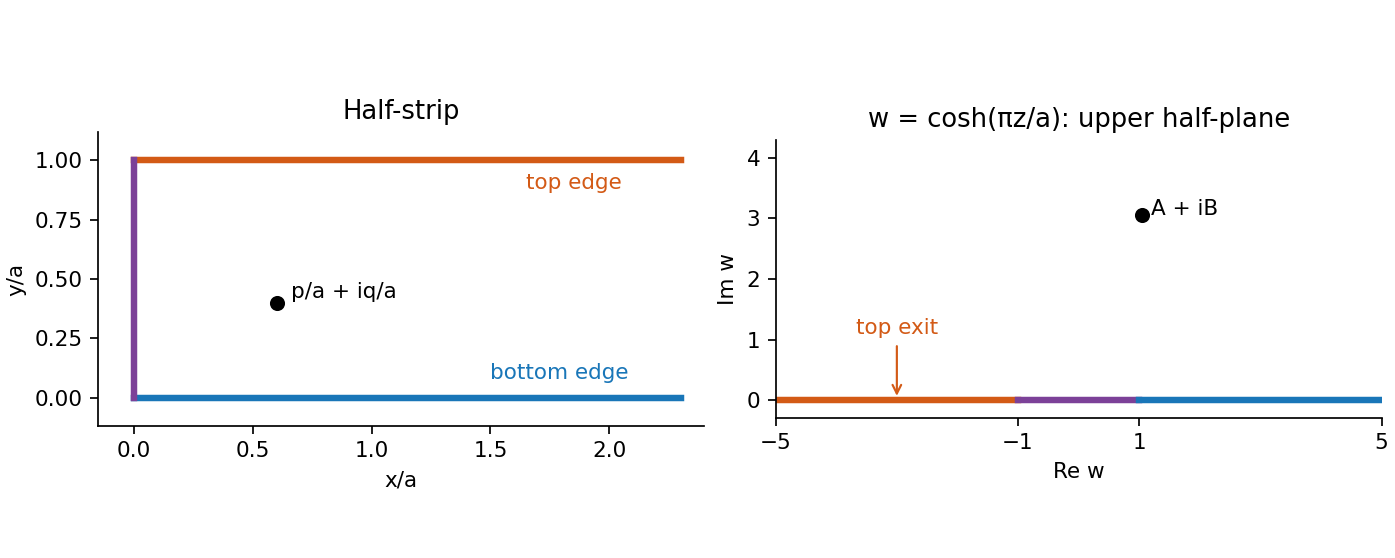
Boundary pieces of the half-strip under the hyperbolic-cosine map
. Details. 
Let . With and fixed,The principal arctangent satisfies throughout this interval. Substitution givesFar from the vertical boundary, the limit agrees with the one-dimensional Brownian motion probability of reaching height before zero.
The disk exit time is finite almost surely; for example, either coordinate of the planar Brownian motion eventually leaves . By path continuity, the exit lies on the unit circle. Starting at the origin, rotational invariance of planar Brownian motion makes the exit law invariant under every circle rotation. The unique rotation-invariant probability measure is normalized arc length. Consequently is uniform on the unit circle, or equivalently its angle has density on .
By conformal invariance of planar Brownian motion, has the uniform boundary law from part (a), because the image process starts at zero. A disk automorphism extends to an orientation-preserving boundary diffeomorphism. Choose a continuous angular lift satisfyingThe principal-angle version may have a branch jump, which is harmless for the density. The change of variables for probability densities yields the exit-angle density . Differentiating the boundary relation givesTaking absolute values proves . ThereforeThe angular lift explains rigorously the derivative appearing in the printed hint despite the principal-angle branch cut.
By Brownian scaling, is planar Brownian motion started at . Its unit-disk exit angle is exactly the original radius- exit angle. Substitute into the supplied Poisson kernel for the unit disk:This density is with respect to angle . Its density with respect to arc length would be smaller by a factor .
Put . The triangle inequality gives , so the Poisson kernel for the unit disk obeysIf , replace the lower bound by and the upper bound by . Integrating against the positive measure givesHere is exactly the uniform boundary average from part (a). Positivity permits multiplication of the pointwise kernel bounds; continuity on the compact circle ensures all integrals are finite. This is the Harnack inequality on the unit disk.
Use first that planar Brownian motion avoids a fixed point, so the path starting at never reaches zero. Its continuous logarithmic lift, initialized at zero, has real part and imaginary part the continuous unwrapped angle . Local branches of the complex logarithm, patched along the path, and the Itô formula show that both coordinates are continuous local martingales withThe clock is finite on every compact time interval, since a continuous nonvanishing path stays a positive distance from zero there. It is continuous and strictly increasing. Moreover : by recurrence, planar Brownian motion spends infinite total time in a fixed disk, and inside the unit disk the clock integrand is at least one. This is the divergence of a positive planar Brownian occupation integral.
The common-clock time change of orthogonal local martingales, using the Lévy characterization of multidimensional Brownian motion, supplies independent Brownian coordinates such that . Exponentiating givesTo identify the inverse clock, write . The derivative of an inverse function and the representation just obtained giveConsequentlyThe strict inequality in this generalized inverse has the same infimum as the unique inverse value, since is continuous and strictly increasing onto the half-line.
Assume , as required for the annulus and logarithms. The logarithmic radius of planar Brownian motion is a local martingale. Stopping at keeps it between the constants and , so the stopped process is a bounded martingale. The exit time is finite almost surely because the annulus is bounded and Brownian motion eventually exits its containing disk.
The optional stopping theorem followed by dominated convergence gives . Continuity puts the exit radius at either or . If is the inner-exit probability, then . HenceStopping before taking expectations matters: the unstopped logarithmic-radius process is a strict local martingale, so one cannot assume its unrestricted expectation is constant.
The second coordinate is one-dimensional Brownian motion, whose zero set is unbounded almost surely by recurrence. The clock and its inverse are continuous, increasing, and unbounded, so the unwrapped angle has zeros at arbitrarily large original times.
To ensure the times are stopping times for the original Brownian filtration, define directlyThe logarithmic lift makes a continuous adapted process. Hitting a closed set after a stopping time is a stopping time under the usual filtration conditions, and the unbounded zero set proves inductively that each is finite almost surely. Since , the sequence tends to infinity, and continuity givesGeometrically, the Brownian path returns to the positive real ray at arbitrarily late times with zero net unwrapped winding angle about the origin. The assertion is stronger than principal argument zero, which also allows any integer number of completed turns.
The long-time Spitzer winding theorem states that, for the continuous unwrapped angle of planar Brownian motion started at ,Here has the standard symmetric Cauchy distribution. The notation means convergence in distribution: for every real ,Equivalently, expectations converge for every bounded continuous test function. This is a statement about the laws at large deterministic times, without asserting almost-sure convergence of sample paths. The angle is unwrapped; a principal argument is bounded and would instead give zero after division by .
Articles by others on the same topic
There are currently no matching articles.