Assume for the directions and parametrizations; the boost formulas retain their signed meaning for reversed fields. A Lorentz boost with velocity along transforms the transverse electric field and magnetic field asIn the electric-dominated case chooseThe inequality ensures , so this is an inertial frame. The field-removing boosts for perpendicular electric and magnetic fields are governed by the electromagnetic field invariants and explain why a purely electric inertial frame exists and a purely magnetic one does not.
The electron is not initially at rest in this convenient inertial frame: its initial velocity is and its initial three-momentum is . Thereafter , while stays constant. The electric field accelerates it toward ; as its relativistic energy increases, its negative transverse velocity decreases in magnitude. Defining and gives a useful parametric world line:Here is the proper time. These formulas follow by integrating , , and constant . Its projection onto the plane is a hyperbola, but the spatial trajectory includes the initial transverse motion and is not a straight line.
Transforming back with , givesThe laboratory trajectory starts from rest toward , then bends toward . It is unbounded in and ultimately has and . Thus the late velocity has magnitude as a limit, consistent with the relativistic energy-momentum relation, rather than undergoing a closed cyclotron orbit.
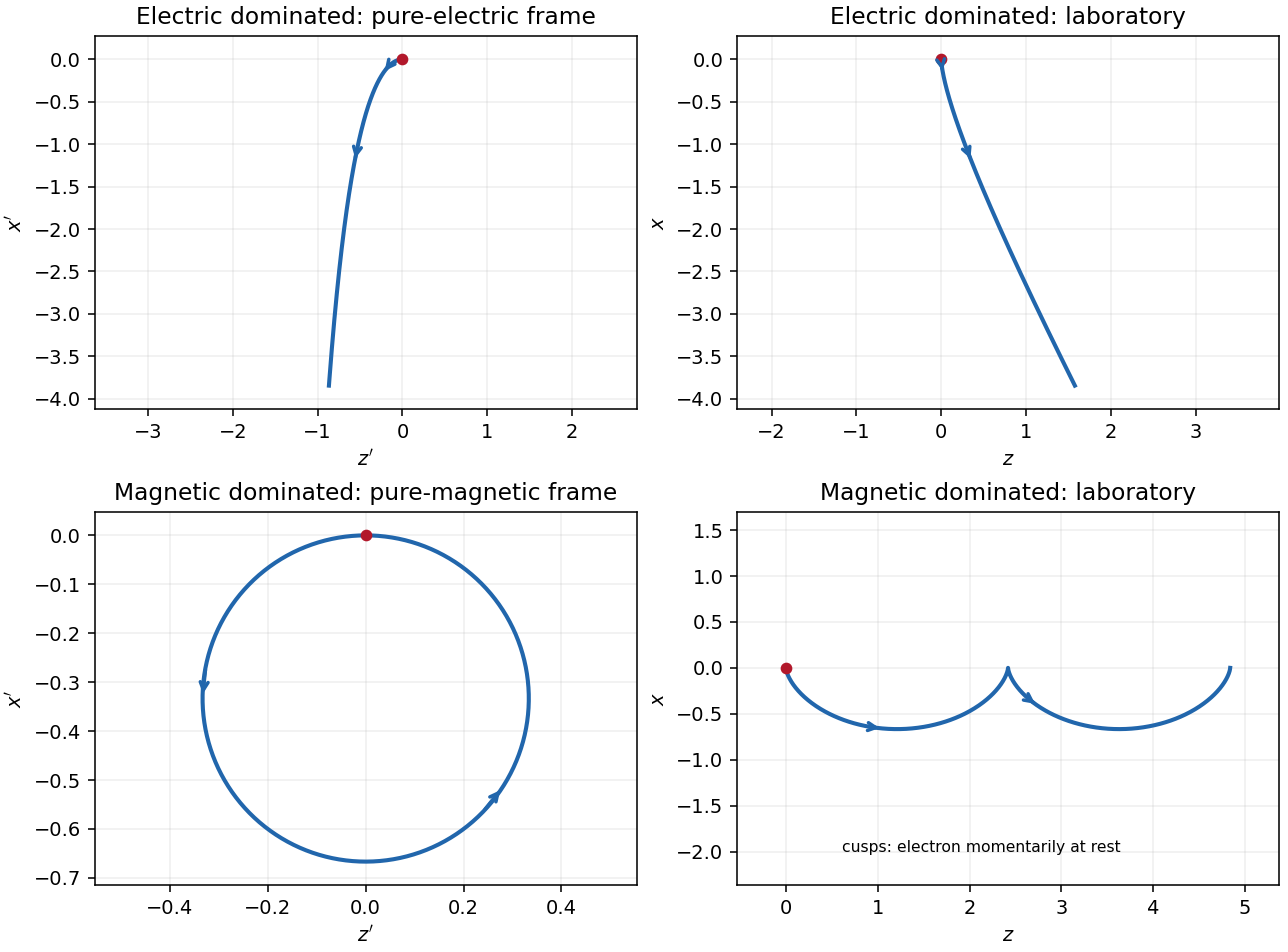

In the magnetic-dominated case the suitable Lorentz boost instead hasThe hypothesis gives . The electromagnetic field invariants now have , allowing a purely magnetic inertial frame. The initial velocity is again , perpendicular to . Since a magnetic field does no work, the electron's relativistic energy and speed in this inertial frame remain constant. Its trajectory is a circle in the plane with Lorentz factor and cyclotron frequency .
For , set and . A parametrization with the correct initial velocity and Lorentz force isTransforming the world line back to the laboratory givesThe laboratory trajectory is a stretched cycloid, with cusps at where the electron is momentarily at rest. It first accelerates toward , then curves toward , returning to its original coordinate each cycle while advancing in . Its mean drift is , the E-cross-B drift. Its laboratory kinetic energy oscillates as the electric field does positive and then negative work; it does not grow indefinitely. The strict inequalities in the two branches exclude the null case , where neither field can be removed by a finite Lorentz boost.
Articles by others on the same topic
There are currently no matching articles.