Assume for the directions and parametrizations; the boost formulas retain their signed meaning for reversed fields. A Lorentz boost with velocity along transforms the transverse electric field and magnetic field asIn the electric-dominated case chooseThe inequality ensures , so this is an inertial frame. The field-removing boosts for perpendicular electric and magnetic fields are governed by the electromagnetic field invariants and explain why a purely electric inertial frame exists and a purely magnetic one does not.
The electron is not initially at rest in this convenient inertial frame: its initial velocity is and its initial three-momentum is . Thereafter , while stays constant. The electric field accelerates it toward ; as its relativistic energy increases, its negative transverse velocity decreases in magnitude. Defining and gives a useful parametric world line:Here is the proper time. These formulas follow by integrating , , and constant . Its projection onto the plane is a hyperbola, but the spatial trajectory includes the initial transverse motion and is not a straight line.
Transforming back with , givesThe laboratory trajectory starts from rest toward , then bends toward . It is unbounded in and ultimately has and . Thus the late velocity has magnitude as a limit, consistent with the relativistic energy-momentum relation, rather than undergoing a closed cyclotron orbit.
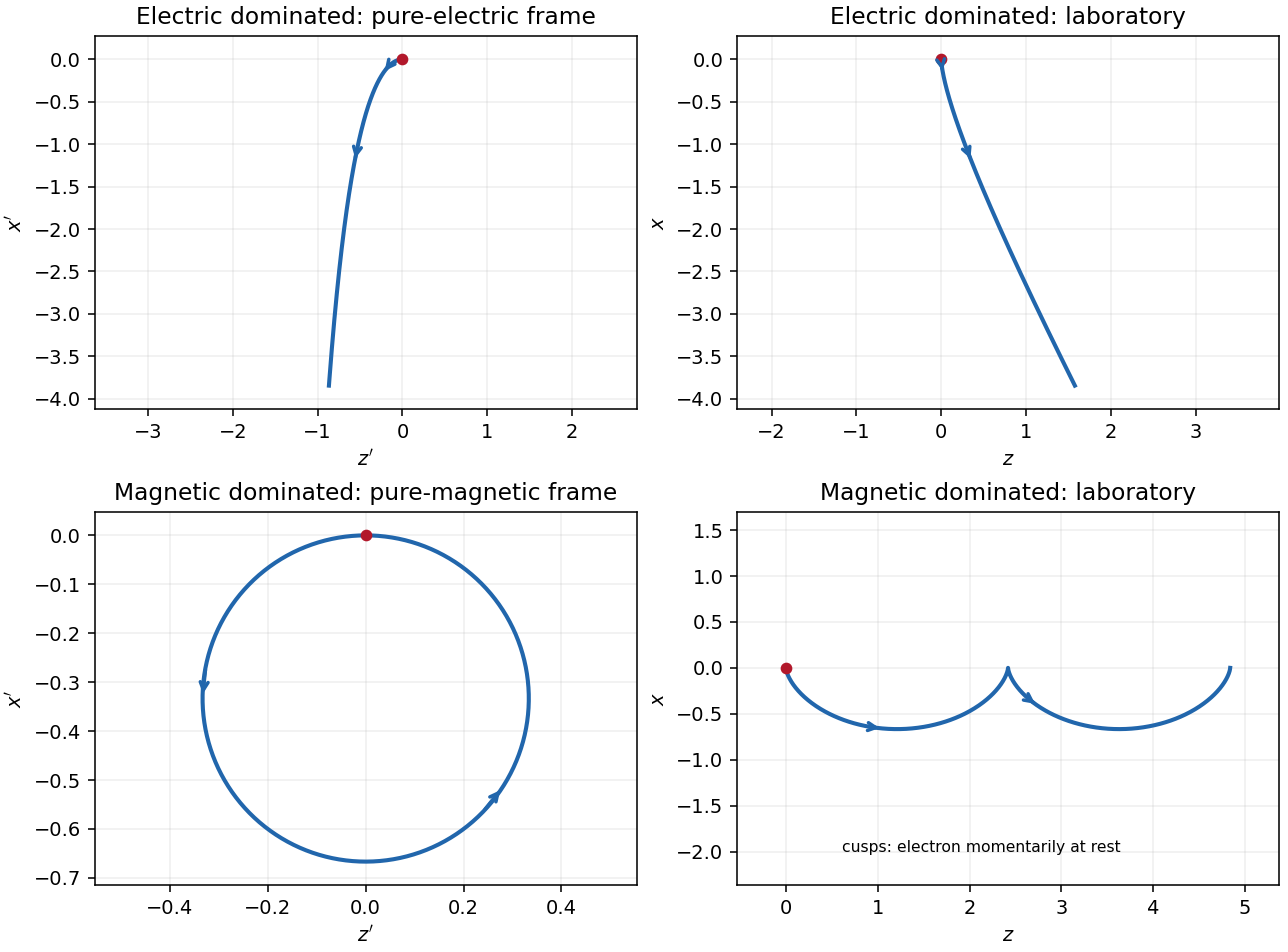

In the magnetic-dominated case the suitable Lorentz boost instead hasThe hypothesis gives . The electromagnetic field invariants now have , allowing a purely magnetic inertial frame. The initial velocity is again , perpendicular to . Since a magnetic field does no work, the electron's relativistic energy and speed in this inertial frame remain constant. Its trajectory is a circle in the plane with Lorentz factor and cyclotron frequency .
For , set and . A parametrization with the correct initial velocity and Lorentz force isTransforming the world line back to the laboratory givesThe laboratory trajectory is a stretched cycloid, with cusps at where the electron is momentarily at rest. It first accelerates toward , then curves toward , returning to its original coordinate each cycle while advancing in . Its mean drift is , the E-cross-B drift. Its laboratory kinetic energy oscillates as the electric field does positive and then negative work; it does not grow indefinitely. The strict inequalities in the two branches exclude the null case , where neither field can be removed by a finite Lorentz boost.
Use the electromagnetic field tensor convention stated above, and lower indices with the Minkowski metric . Lowering a single time index changes its sign. Summing both orders of each antisymmetric index pair gives the Lorentz scalarFor , and . Direct substitution in the printed electromagnetic stress-energy tensor yieldsFor a spatial index , and . HenceThus the full top row isHere is the electromagnetic energy density and the Poynting vector, using . By the symmetry , these components describe both energy flux divided by and times the electromagnetic momentum density . Keeping the factor is essential because the time coordinate is .
Let starred quantities denote the capacitor's rest inertial frame, , , and . Work in the uniform interplate region of an ideal parallel-plate capacitor, neglecting its fringing field of a capacitor. To transform from that rest inertial frame to a laboratory in which the capacitor moves along , use the positive-sign Lorentz transformationFor a purely electric field, the spatial block of the electromagnetic stress-energy tensor isThis is the negative of the Maxwell stress tensor: it has along the electric field and perpendicular to it. The stress contribution to energy transport in a moving capacitor is essential to the Lorentz transformation of the energy density and flux.
Plates parallel to . Choose and . The electromagnetic field tensor and electromagnetic stress-energy tensor areThe transformed nonzero independent electromagnetic field tensor components are and . Thus and , consistent with . Transforming the electromagnetic stress-energy tensor givesIn particular, the laboratory Poynting vector is , and the electromagnetic energy density is . The ratio is subluminal for , but differs from the capacitor's velocity. The difference from a simple convective flux isThe extra term is , the rest-frame stress multiplied by the velocity. This shows why treating stored field energy as an unstressed parcel moving rigidly with the plates misses part of the energy transport.
Plates parallel to . Now . The rest tensors areThe electric field is parallel to the Lorentz boost, so remains unchanged and . The cancellation between and givesThere is no Poynting flux in the ideal interior in this orientation, although the region containing the electric field moves. The longitudinal negative stress contribution cancels the convective term: . Field energy is removed at the receding boundary and supplied at the advancing boundary by work on the charged plates; it need not flow through the interior to accompany the moving region. At edges, omitted fringing fields provide additional local structure.
For a finite idealized interplate rest volume , length contraction gives . The field-only integrated laboratory energies would consequently be and , with . Their different transformation laws are not paradoxical: the field alone is not a closed system. Include the plates and the supports holding them apart, whose mechanical stresses balance the Maxwell stress tensor. The total closed-system four-momentum then has the ordinary Lorentz transformation law. This is the same distinction between a subsystem and a conserved whole that appears in b.
Articles by others on the same topic
There are currently no matching articles.