The inviscid equations are and . Write , and retain only linear terms. With , barotropy gives . Irrotational perturbations allow . The momentum equation integrates to , after using the time-dependent gauge of to remove the spatially constant integration term. ThusSubstitution into gives the acoustic wave equation .
Impermeability imposes homogeneous Neumann data: at and at . Separation of variables therefore givesOne may take without duplication. For a nontrivial oscillation they are not both zero. A time-independent spatially constant potential is a gauge mode at zero frequency, rather than an additional sound oscillation.
At leading order the two wall conditions may be evaluated on the undeformed line : shifting the evaluation point multiplies small perturbations and creates only second-order errors. The dynamic relation and the linear Bernoulli relation give . Differentiate this in time and use :The sign follows from the convention that positive pressure displaces the upper wall upward.
Retain the rigid-wall cosine in and the lower-wall cosine in :The wave equation gives . The upper-wall condition gives , henceFor nonzero real , eliminating gives with , .
On every interval , the left side decreases from positive infinity to zero, while the right side is finite and positive. Continuity gives at least one intersection per interval for each . The functions are analytic between their poles, so roots are isolated there; their union over countably many intervals is a countably infinite set. Reflection gives the redundant negative- solutions. For , the limiting formal root is the zero-frequency gauge mode, not one of these positive-frequency branches.
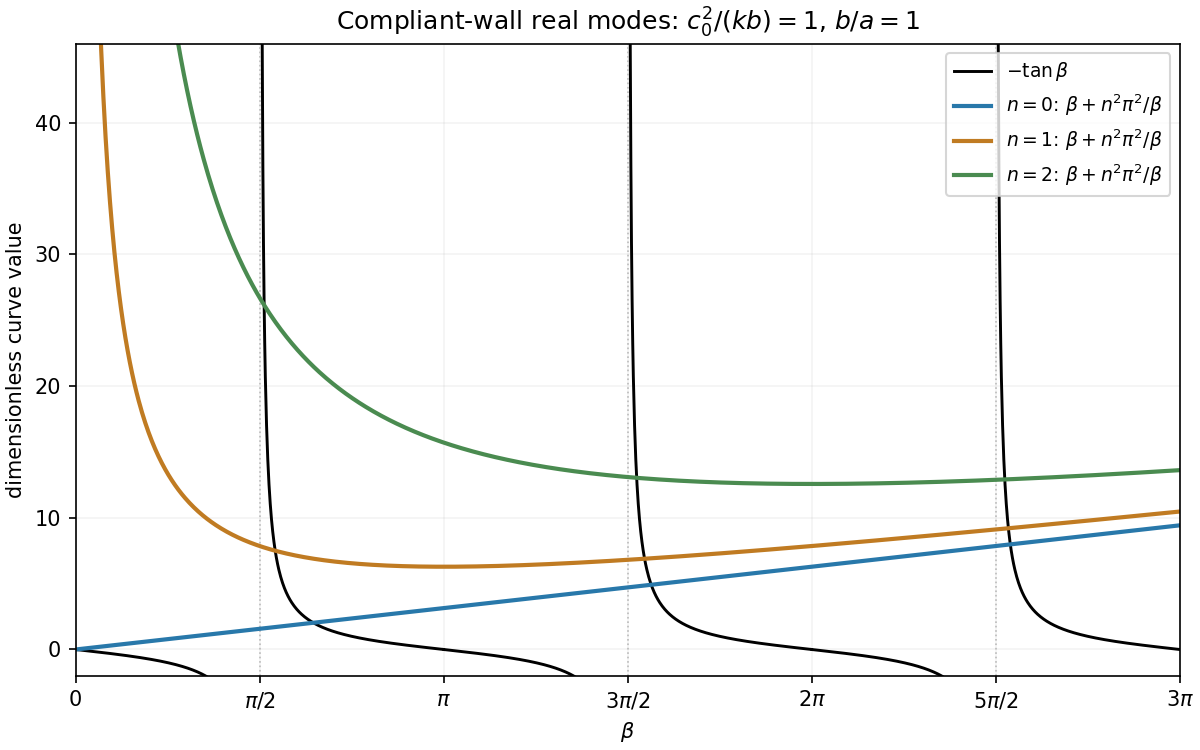

The graph uses representative dimensionless values and ; the interval argument applies for all positive values. For fixed and fixed branch , take . The positive right side becomes large, forcing the intersection towards the tangent pole from the right:More precisely, if , then . Therefore the requested real-branch frequencies satisfyThe limiting upper condition is effectively pressure release for these acoustic branches. No claim is made here about imaginary or other complex branches, which were excluded from the requested analysis.
Articles by others on the same topic
There are currently no matching articles.