The inviscid equations are and . Write , and retain only linear terms. With , barotropy gives . Irrotational perturbations allow . The momentum equation integrates to , after using the time-dependent gauge of to remove the spatially constant integration term. ThusSubstitution into gives the acoustic wave equation .
Impermeability imposes homogeneous Neumann data: at and at . Separation of variables therefore givesOne may take without duplication. For a nontrivial oscillation they are not both zero. A time-independent spatially constant potential is a gauge mode at zero frequency, rather than an additional sound oscillation.
At leading order the two wall conditions may be evaluated on the undeformed line : shifting the evaluation point multiplies small perturbations and creates only second-order errors. The dynamic relation and the linear Bernoulli relation give . Differentiate this in time and use :The sign follows from the convention that positive pressure displaces the upper wall upward.
Retain the rigid-wall cosine in and the lower-wall cosine in :The wave equation gives . The upper-wall condition gives , henceFor nonzero real , eliminating gives with , .
On every interval , the left side decreases from positive infinity to zero, while the right side is finite and positive. Continuity gives at least one intersection per interval for each . The functions are analytic between their poles, so roots are isolated there; their union over countably many intervals is a countably infinite set. Reflection gives the redundant negative- solutions. For , the limiting formal root is the zero-frequency gauge mode, not one of these positive-frequency branches.
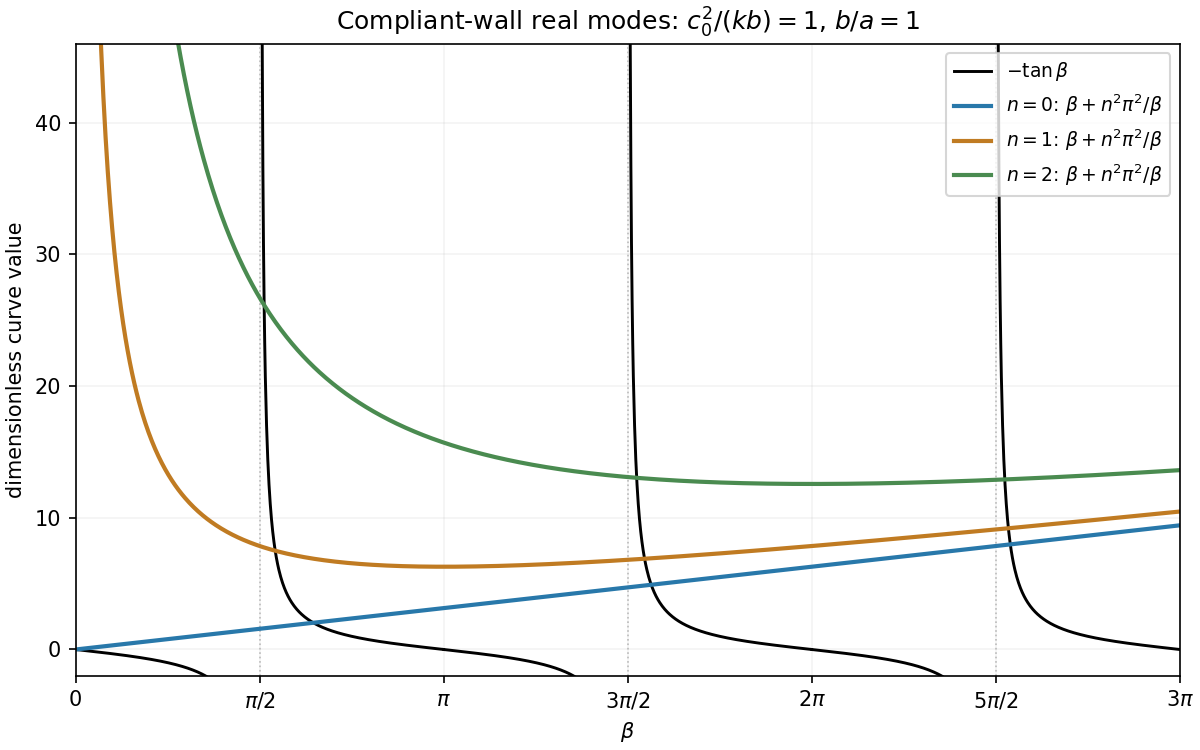
The graph uses representative dimensionless values and ; the interval argument applies for all positive values. For fixed and fixed branch , take . The positive right side becomes large, forcing the intersection towards the tangent pole from the right:More precisely, if , then . Therefore the requested real-branch frequencies satisfyThe limiting upper condition is effectively pressure release for these acoustic branches. No claim is made here about imaginary or other complex branches, which were excluded from the requested analysis.
Split into the two tails and the interval . On each tail has a fixed nonzero sign, so changing variable to produces a nonstationary Fourier integral. Under the usual decay and regularity needed for integration by parts, these pieces are .
Near the nondegenerate stationary point, make the signed local changeIt has at zero and makes the phase exactly . The transformed amplitude tends to . Scale by and use the Fresnel integral to obtainThe tails are smaller than this leading stationary contribution. If , complex conjugation of the Gaussian phase changes the phase correction to and replaces the second derivative by its absolute value:When the leading coefficient is nonzero this may be written as an asymptotic equivalence. For full rigor, continuity of an arbitrary amplitude alone is not sufficient for the stated nonstationary rate, nor does it ensure convergence of an infinite integral. Piecewise differentiability with integrable derivative, bounded variation, or an equivalent localization/decay hypothesis supplies the usual missing assumption. The exponentially decaying beam amplitude below has the required piecewise regularity.
Use and the inverse factor . Fourier transformation gives . The supplied Lorentzian transform and zero initial velocity therefore implyAlong , split the cosine into two exponentials. Their phases are , with stationary points , phase values and second derivatives . Both amplitudes equal . The two stationary-phase contributions are conjugate, givingThus the finite-width pulse retains a ray-dependent attenuation. In the further regime , it may be replaced by one, recoveringThe large-time ray limit means is fixed. Merely making both and large does not justify dropping the attenuation if becomes large compared with . The leading oscillation decays as because each saddle samples a Fourier band of width .
Integrate each steady one-dimensional conservation law across a thin region enclosing the shock. Mass conservation gives constant mass flux . Momentum conservation includes both advected momentum and pressure force, so is constant. The total energy flux is , where . For a genuine shock , division by the mass flux and the equation of state give the conserved stagnation enthalpyThus the Rankine-Hugoniot conditions for a perfect gas areThe velocities here are measured in the stationary shock frame; a moving-shock problem must first be transformed to that frame.
Let state zero be the undisturbed gas and state one the uniform gas between piston and shock. Their laboratory velocities are zero and . In the shock frame their speed magnitudes are and . Mass and momentum jumps giveEnergy conservation gives . Substitute the preceding relations and , then divide by the nonzero . The result isThe right-moving root isThe other root is negative and does not describe the outgoing shock. For , the quadratic is negative at , hence its positive root obeys : the shock stays ahead of the piston and the density ratio is positive.
The second law requires the specific entropy to increase along the fluid's passage through a nontrivial physical shock: . For a perfect gas this selects a compressive shock, whose upstream shock-frame Mach number is greater than one and whose downstream shock-frame flow is subsonic.
Here the upstream Mach number is . The quadratic gives , so . Density and pressure both rise. With , one also has . For example, put and use the normal-shock identityThe characteristic geometry is therefore . The plus-family characteristics from the gas ahead are overtaken by the shock, while those behind catch up with it; they converge into the discontinuity. The minus-family speeds are ahead and behind. The piston is the line and the shock is the steeper-in- line .
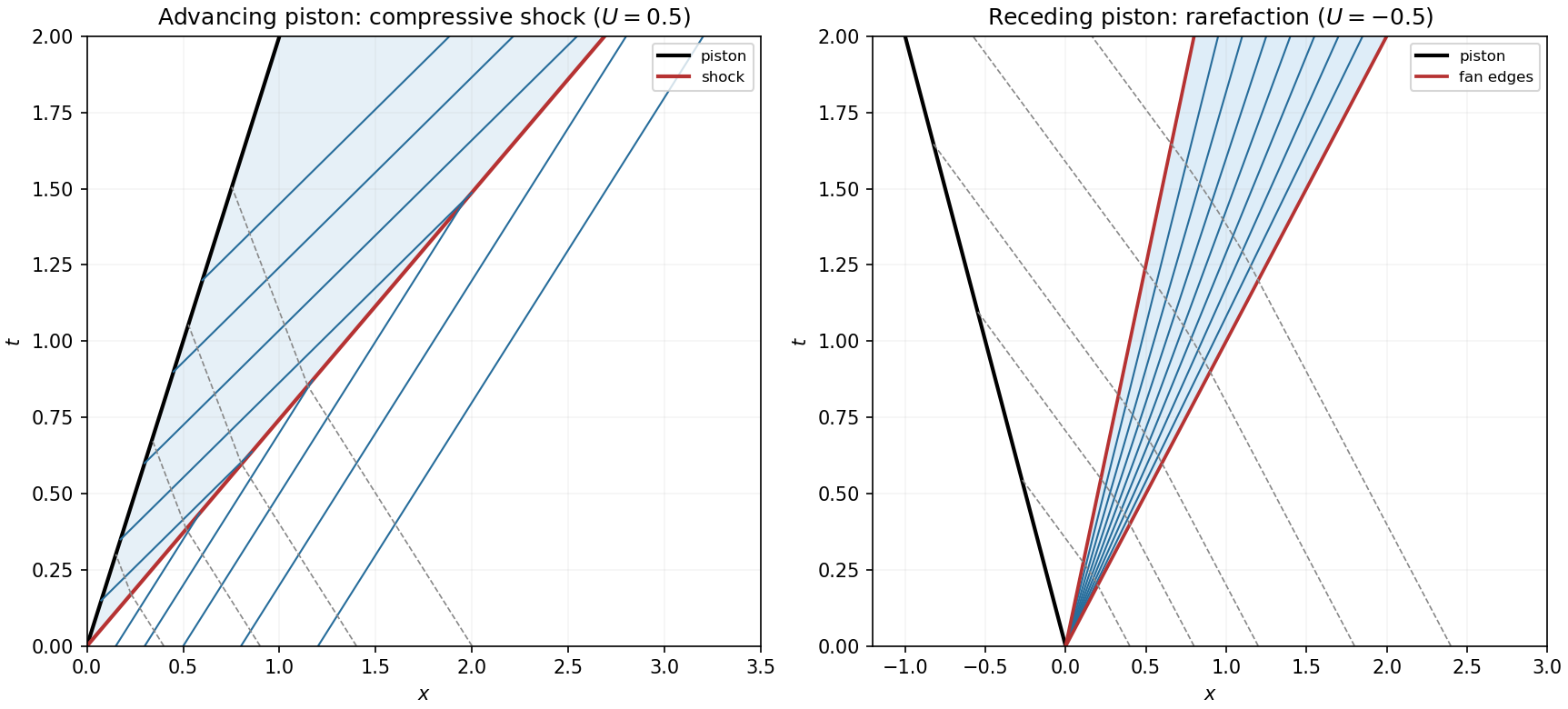


For the same positive algebraic root remains real and satisfies , because . The jump relations then give a density decrease, , and a pressure decrease. Where both states remain thermodynamically positive, this is an expansion shock: its upstream shock-frame flow is subsonic and its entropy change has the forbidden sign. At sufficiently large negative the formula even predicts nonpositive pressure, an additional reason it cannot represent a physical gas state.
The observed outgoing wave is instead a continuous isentropic rarefaction wave. Its plus-family rays spread from the initial piston corner rather than coalescing. The fan head enters the undisturbed gas at ; for moderate recession the tail is , with the uniform gas next to the piston moving at and . The appropriate Riemann invariant is , so inside the fan, with ,These expressions show the spreading characteristics in the right panel of the preceding figure. If , the gas cannot follow the piston with positive sound speed; a vacuum gap forms, bounded by the limiting rarefaction wave edge. Thus the fan description also identifies the strong-recession limit.
Articles by others on the same topic
There are currently no matching articles.