The flux average for a translating lubrication gap follows by integrating the pressure gradient between the endpoints:If were smaller than the minimum height, the integrand would be strictly positive everywhere, contradicting zero total pressure change. If it were larger than the maximum, the integrand would be strictly negative. ThereforeEquivalently,is a weighted average of the height with strictly positive weight . This also identifies the constant flux uniquely.
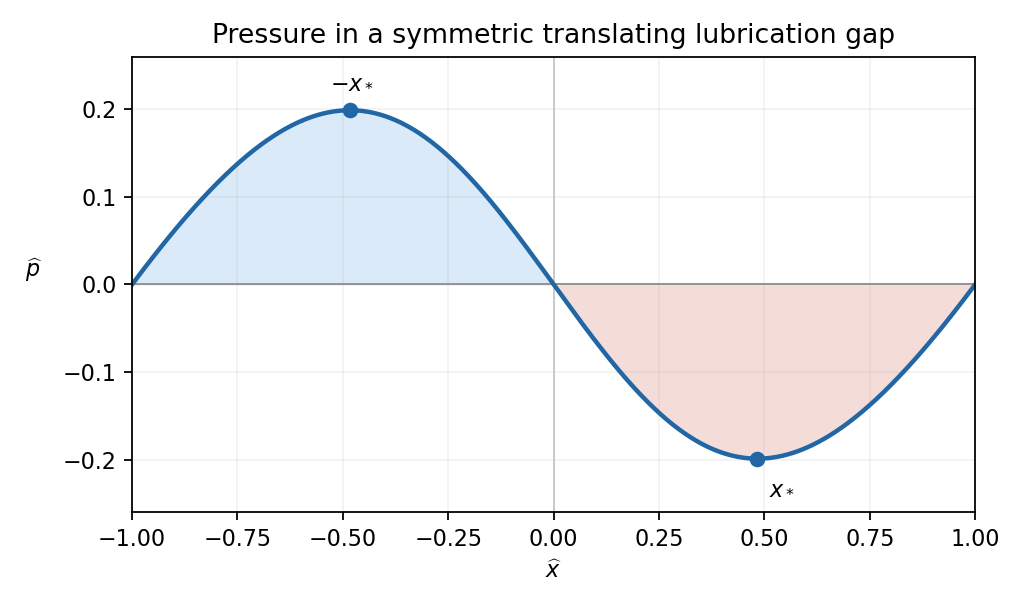
For pressure lobes in a symmetric translating lubrication gap, the height integrals areHenceThe denominator of the pressure gradient is positive. Its numerator changes sign when , that is at with . The gradient is positive for , zero at those two points, and negative for . Integration, with either endpoint condition, givesThis function is odd and vanishes at . It has a positive maximum at and a negative minimum at . Thus the sketch has a positive pressure lobe in the converging left half of the gap and a negative gauge-pressure lobe in the diverging right half.

Articles by others on the same topic
There are currently no matching articles.