Let and use the given anisotropic scales. Continuity makes the transverse velocity scale consistent with the gap height . The streamwise viscous stress divergence has scale , while the streamwise pressure gradient has scale . Their balance selectsThe streamwise equation then has the dimensionless formThe normal equation becomesWhen and , neglecting the indicated smaller terms givesThe bottom conditions express no slip on a plate moving at speed and no penetration. The top conditions express no slip and no penetration on the stationary wall. The leading pressure is a function of the streamwise coordinate alone.
Suppress hats temporarily. Mass conservation between any two cross-sections, together with impermeability of both walls, makes their fluxes equal. Where the wall is differentiable, the same result follows locally by differentiating the flux with a variable upper limit and using continuity givesBoth the upper-limit term and the boundary velocities vanish by the wall conditions. Thus the flux is constant. Since , integrate twice and impose , :Integrating across the gap gives . Restoring hats,The endpoint conditions are the specified equal reservoir pressures after subtracting and dividing by the pressure scale.
The flux average for a translating lubrication gap follows by integrating the pressure gradient between the endpoints:If were smaller than the minimum height, the integrand would be strictly positive everywhere, contradicting zero total pressure change. If it were larger than the maximum, the integrand would be strictly negative. ThereforeEquivalently,is a weighted average of the height with strictly positive weight . This also identifies the constant flux uniquely.
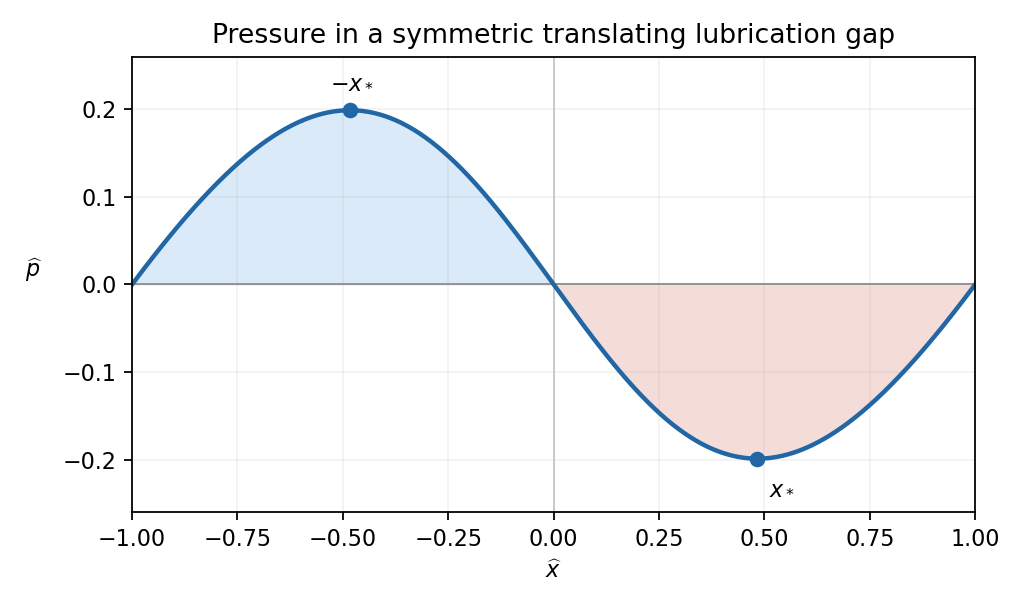
For pressure lobes in a symmetric translating lubrication gap, the height integrals areHenceThe denominator of the pressure gradient is positive. Its numerator changes sign when , that is at with . The gradient is positive for , zero at those two points, and negative for . Integration, with either endpoint condition, givesThis function is odd and vanishes at . It has a positive maximum at and a negative minimum at . Thus the sketch has a positive pressure lobe in the converging left half of the gap and a negative gauge-pressure lobe in the diverging right half.

Articles by others on the same topic
There are currently no matching articles.