Measure both angles from the downward vertical, as in the PDF. With the support as origin and downward coordinate ,Thus . The requested expression implicitly uses a zero-rest-length spring: its energy is . The exact Lagrangian for equal masses isExpand the cosines and count angles and velocities as first order. The cosine correction multiplying is fourth order and is dropped. After removing constants,The positive spring term in means the spring lowers its energy when the straight assembly bends. If its natural length were , this term would instead be . An unspecified ordinary natural length cannot simply be ignored; the displayed target fixes the zero-length idealization.
Put and . Applying the Euler-Lagrange equations to the quadratic Lagrangian givesA nonzero motion satisfying the specified equal-and-opposite initial displacements can have one frequency only if is a normal-mode vector. Its acceleration terms are proportional to , while the restoring terms are proportional to . HenceandThe rods swing oppositely. The hinge mass moves sideways, while the final mass has no first-order displacement: the two horizontal contributions cancel and its vertical change is quadratic in angle. In the corresponding geometric ansatz it moves vertically at twice the small-oscillation frequency to leading nonzero order, but the displayed single-frequency solution is a linearized result. The trivial case imposes no parameter condition.
Removing the hinge mass gives the exact LagrangianThe stated equations again concern its small-angle quadratic approximation. In the sum and difference coordinates this becomesConsequentlyFor unequal squared frequencies, : the rods remain aligned to first order and the end mass swings like a pendulum of length . This degenerate Lagrangian gives the difference coordinate no quadratic kinetic term, so its equation is an algebraic constraint, not a second oscillator. If , the quadratic action loses all dependence on . Its motion is then undetermined at this order; nonlinear terms or a small hinge mass must resolve the degeneracy. For larger spring stiffness the straight constrained branch is not a minimum of the bending potential, despite the absence of a finite-inertia growing mode in this strictly massless quadratic description.
Write and . With the printed Fourier transform convention, a time derivative transforms to . The retarded Green function isIts poles are , both in the upper half-plane. For close the contour above; for close below, where there are no poles. Residues giveIt is continuous at and has derivative jump , reproducing the Dirac delta function source. Thus the solution initially at rest isand vanishes for . Set . Evaluating the integral givesThe homogeneous solution constants are and . Substitution at zero gives . Causality selects this response; an arbitrarily excited prehistory would add a homogeneous solution.
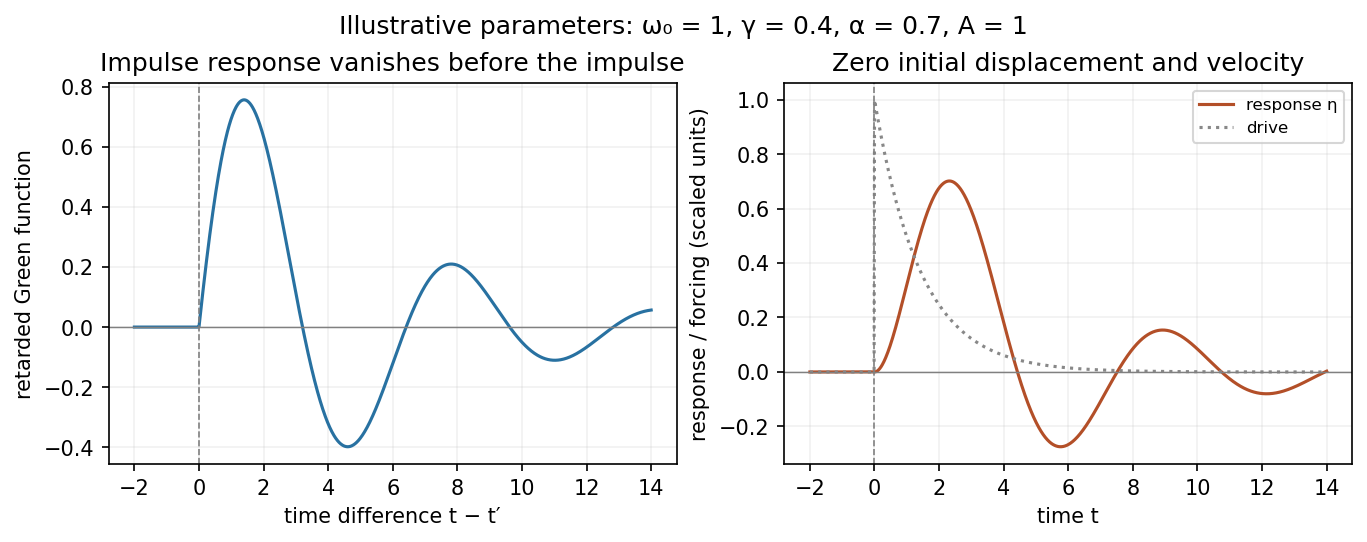
Illustrative retarded impulse response and initially resting response to a decaying drive
. Details. 
Articles by others on the same topic
There are currently no matching articles.