Write for cylindrical radius in this question, not the rod's mass density. A charged relativistic particle in a time-independent magnetic field has the charged-particle electromagnetic Lagrangianwith zero electrostatic potential. The cylindrical speed is . Inside a uniform axial field, choose the symmetric magnetic vector potential , . Its cylindrical curl gives . HenceIn a field-free region far from either end one can use , recovering the requested outside expression. The question's is a velocity-dependent generalized potential, not electrostatic potential energy.
There is an important end-field qualification. A finite axial field that jumps to zero with no radial component would violate Gauss's law for magnetism. The consistent near-axis idealisation is the solenoid fringe field from an axisymmetric vector potential, , giving and . The piecewise Lagrangian is its hard-edge limit and retains fringe impulses through the jump in . Those impulses are essential to the focusing calculation.
The azimuth is a cyclic coordinate, so its canonical momentum is conserved:Initially the velocity is parallel to the axis in a field-free region, so . Conservation of canonical angular momentum across a solenoid fringe therefore gives, inside the uniform field,This holds away from the coordinate singularity ; the Cartesian orbit will be smooth there.
Time independence also conserves the energy Hamiltonian,The velocity-linear magnetic term cancels in this Legendre transform. Thus is constant, as expected because a static magnetic Lorentz force does no work. Mechanical angular momentum can change even though and the total speed are conserved.
In a uniform-field region, is cyclic and is constant. Its equation is . The radial Euler-Lagrange equation isso with and ,The radial equation applies on intervals with a regular signed cylindrical-coordinate description; the Cartesian solution handles axis crossings.
In a field-free region, the equations areFor this particle , so and outside, until a coordinate change is needed at an axis crossing.
Axial velocity is constant within each uniform region, but not across the ends. In a smooth fringe,The entrance develops an azimuthal speed while radial velocity remains zero. Conservation of total speed givesForward passage presumes the radicand is positive. The exit fringe changes axial velocity again. Neglecting these small changes is a paraxial approximation, requiring , rather than an exact consequence of cylindrical symmetry.
Set just inside the entrance, , and . The stated continuity gives . Until the first axis crossing,For the full orbit, including any crossings, use the transverse complex coordinate :This helical solenoid trajectory with zero incident angular momentum is a circle of radius about transverse guiding centre , combined with uniform axial motion. Its cyclotron angular frequency is , and its axial pitch per turn is . The speed check is .
The physical radius is . When the cosine changes sign, a nonnegative-radius coordinate adds to ; this is a coordinate change, not a discontinuous turn of the particle. For or , the limit is simply , .
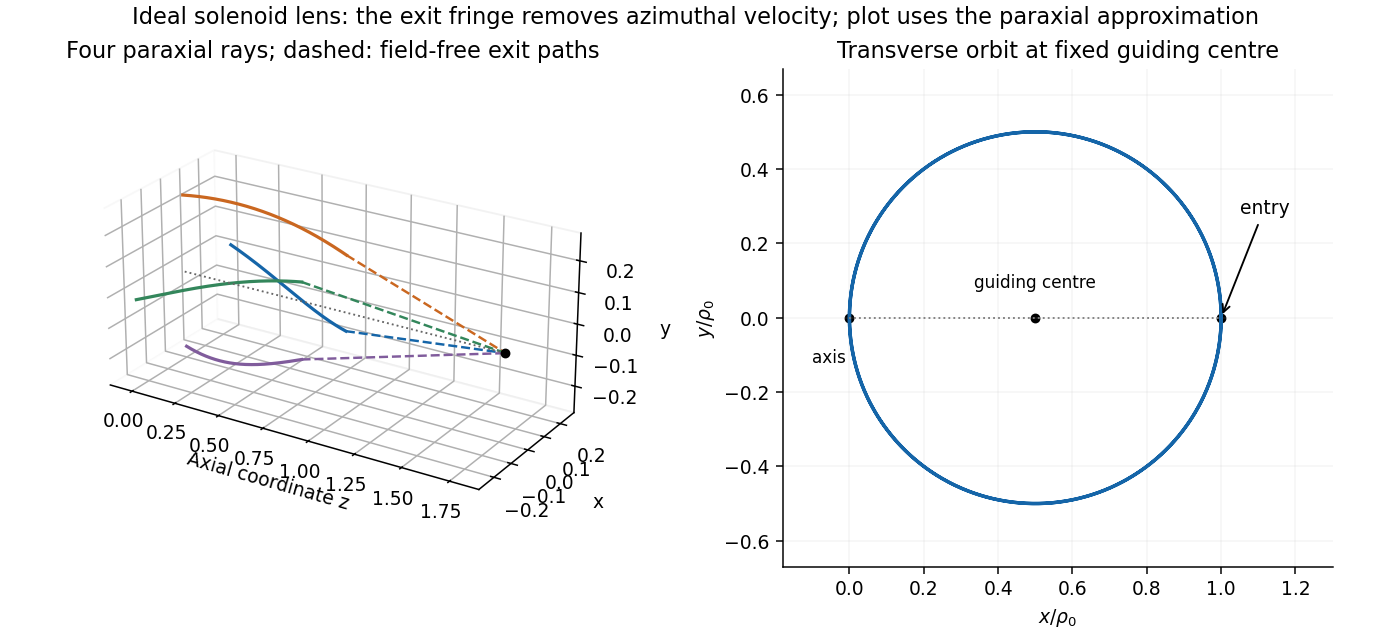
Original solenoid-lens trajectories: transverse circular motion, helical drift and paraxial focusing after the exit fringe
. Details. 
Define the positive focusing frequencyIn the paraxial approximation , traversal time is . The exit values areAcross the exit fringe, and remove the azimuthal velocity. The radial velocity remains continuous in the thin-fringe model. Outside, the transverse trajectory is therefore straight along a fixed azimuth, not a continuing helix. Taking the outgoing axial speed also as , the distance to the axis isIt is independent of , so all equal-speed paraxial rays focus to a common point. The condition ensures the first focus lies beyond the exit. For a weak lens, .
The relativistic solenoid magnetic lens focuses either charge sign, while its rotation reverses with . Keeping the exact radius-dependent , or the exit axial-speed change, produces radius-dependent corrections and spoils an exact common focus. Thus the requested focus is appropriately a paraxial result, with the end fields included even when their axial-speed changes are neglected.
Articles by others on the same topic
There are currently no matching articles.