A scattering phase shift measures the change of a partial wave's outgoing phase relative to the free radial solution. For a real central potential and elastic scattering, probability conservation gives a unit-modulus Partial-wave S-matrix . Indeedso the incoming amplitude is unchanged and the outgoing one acquires .
Expanding an incident plane wave in Legendre polynomials and comparing the outgoing spherical wave givesUse and to remove cross terms:This is the elastic total scattering cross-section for the one-particle central-potential problem, with no identical-particle symmetrization factor.
For , put . The radial Schrödinger equation reduces to inside and outside, where and . Regularity at the origin requires , excluding the inner cosine. A real outer sine-cosine combination can be written with an amplitude and a phase shift:The inner expression has the finite limiting value at the origin. An overall complex normalization can carry the asymptotic phase convention of part a.
At a finite potential step, both and are continuous:Taking the logarithmic derivative eliminates the amplitudes:At a zero of a denominator, the original two matching equations provide the continuous limiting condition.
Write and . At low energy, the wave normally dominates. Under the additional stated near-resonance assumption , neglect inside the cotangent of the matching condition and set :Substitution in givesThis is a near-resonance square-well approximation, not a uniform formula for every well radius. A phase shift is defined modulo ; its representative must be chosen consistently when applying the comparison with .
For small fixed positive , the stated approximate curve has maxima atIts formal minima are zero at . The peak height is the -wave unitarity limit, and the peaks narrow as decreases.
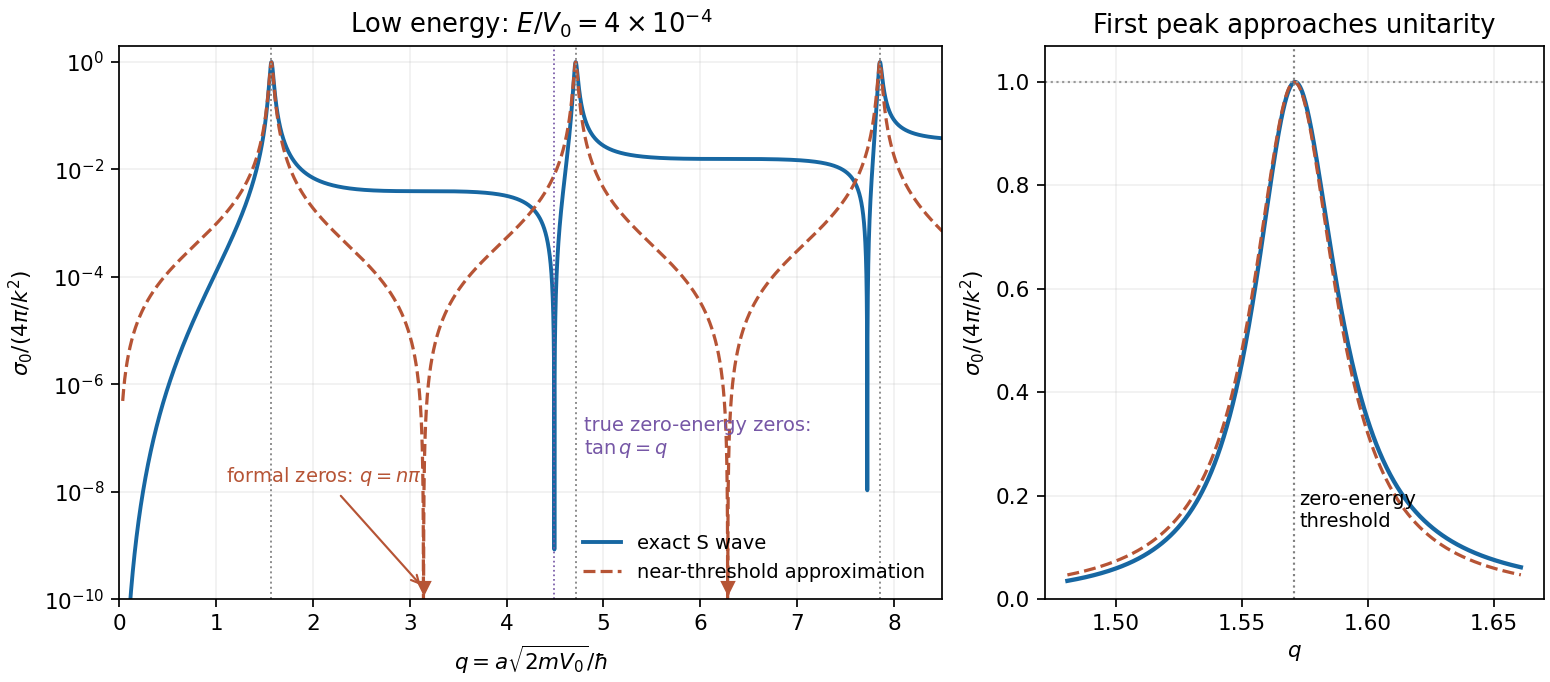

To identify the bound-state threshold, let the bound-state energy be with . The reduced radial wave is proportional to inside and outside, with and . Matching gives . As a new bound state emerges at ,Thus the limiting peak locations coincide with the appearance of successive -wave bound states. At the exact threshold the zero-energy radial solution is not square-integrable; a normalizable bound state appears just beyond it. Finite-energy maxima shift slightly from the zero-energy positions.
The formal minima require care because the assumption used in part d fails there. Retaining in the exact matching condition gives the spherical square-well scattering lengthaway from a threshold. At , , so the true low-energy S-wave scattering contribution is , not zero. Genuine leading-order zeros of that contribution instead satisfy , for example and . The original sketch compares the exact finite-energy wave with the requested approximation, making this nonuniformity visible. Dominance by the wave must be checked separately near a higher-partial-wave threshold. The scattering-length divergence and its bound-state interpretation are also derived in institutional lecture notes.[ref]
Topics in Quantum Mechanics by David Tong. 2017, §6.2.6, printed pp. 219–222: square-well matching, scattering length and threshold bound states
Articles by others on the same topic
There are currently no matching articles.