Write , and for , with . Direct differentiation givesAlso and, for a smooth bounded test function ,Thus tends to a Dirac delta distribution as . Defining the retarded kernel supplies the initial impulse:The source term arises from the jump at in the distributional sense; differentiating only the smooth positive-time Gaussian would miss it.
Take and split it into intervals of width . The markov property and Gaussian convolution giveThis finite-dimensional identity is exact for every positive . Define the path-integral measure by these normalized time slices:In the time-sliced diffusion path integral, the discrete exponent is . Its conventional continuum notation is thereforeThe time-slice normalization is essential, not an arbitrary multiplicative constant. Brownian paths are almost surely nondifferentiable, so the displayed action is shorthand for the Gaussian limiting measure rather than an ordinary integral of the derivative of each typical path.
Multiply each time-sliced path weight by . A nonnegative finite is a local killing rate: the Feynman-Kac weight attenuates paths in proportion to the time spent in regions where . Let that rate tend to infinity outside the allowed interval. Paths that exit are removed, leaving Brownian motion killed at its first boundary hit.
Consequently the required kernel is the Gaussian path measure restricted to surviving paths, equivalentlywith the infinite-barrier interpretation stated above. It solves in the interior with absorbing Dirichlet boundary conditions at . A reflecting boundary condition for a diffusion would describe a different process.
Strictly, this is a transition probability density in the final position, jointly with survival; a probability for an interval of final positions includes an integral over . Its integral over the whole allowed interval is at most one. It is not the normalized endpoint density conditional on survival, which would require division by the survival probability. In these diffusion units and the eigenvalues of have units of inverse time.
The normalized Dirichlet eigenfunctions on and their decay rates areTheir norms are one because the sine-squared integral is . At the initial position zero, , so all even disappear. For , the two signs from and cancel, yieldingThis holds for and is zero outside. The kernel is even in , vanishes at both boundaries and tends weakly to the initial delta. The eigenvalues are decay rates rather than quantum energies unless one makes an additional unit convention.
The survival probability from an absorbing transition density follows by integrating over final position. Sincethe exact survival probability for isThe slowest Dirichlet mode dominates at large time:The first relative correction is . The approximation is a late-time result; extrapolating its prefactor to would incorrectly give a probability larger than one. The full alternating series tends to one there.
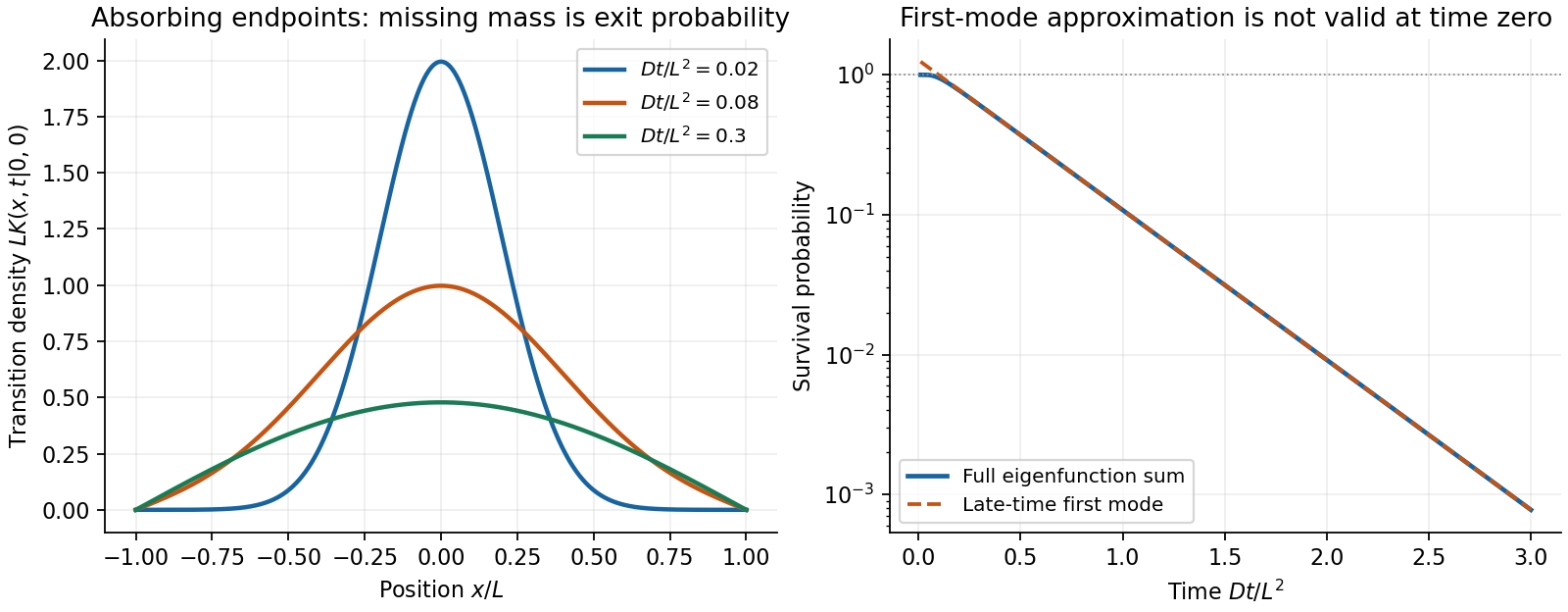
Original absorbing-interval transition densities and the approach of the survival probability to its slowest-mode asymptote
. Details. 
Articles by others on the same topic
There are currently no matching articles.