Treat as the probability of the complete coarse-grained state at time , with and . In the column-vector convention of the master equation, for is the transition rate from to . The short-time transition law isNonnegative transition probabilities and conservation of total probability requireFor a finite state space these conditions define a continuous-time Markov chain. The Markov property means that, conditional on the present state, no further history affects the transition probabilities. A time-independent additionally assumes time-homogeneous rates; the waiting time in a state is exponential, and multiple jumps in an infinitesimal interval contribute beyond first order. A reduced description that omits relevant slow variables can retain memory and need not obey this closed equation. Quantum coherences are likewise absent from this classical population model. For infinite state spaces one also needs conditions preventing infinitely many jumps in finite time. Neither equal forward/backward rates nor detailed balance is required merely to conserve probability.
Use states , where denotes an empty molecule and the other states denote its single occupied site. The source arrows give at rate , at rate , at rate , and at rate . ThusEach diagonal entry is the negative total escape rate from its column's state. In particular, the empty state cannot make a direct jump to : the reservoir touches alone. Conversely, is not a second charge arriving on the molecule; it is an internal hop of its existing charge. Summing the three equations gives , which checks the master equation convention and the single-charge constraint.
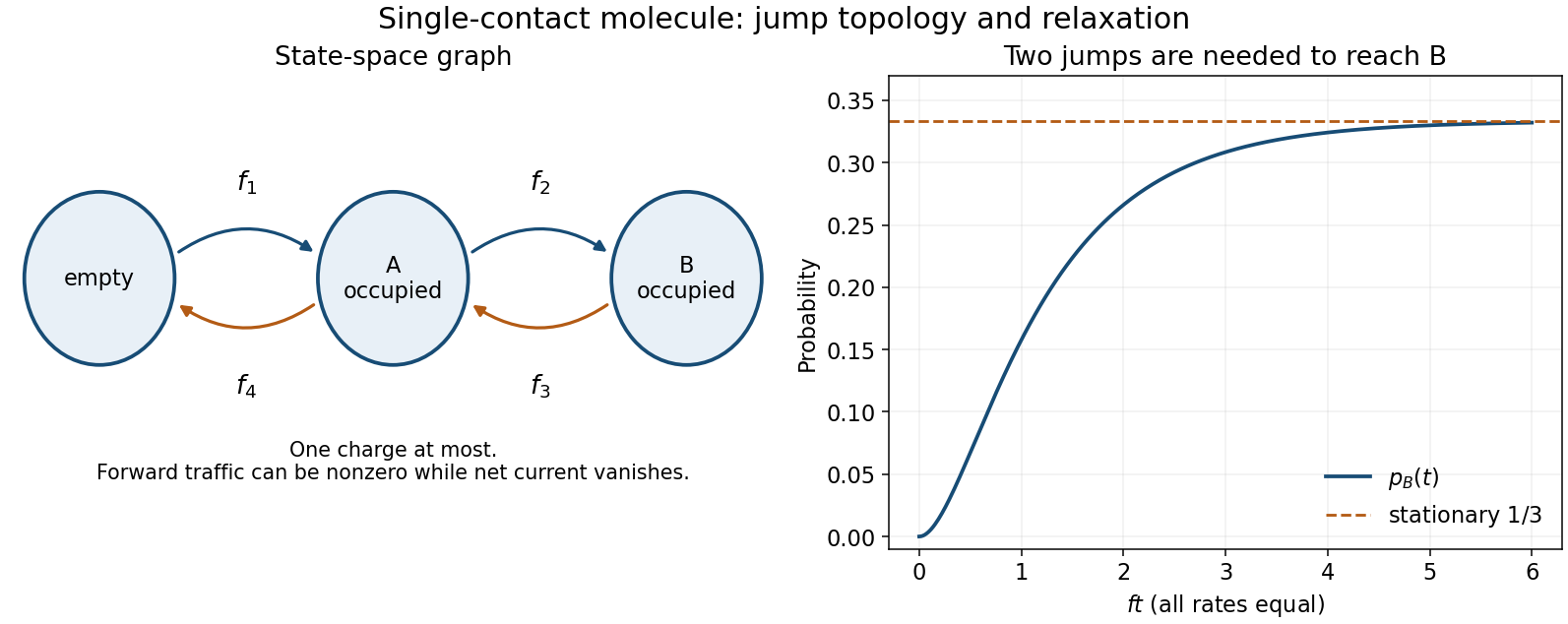
Three-state charge kinetics and the two distinct stationary jump counts
. Original state-space graph inferred from the source rates. Each arrow is a charge jump; an A-to-B jump changes location without changing the molecule's total charge. Details.
For positive rates the three states communicate, so the finite continuous-time Markov chain has a unique stationary probability vector. The first and third components of giveThese two edge-balance relations and normalization yield, with ,Their sum is one and each is nonnegative. The middle balance equation then follows from the other two, as expected from probability conservation. A line graph has no cycle that could carry a nonzero stationary circulation: each edge's forward and backward stationary traffic balances even if the bare rates differ. If some rates vanish, the process need not be an irreducible Markov chain and its stationary distribution need not be unique. The displayed expression remains valid when its denominator is nonzero and its limits select the communicating class reached, but it must not be used as a unique late-time law when disconnected closed classes retain dependence on the initial state.
Condition on the molecule being empty. Its instantaneous incoming-charge jump rate is , so the unconditional stationary number of arrivals per unit time isThis stationary jump traffic at a single contact is a unidirectional jump count, not a signed net current. Stationarity also gives . Multiplying their difference by the charge gives zero net stationary electrical current through the molecule's single contact, even though individual arrival and departure events continue.
An hop can occur only while the charge occupies . Hence its stationary number per unit time isThe reverse count is , which equals this result. There is therefore no signed stationary current along that edge. The individual hopping traffic need not equal the contact-arrival traffic; their ratio is . A charge can make several internal visits before leaving, so neither conservation nor the single-charge constraint forces those two one-way rates to coincide.
For equal rates, the master equation generator is times the symmetric path-graph matrixIts eigenvectors may be chosen as , , and , with eigenvalues . Resolve the initial empty state asEach nonstationary eigencomponent decays with its own rate, givingThe remaining probabilities are and . These satisfy the full equations and sum to one. The limit agrees with the stationary result. At short times : two successive jumps, , are necessary, so a term linear in would signal an incorrectly included direct transition.
Articles by others on the same topic
There are currently no matching articles.