The Euler-Lagrange equation for the real scalar field givesThus the conjugate momentum and Hamiltonian density areThe spatial Fourier transform reduces the Klein-Gordon equation to , with positive frequency . Hence a general real solution is the mode expansion of a free fieldThe two coefficients are complex conjugates because the field is real. Each pair of initial data fixes these coefficients. The normalization anticipates canonical quantization and the relativistic normalization of one-particle states.
Promote the mode expansion of a free field coefficients to annihilation operators and creation operators, replacing by . The canonical commutation relations areTogether with the normalization in part a, they give and vanishing equal-time commutators between two fields or two conjugate momenta.
Insert the mode expansion of a free field in the Hamiltonian. The spatial integral produces . The and coefficients cancel because . The remaining terms giveThis is a continuum of quantum harmonic oscillators. In a finite periodic volume , . The Fock vacuum satisfies , so its vacuum energy density isNormal ordering would subtract this constant; here it must be retained because it is the quantity being calculated.[ref]
Quantum Field Theory by David Tong. Section 2, canonical quantization of the real scalar field and its zero-point Hamiltonian
A spherical three-momentum ultraviolet cutoff givesFor and , the asymptotic expansion isIn particular, the leading ultraviolet divergence is quartic. For , exactly.
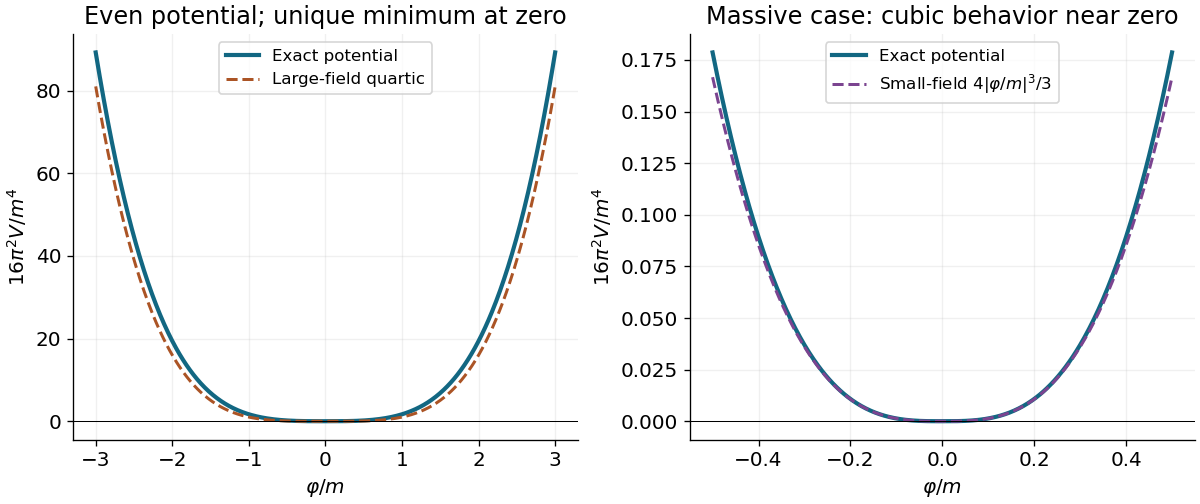
Write . Under the proposed identification, the scalar potential from a field-dependent momentum cutoff is . It is even and nonnegative, and its derivative with respect to is away from zero. Consequently its only global minimum is at : this contribution alone does not cause spontaneous symmetry breaking. At large it grows quartically. At small with fixed positive , however,Thus the quartic sketch is an asymptotic shape, not the exact small-field behavior for a massive original field. Identifying a regulator with a new field is an additional modeling prescription; an actual effective potential also depends on the new field's dynamics and any other allowed terms.

Use one common ultraviolet cutoff for all physical degrees of freedom, with positive sign for each bosonic degree of freedom and negative sign for each fermionic degree of freedom. For the mass-moment cancellation of vacuum energy divergences, define the weighted supertrace . The large-momentum expansion isAfter multiplication by the radial measure , these three terms produce quartic, quadratic and logarithmic ultraviolet divergences. Therefore the necessary and sufficient cancellations for the displayed unsubtracted finite-species vacuum energy areThey respectively mean equal numbers of bosonic and fermionic physical degrees of freedom, equal sums of squared masses, and equal sums of fourth powers of masses. Once they hold, the remaining radial integrand falls as and is integrable at infinity. Nonnegative masses introduce no lower-end divergence.
Pairing every bosonic degree of freedom with a fermionic one of the same mass, as in an unbroken supersymmetric spectrum, is sufficient and cancels the entire expression. It is stronger than these three moment conditions. For a concrete non-paired example, take bosonic squared masses and fermionic squared masses . Both have three degrees of freedom, squared-mass sum and fourth-power-mass sum , but their spectra differ. If a vacuum energy counterterm is instead permitted, a renormalized finite answer need not satisfy them; that is a different prescription from finiteness of the source's bare sum.
Articles by others on the same topic
There are currently no matching articles.