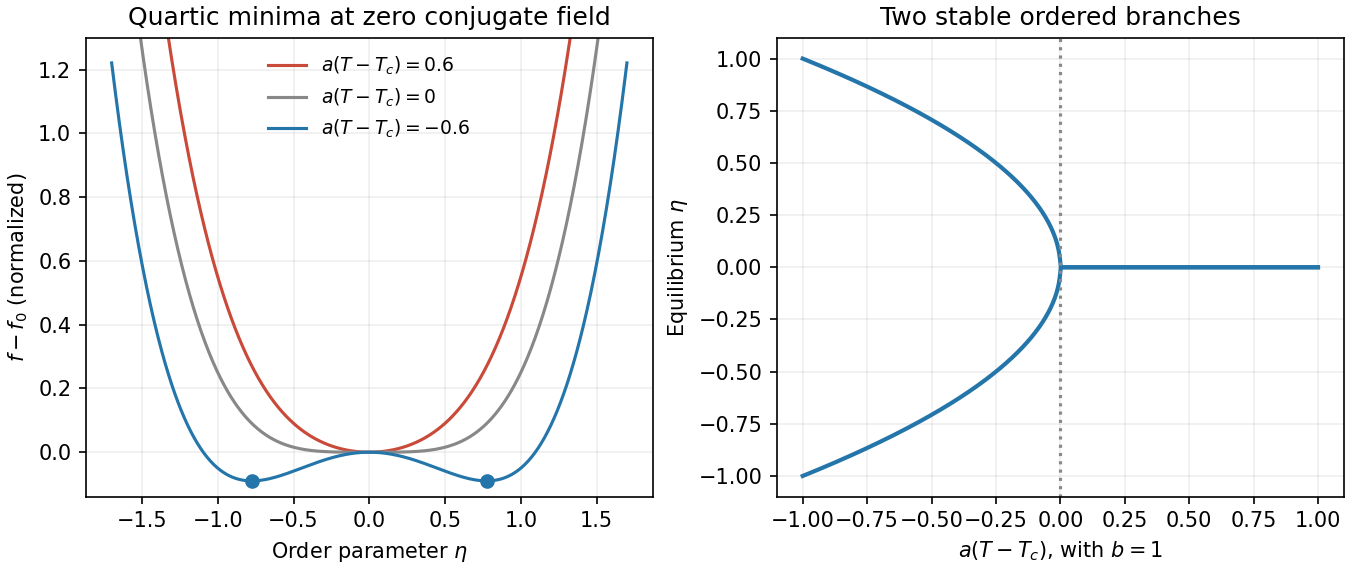
Landau theory expands a thermodynamic potential in an order parameter, constrained by symmetry. For a scalar with sign-reversal symmetry, a useful free-energy density isHere is the conjugate field. At , minimizing rather than merely finding stationary points givesThe symmetry-related minima represent spontaneous symmetry breaking, as for a simple uniaxial ferromagnet with magnetization as order parameter. An infinitesimal field selects one sign. Above , the susceptibility is ; below it the stable-branch susceptibility is . Minimization lowers by below , producing a heat-capacity density jump with continuous entropy.
Landau minima
. Original normalized quartic free-energy curves above, at and below a continuous transition, with the two symmetry-related equilibrium order-parameter branches. Details.
A negative quartic coefficient requires a stabilizing with . It can produce a first-order transition before the quadratic coefficient changes sign: coexistence occurs at and . Odd terms are allowed when the assumed symmetry is absent. Landau theory predicts mean-field exponents; spatial fluctuations can change critical behaviour, especially close to a critical point in low dimensions. A gradient term extends the model to nonuniform order parameters but does not by itself supply dynamical equations.
Articles by others on the same topic
There are currently no matching articles.