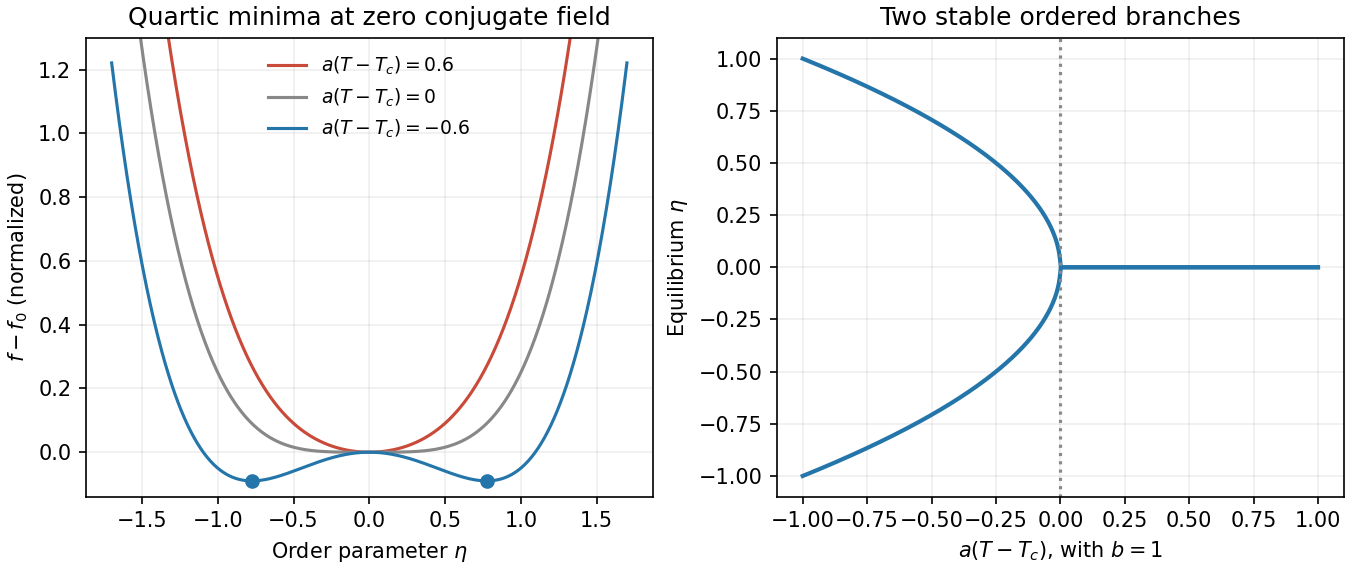
Landau theory expands a thermodynamic potential in an order parameter, constrained by symmetry. For a scalar with sign-reversal symmetry, a useful free-energy density isHere is the conjugate field. At , minimizing rather than merely finding stationary points givesThe symmetry-related minima represent spontaneous symmetry breaking, as for a simple uniaxial ferromagnet with magnetization as order parameter. An infinitesimal field selects one sign. Above , the susceptibility is ; below it the stable-branch susceptibility is . Minimization lowers by below , producing a heat-capacity density jump with continuous entropy.
Landau minima
. Original normalized quartic free-energy curves above, at and below a continuous transition, with the two symmetry-related equilibrium order-parameter branches. Details.
A negative quartic coefficient requires a stabilizing with . It can produce a first-order transition before the quadratic coefficient changes sign: coexistence occurs at and . Odd terms are allowed when the assumed symmetry is absent. Landau theory predicts mean-field exponents; spatial fluctuations can change critical behaviour, especially close to a critical point in low dimensions. A gradient term extends the model to nonuniform order parameters but does not by itself supply dynamical equations.
Brownian motion arises from many microscopic collisions. A one-dimensional Langevin description isThe fluctuation-dissipation relation ties random forcing to drag, ensuring thermal equilibrium. For a free particle set . With initially thermal velocities, its mean-square displacement isIt is ballistic, , at short times and diffusive, , for . In three dimensions the corresponding long-time result is . At diffusive times, the position propagator from a specified origin is Gaussian with variance per coordinate. A small sphere in a viscous liquid supplies a physical example; in the slow unbounded-fluid limit its drag is .
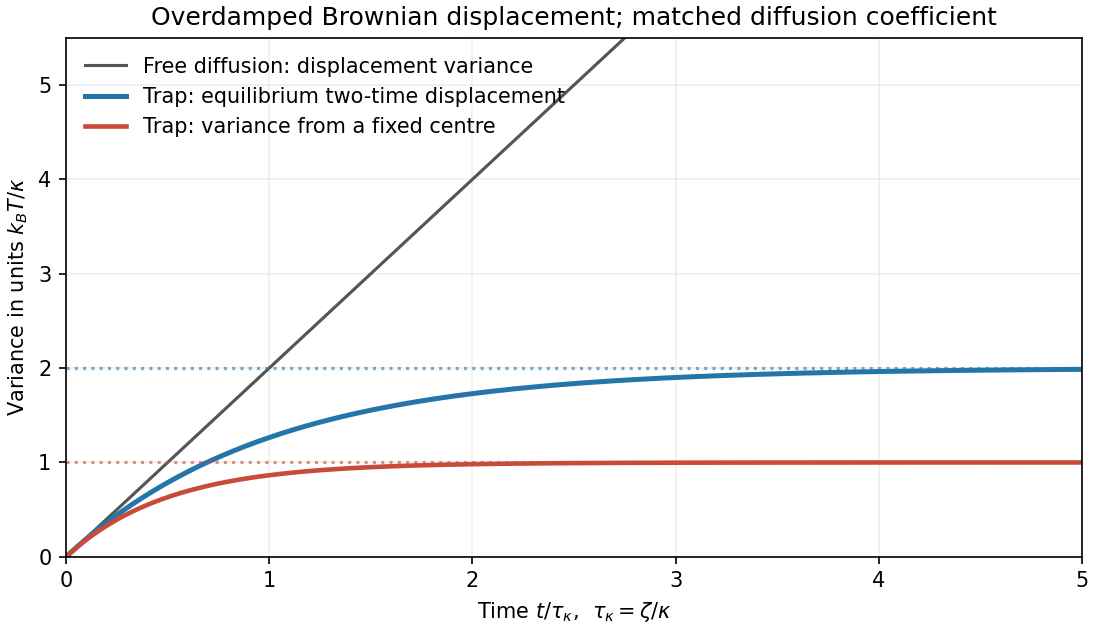
For a harmonic trap, overdamped relaxation has time , equilibrium variance and stationary correlationConsequently stationary trapped Brownian displacement obeysConfinement makes this displacement saturate, unlike free diffusion. A trajectory initialized exactly at the centre instead has variance ; confusing that conditional variance with the stationary displacement gives an erroneous factor of two. The equilibrium position distribution is proportional to . More general finite confinement has a geometry-dependent equilibrium distribution and bounded displacement, not necessarily a Gaussian one.
Free and trapped Brownian motion
. Original analytic mean-square-displacement curves compare free overdamped diffusion, a stationary harmonic trap and a fixed-origin harmonic-trap variance. The last two have different initial ensembles. Details.
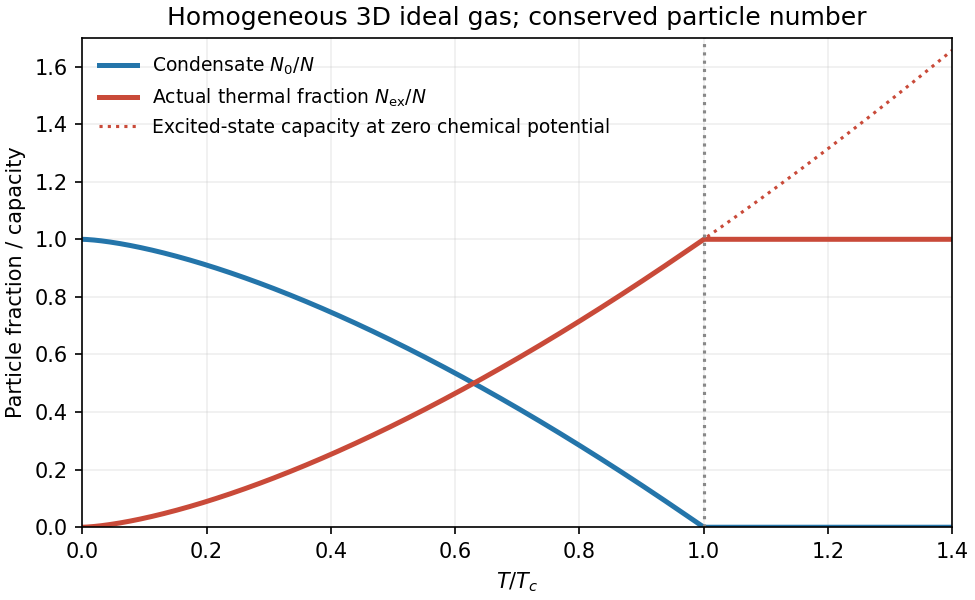
Bose-Einstein condensation is macroscopic occupation of a single lowest-energy one-particle state. For a homogeneous three-dimensional ideal gas of conserved massive bosons, set that energy to zero. The excited-state population isHere . As , the excited states can hold only particles. Additional particles occupy the ground state. ThusThe isolated ground state must be counted separately from the continuum density of states; otherwise one misses the condensate. A dilute atomic gas is a physical realization of the quantum-degeneracy regime, but trapping geometry and interactions modify the homogeneous ideal-gas formulas.[ref]
Statistical Physics by David Tong. §3.5.3: saturation of excited states, separate ground-state occupation and ideal-gas condensation temperature
Ideal Bose condensate fraction
. Original homogeneous three-dimensional ideal-gas condensate fraction and maximum thermal population, normalized to the critical temperature. No trapped-gas or experimental data are implied. Details.
In the homogeneous ideal gas, one and two dimensions do not have finite-temperature condensation in the thermodynamic limit because the low-energy population integral diverges. Finite size or a trap changes that conclusion's assumptions. Condensation and superfluidity are distinct: the ideal quadratic gas has zero Landau critical velocity, while interactions can support a sound mode and superfluid flow. Neither zero viscosity nor phase-rigid flow follows from the occupation formula alone.
Articles by others on the same topic
There are currently no matching articles.