Brownian motion arises from many microscopic collisions. A one-dimensional Langevin description isThe fluctuation-dissipation relation ties random forcing to drag, ensuring thermal equilibrium. For a free particle set . With initially thermal velocities, its mean-square displacement isIt is ballistic, , at short times and diffusive, , for . In three dimensions the corresponding long-time result is . At diffusive times, the position propagator from a specified origin is Gaussian with variance per coordinate. A small sphere in a viscous liquid supplies a physical example; in the slow unbounded-fluid limit its drag is .
For a harmonic trap, overdamped relaxation has time , equilibrium variance and stationary correlationConsequently stationary trapped Brownian displacement obeysConfinement makes this displacement saturate, unlike free diffusion. A trajectory initialized exactly at the centre instead has variance ; confusing that conditional variance with the stationary displacement gives an erroneous factor of two. The equilibrium position distribution is proportional to . More general finite confinement has a geometry-dependent equilibrium distribution and bounded displacement, not necessarily a Gaussian one.
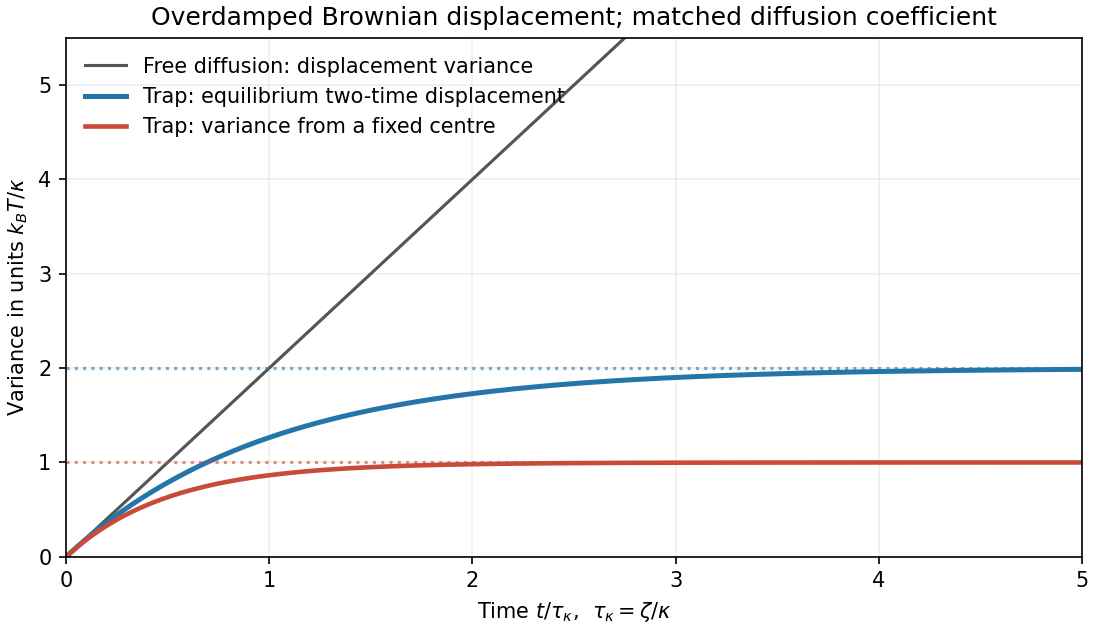
Free and trapped Brownian motion
. Original analytic mean-square-displacement curves compare free overdamped diffusion, a stationary harmonic trap and a fixed-origin harmonic-trap variance. The last two have different initial ensembles. Details.
Articles by others on the same topic
There are currently no matching articles.