The iteration of a map is . For every , , so and . A cobweb alternates vertical steps to the graph and horizontal steps to the diagonal, approaching the origin monotonically.
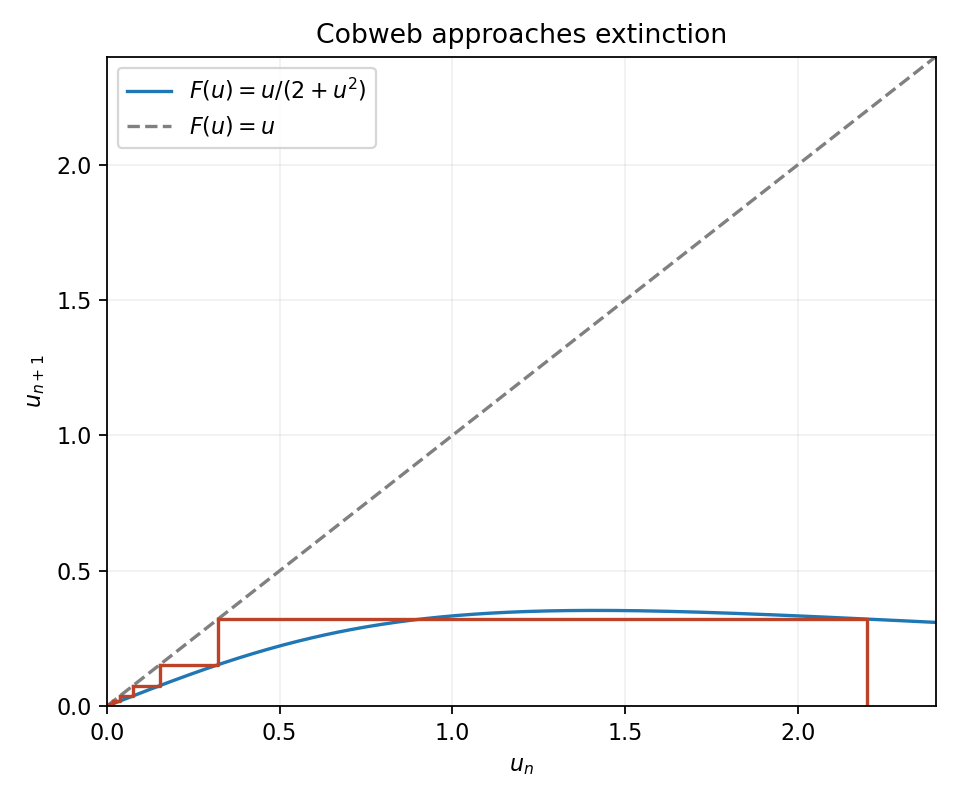

More precisely . The product has a finite strictly positive limit because . Thus for a positive constant depending on the initial biological population.
A positive fixed point requires , so it exists exactly when and is . Differentiating the map at it givesFor and , this fixed-point multiplier is strictly between and . Hence the positive fixed point is linearly asymptotically stable, including ; positivity of makes the lower bound strict.
The fixed-point multiplier decreases continuously with and first reaches the unit circle at . Solving givesIt is stable for and unstable for . At the critical value linear stability is inconclusive. The crossing at is the local signature of a period-doubling bifurcation, rather than a crossing through .
At low density the per-generation growth factor is approximately . The power controls how sharply crowding reduces recruitment or survival when resources become limiting; at high density . Larger therefore means a stronger overcompensation in a population model.
The flip threshold says that sufficiently strong density feedback can destabilize a constant positive biological population and create alternating generations, under the usual nondegeneracy conditions. A local loss of fixed-point stability alone does not establish chaos, nor does it prove every ecological system with stronger crowding must follow the same route.
A fixed point of is also a fixed point of . By the chain rule,If the original fixed-point multiplier has modulus greater than one, its square also exceeds one, so the same fixed point is unstable for the twice-iterated map. New stable fixed points of the twice-iterated map, if present, must be different points; they can represent a genuine two-cycle of the original map.
Articles by others on the same topic
There are currently no matching articles.