The iteration of a map is . For every , , so and . A cobweb alternates vertical steps to the graph and horizontal steps to the diagonal, approaching the origin monotonically.
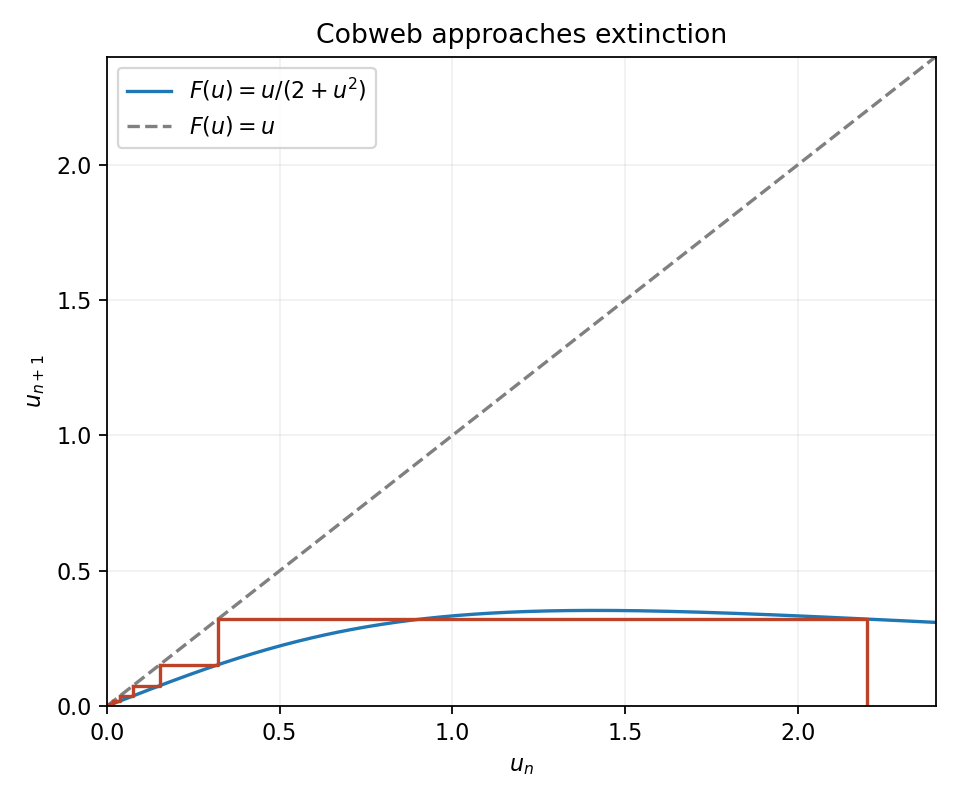

More precisely . The product has a finite strictly positive limit because . Thus for a positive constant depending on the initial biological population.
A positive fixed point requires , so it exists exactly when and is . Differentiating the map at it givesFor and , this fixed-point multiplier is strictly between and . Hence the positive fixed point is linearly asymptotically stable, including ; positivity of makes the lower bound strict.
The fixed-point multiplier decreases continuously with and first reaches the unit circle at . Solving givesIt is stable for and unstable for . At the critical value linear stability is inconclusive. The crossing at is the local signature of a period-doubling bifurcation, rather than a crossing through .
At low density the per-generation growth factor is approximately . The power controls how sharply crowding reduces recruitment or survival when resources become limiting; at high density . Larger therefore means a stronger overcompensation in a population model.
The flip threshold says that sufficiently strong density feedback can destabilize a constant positive biological population and create alternating generations, under the usual nondegeneracy conditions. A local loss of fixed-point stability alone does not establish chaos, nor does it prove every ecological system with stronger crowding must follow the same route.
A fixed point of is also a fixed point of . By the chain rule,If the original fixed-point multiplier has modulus greater than one, its square also exceeds one, so the same fixed point is unstable for the twice-iterated map. New stable fixed points of the twice-iterated map, if present, must be different points; they can represent a genuine two-cycle of the original map.
Law of mass action assigns net substrate gain to autocatalytic replication, substrate-enzyme binding flux , dissociation flux and product-formation flux . ThereforeComplex breakdown to product restores free enzyme but does not restore substrate. Product concentration, if required, satisfies .
Adding the last two equations gives . The initial conditions therefore imply , or . Substitute this in the first two balances:The enzyme inventory is conserved even while substrate can grow autocatalytically.
Use , and slow time . Dividing the equations by their respective concentration and time scales givesThus and . Notice that and the physical enzyme fraction satisfies . The initial values are , for this particular normalization; the threshold analysis compares different initial substrate abundances using a fixed reference scale.
At equilibrium and adding gives . The positive equilibrium isThis condition also gives . The nullclines are and . The second lies above the first for and below it for . Below the first nullcline ; above it . Below the second nullcline ; above it .
At the origin the Jacobian has trace and determinant . Its off-diagonal entries are positive, making the eigenvalues real, so this is an attracting node. At the positive equilibrium the slow reduced derivative is , while the fast derivative is ; equivalently the full Jacobian determinant is negative. Thus the positive point is a saddle equilibrium. Its stable manifold separates extinction from unbounded substrate growth.
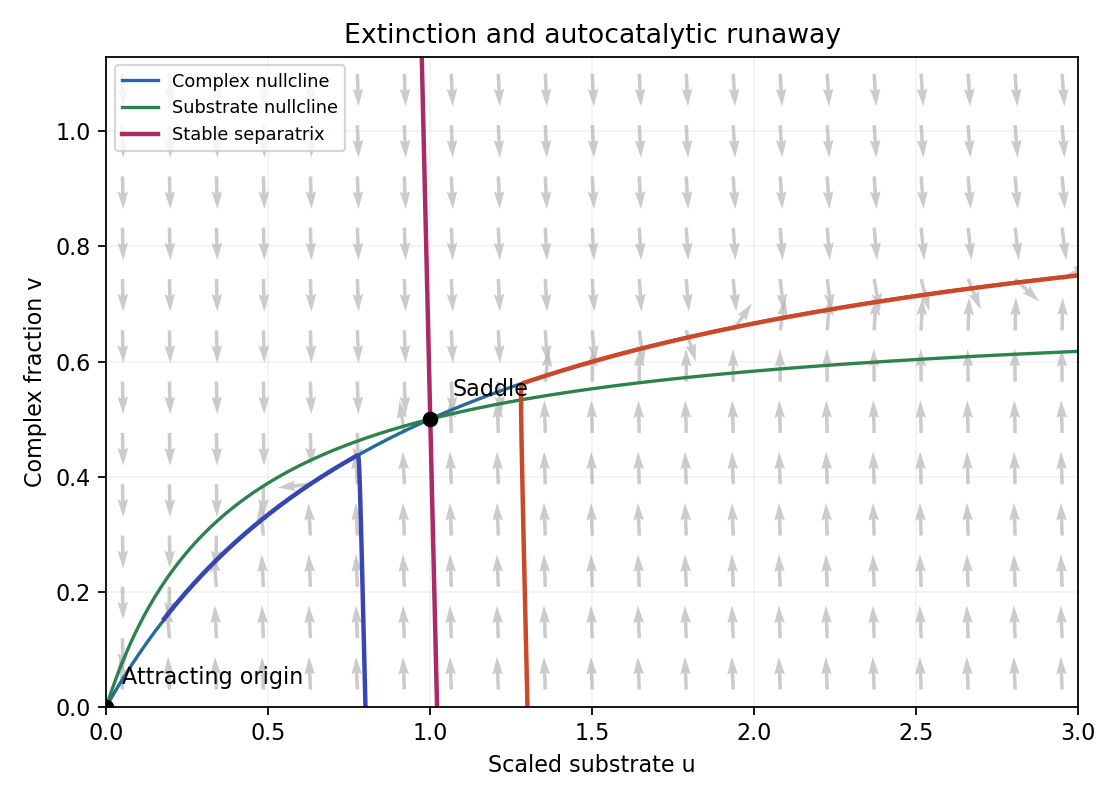
Autocatalytic enzyme phase plane: a fast complex fraction and a saddle threshold separate extinction from substrate runaway
. Details. 
After an initial layer of duration in slow time, while changes only slightly. The reduced substrate equation isBelow it decreases to zero; above it increases without bound. The exact threshold for initial is the intersection of the saddle equilibrium's stable manifold with that axis. For small it isIn dimensional initial-substrate units the leading threshold is . Comparing the actual initial value to this threshold determines its fate; the reference scale can be held fixed when varying the initial concentration.
The initial sequestration produces an correction if desired. Write the stable manifold as . The invariance equation at leading order gives and . Hencefor fixed parameters away from degenerate limits. The positive correction reflects the substrate consumed in building complexes from the initially enzyme-free-complex state.
The physical strip , is invariant, and the off-diagonal derivatives are nonnegative there, so ordered initial substrate values remain ordered. There are only the attracting origin and the saddle equilibrium. With Dulac function , the divergence of the weighted vector field is , excluding periodic orbits in its interior. The saddle equilibrium separatrix therefore gives the unique threshold on the initial axis: below it solutions tend to extinction, at it they tend to the saddle equilibrium, and above it they escape to infinity. Growth is at most exponential, so this is as time tends to infinity, not a finite-time blowup. This is autocatalytic enzyme clearance with a saddle threshold.
The travelling coordinate has , . Therefore the profile equation isThe wave moves right with speed . It joins a populated equilibrium behind to an empty equilibrium ahead.
The phase-plane equations are , . Nonnegative equilibria require and , hence only . At the origin , so the linear eigenvalues solveFor the roots are complex with negative real part, giving a stable focus. For both are negative real numbers, giving a stable node. Equality is the repeated-root threshold and is not covered by either strict classification.
A nonconstant trajectory approaching a stable focus winds around it infinitely often. Its coordinate therefore changes sign repeatedly near zero. Since the biological population profile must remain nonnegative, such a trajectory cannot represent the wave. The only nonnegative trajectory avoiding that winding at the origin would be the equilibrium itself, which cannot join the populated state. Thus .
On with ,Thus . Since , comparing slopes alone can reverse one's intuition about crossing direction. More directly, for the inward test isso the sloping edge also points into .
The top edge points down by (a), the sloping edge points upward in the inward normal sense by (b), and on the velocity points left. At the region contains only the equilibrium . Thus the closed triangle is forward invariant.
The given unstable saddle equilibrium branch enters its interior from and stays in this compact region. Along it , so decreases and has a limit. An interior limiting orbit with would keep changing , while an interior point with , has and is not an equilibrium. Hence the only possible forward limit is . Ordinary-differential-equation uniqueness prevents reaching and leaving an equilibrium in finite profile coordinate. The whole orbit therefore joins at to at with and .
Consequently . This proves the requested strict-speed result without claiming an unproved conclusion at the repeated-root threshold. It is a trapping triangle for a saturating monostable invasion front.
The reaction Jacobian isIts trace is and determinant is , so both eigenvalues have negative real parts. Explicitly they are . Therefore the homogeneous reaction equilibrium is a stable focus in the absence of diffusion.
The cosine modes satisfy both zero-flux endpoint conditions and . Linearizing the reaction terms gives and . Cancelling the common mode factor yieldsThe derivatives are exactly the entries of the matrix computed in (ii). The zero mode reproduces the stable homogeneous perturbation; positive integers give the possible spatial instabilities.
Put . The mode matrix has trace , so a growing eigenvalue occurs exactly when its determinant is negative:This upward quadratic has two positive roots only if and . Within this isFor such , defineThe unstable modes satisfy . These are strict inequalities: at either endpoint the leading eigenvalue is zero rather than positive.
If , both nonconstant coefficients of are nonnegative, so it is positive for . If , its discriminant is negative, so it is again strictly positive. Therefore .
At the double root can only give a neutral zero eigenvalue if it coincides with an allowed spatial mode; it still gives no positive growth rate. This is the finite-wavenumber onset of a Turing instability, not an oscillatory crossing since the mode trace stays negative.
Small makes every nonzero large, placing them above the finite instability band, where diffusion dominates reaction. The homogeneous zero mode is already stable.
For , the first possible band entry as increases is crossing . Hence the critical length isAt equality the mode is neutral; it is unstable just above this value, while . Thus strictly positive growth has infimum , with no attained smallest length if “unstable” means . The conventional threshold answer is . Larger modes cannot enter earlier because their first-entry lengths are .
Articles by others on the same topic
There are currently no matching articles.